Will the Bulgarian pink tomato withstand extreme temperatures?
Author(s): гл.ас. Надежда Шопова, Институт за изследване на климата, атмосферата и водите към БАН
Date: 01.08.2023
3326
![MultipartFile resource [file_data]](/assets/img/articles/домат-заглавна-1.jpg)
Summer values above 30 °C and prolonged droughts both in Southeastern Europe and in our country lead to loss of production.
Climate change and the increased frequency of extreme meteorological events exert both direct and indirect impacts on open-field tomato cultivation. High summer temperatures cause heat and water stress; shedding of flowers and fruit set; reduced pollen viability; sunscald on fruits and ultimately lower yields. Other direct adverse consequences include changes in growth and development conditions, as well as the need for higher irrigation and fertilization rates. On the other hand, changes in temperatures and precipitation increase the aggressiveness of weeds, diseases and pests in tomatoes. Stress factors lead to a reduction in immunity and the overall health status of the plants.
We have all heard our grandparents tell legends about the unique taste of Bulgarian tomatoes. Are these tales mainly tinged with sentimentality, and is there a real risk that in the future our children and grandchildren will only hear legends about the taste of Bulgarian tomatoes without ever actually knowing it?
Tomatoes are plants from the nightshade family Solanaceae and are the most important horticultural crop in the world – 182 million tonnes of produce are grown every year, which equals the weight of almost 32 pyramids of Giza.
What is the impact of climate change on open-field tomato cultivation?
Globally there is a decline in the production of open-field tomatoes. The increase in temperature across Europe has led to a reduction in open-field tomato production in recent years (EU report from 2021). In the future, global tomato production is expected to decrease, with summer droughts and rising temperatures affecting the main growing areas for this crop being key factors. According to a recent study published in Nature, yields in major tomato-growing regions such as Italy and California are projected to decline by up to 6% by 2050. Conversely, production regions such as China and the northern parts of California will strengthen their competitive advantage, meaning that the main tomato production areas are likely to undergo changes.
The increase in temperatures is a serious threat to tomato yields.
Tomato growth and development conditions are directly influenced by hydrothermal conditions. Some studies for areas in southeastern Italy mention that climate change in the same region causes accelerated phenological development, reducing dry matter production and final yields. Tomatoes develop well at temperatures between 21 °C and 28 °C during the day and 18 °C and 21 °C at night, and at a day length between 12 and 14 hours. At temperatures below 10 °C growth processes slow down. Outside these optimal conditions (comfort zone), the following can be expected:
- reduced pollen viability;
- a lower number of formed flowers and fruits;
- shedding of flowers and fruits;
- a shorter fruiting period.
All higher air temperature values affect productivity by leading to a rapid decrease in yields. In recent years, intense solar radiation and the higher frequency of hot, dry winds at the beginning of summer have led to spots and damage on crops.
Entire production directions are under threat
There is a real risk that we may be left without late production due to economic inefficiency or that we will be eating expensive tomatoes at the height of summer. Medium-early cultivation, which is predominant in the country, is already taking place under much more extreme conditions. Summer values above 30 – 35 °C and longer droughts both in our country and in Southeastern Europe are occurring more and more frequently and are the cause of:
- a higher risk of production losses;
- more funds and resources for irrigation;
- the need for more intensive plant protection;
- fewer people willing to grow large areas of tomatoes.
Climate change affects development conditions and open-field growing directions
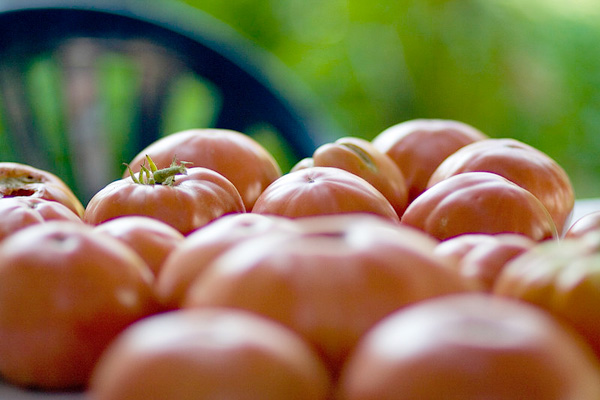
In our country, field tomatoes are grown in several production directions, with the first plantings in the field carried out after the risk of late spring frosts has passed. This is a necessary condition because air temperature values slightly below 0 °C lead to the death of tomato plants.
The growing directions according to transplanting dates are early, medium-early and late.
- in the early direction, transplanting with ready seedlings takes place between 15 and 30 April, and harvesting begins after mid-June.
- Medium-early cultivation is predominant; the ready seedlings are taken outdoors around 10 May and production is harvested at the height of summer.
- Late planting is after mid-June, with ripening and harvesting starting from September and continuing until the first autumn frosts.
These dates differ in the various parts of the country due to local climatic characteristics of the growing regions. In all cases, as a result of warming, these periods may be shifted.
The aggressiveness and harmful activity of tomato diseases and pests intensifies as a result of changes in environmental conditions.
The main pests in tomatoes are aphids, mites, cotton bollworm and the tomato leafminer. Recently, EURACTIV Bulgaria published a report that the larva of the tomato leafminer is capable of destroying 100% of the crop of pink tomatoes in Kurtovo Konare. According to Prof. Dimitrova from the Institute of Biodiversity and Ecosystem Research at the Bulgarian Academy of Sciences, the weakened phytosanitary control in cases of unregulated imports of agricultural products leads to mass multiplication of the pest, which until recently was not widely distributed in our country. At present, the warm and dry summer weather favours the harmful activity of the moth, while snowless and mild winters allow its stable overwintering.
Under more extreme meteorological conditions, mite development flourishes, while humid weather favours the activity of various aphid species. The latter pests also cause indirect damage by transmitting viruses. Tomatoes are most frequently attacked by late blight and brown leaf spots. Bacterial spots occur massively during temperature fluctuations, under extreme values and high daily amplitudes.
Consequences of climate change
As a result of extreme events during the ripening period of open-field tomatoes, we can expect unstable yields and higher production costs related to irrigation and plant protection. High summer temperatures cause heat and water stress and increasingly lead to fruit damage and deterioration of product quality. Conditions will be more favourable further north and at slightly higher altitudes. The increase in weather-related risks may discourage many producers and may be a serious argument for choosing more resilient hybrids with lower flavour quality.
How are climatic conditions changing in Bulgaria?
To what extent are tomatoes dependent on total precipitation?
Both insufficient rainfall and waterlogging adversely affect tomato physiology. Precipitation in Bulgaria during the vegetation period does not meet the water requirements of this and other vegetable crops. Irrigation is necessary to obtain good yields. Hydrothermal conditions imply higher irrigation rates, as well as the availability of water sources and an appropriate, cost-effective irrigation system. Water deficit during the period of mass flowering and ripening causes fruit set drop, cracking and blossom-end rot in ripening fruits. Excessive moisture, on the other hand, leads to fungal diseases that impair product quality and may completely compromise yields. Comfortable conditions for flowering and fruit set also require a relative air humidity of about 65%. Over the past 30 years, summer and autumn precipitation totals have been slightly higher compared to the previous climatological period (1961 – 1990), with the most pronounced positive difference observed in autumn.
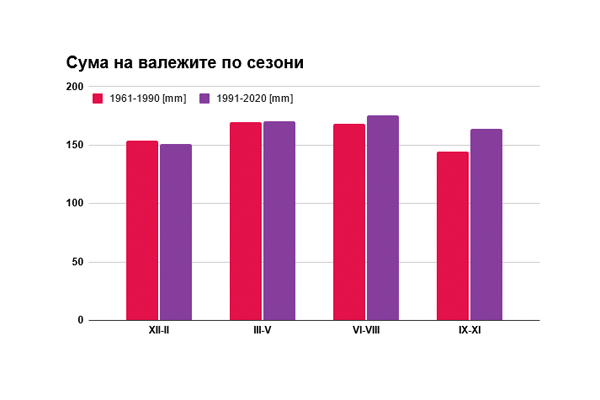
Seasonal precipitation totals in Bulgaria. Data source – World Bank
Summer precipitation is either extremely high, for example in 2014 and 2021, or insufficient (2008, 2011), which increases risks and leads to economic losses. The annual precipitation total in the last climatological period 1991 – 2020 is higher compared to the previous 1961 – 1990 period. Summer precipitation totals remain insufficient, and cases of extremely high amounts are not uncommon.
What are the temperature changes?
During the last climatological period, seasonal mean air temperatures show an increase compared to the period 1961 – 1990 (Fig. 2). This requires a precise assessment of spring frosts by region and a shift of planting dates earlier, probably for all growing directions. Wetter and warmer autumns will make it possible to extend the ripening period of late tomatoes.
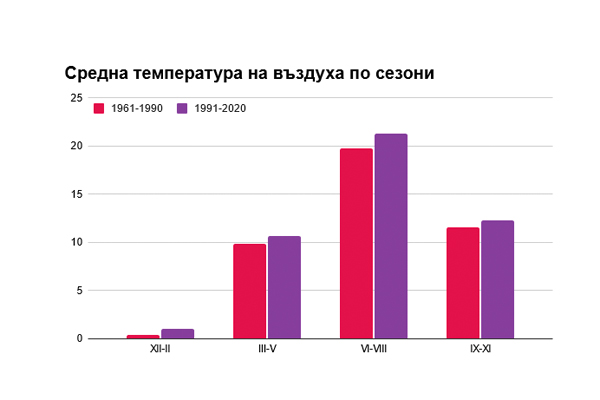
Seasonal mean air temperature in Bulgaria. Data source – World Bank
The observed higher temperatures during the vegetation period, combined with insignificant differences in precipitation, are a prerequisite for deterioration of moisture conditions for vegetable crops – especially in summer, when the mean of maximum air temperature values exceeds 25 °C and leads to stress.

Seasonal mean of maximum air temperature values in Bulgaria. Data source – World Bank
The risk in growing medium-early field tomatoes is increasing
Indirectly, warmer winter months favour the overwintering of some pests such as the moth, which can lead to intensified harmful activity. High temperatures and extreme precipitation values, which cause very dry periods and periods of waterlogging, are harmful to tomato development. Moreover, these conditions strongly favour the development of fungal diseases and pests.
Tomatoes in Bulgaria
In recent years, a decline in open-field tomato area and yields has been observed, according to statistics from the Ministry of Agriculture and Food. For example, in 2019 the harvest was 95,722 tonnes, in 2020 there was a 27% decrease compared to the previous year, and in 2021 the decline compared to 2019 was 61% (57,398 tonnes).
Where are tomatoes grown in Bulgaria?
This traditional Bulgarian crop is grown almost throughout the country – in the regions of Plovdiv, Pazardzhik, Stara Zagora, Blagoevgrad, Petrich, Sandanski, along the entire Black Sea coast, as well as in Northern Bulgaria. Kurtovo Konare is a special place for the local pink tomato. It is here that festivals of pepper, tomato, traditional dishes and crafts, and lyutenitsa are held.
What are the forecasts for the future of local varieties?
In recent years, there has been a discussion about the future of local pink tomato varieties. A large number of producers are turning to modern varieties and hybrids, driven by their good market characteristics. Under economic and climatic risk, high productivity provides greater security. Tomatoes differing in shape, colour and taste, known as cherry types, are an exotic culinary accessory and arouse strong curiosity. Nevertheless, Bulgarians are rather traditionalist and the taste of pink tomatoes is important to them. According to Assoc. Prof. Dr. Ganeva, Director of the Maritsa Vegetable Crops Research Institute, the unique and harmonious taste of Bulgarian pink tomatoes is due to a complex of factors, including climate and soil, varietal characteristics, and a rich content of vitamin C and lycopene.
The role of hobby gardeners
There is a whole array of varieties created with the help of local Bulgarian tomatoes, and it is an undisputed fact that hobby gardeners, with their private gardens, play a major role in their conservation and dissemination.
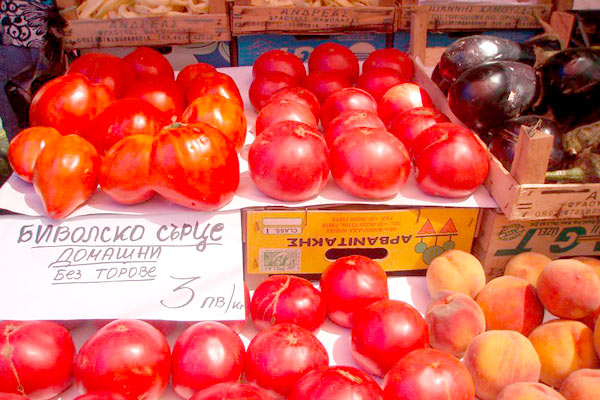
Organic production, integrated pest management and biological control are definitely a priority for smallholdings and hobby gardeners. It is precisely here that the combination “organic pink tomato” has real meaning. This is because the goal of growing it in the yard is not high yields, but its harmonious taste and the absence of chemical contaminants. That is why its price is slightly higher, yields are lower, and the produce is associated with traditional Bulgarian cuisine and rural tourism.
How are science and consumers seeking solutions together?
People love tomatoes, but as global air temperatures rise, risks also increase. Studying local climatic characteristics and the length of the vegetation period in individual regions suitable for tomato cultivation is important for fine-tuning planting dates, fertilization rates, irrigation and others.
Identifying tomato genotypes that can withstand more extreme temperature conditions is one of the solutions.

The EU-funded TomGEM project identifies new varieties with better heat tolerance
The EU-funded TomGEM project identifies new varieties with better heat tolerance to ensure that we will continue to enjoy this crop for a very long time to come. Its main objective was to develop heat-tolerant tomato varieties and to propose new crop management practices under climate change conditions. TomGEM builds on the complementary expertise and skills of internationally recognized laboratories and experienced tomato growers and breeders.
Other results of the project are:
- a platform accelerating the search for candidate genes (TomExpress);
- the study of 4,000 existing tomato mutants;
- a plant biostimulant that can increase tomato tolerance to high temperatures;
- a set of best management practices;
- new tomato hybrids that are already attracting attention in the sector.
In the Harnesstom project, in which Bulgaria also participates, 241 tomato varieties possessing a complex of valuable traits have been selected. This selection of varieties encompasses the maximum biodiversity in cultivated tomatoes and may be of interest to producers, culinary professionals and consumers. Out of a total of 241, 25 varieties have been selected to be included in the “Participatory Breeding and Citizen Science” experiments. In the search for the ideal tomato, a consortium of scientists, breeders, farmers and non-governmental organizations from 7 countries on two continents has set a common goal – to find the best varieties resistant to stressful meteorological factors, climate change, diseases and pests, while preserving their quality as much as possible.
With the help of hobby gardeners, scientists are searching for the ideal tomato in 3 countries – Bulgaria, Spain and Italy. Twenty-five non-genetically modified varieties are being evaluated, including „Rozovo Sǎrtse“ (Pink Heart), „Alya“ and „Pautalia“. Most of these varieties are local landraces, which means that they have developed under specific conditions (regions) and without professional breeder intervention. Modern tomato breeding has developed professional, improved varieties initially based on pure lines (homozygous genotypes) and subsequently on F1 hybrids (obtained by crossing 2 selected parents). Modern professional varieties are often highly productive and resistant to diseases and pests, but in most cases they lack flavour qualities.
The Bulgarian pink tomato will undoubtedly take part in the battle with climate change – both as a victim and as a tool for combating it through breeding work. It is threatened by adverse meteorological factors, especially higher temperatures and extreme precipitation values. Given the warming, the tastiest pink tomatoes may well change address and be found in rural yards in Northern Bulgaria and in regions with higher altitudes. In all likelihood, intensive agriculture, driven by the pursuit of higher output with high durability, will continue to increase the use of more resilient and correspondingly less tasty varieties and hybrids. Nevertheless, local pink tomatoes will continue to be grown primarily in smallholdings, where quality rather than quantity is decisive. This will also include local variants from which people save their own seeds and which cannot be found on the commercial market. Hobby gardeners will find it easier to cope with the indirect consequences of climate change, such as diseases and pests, by using biological methods and integrated plant protection due to the smaller areas and the diversity of cultivated crops.
The well-known and traditional taste of the Bulgarian tomato is due to a number of factors, including Bulgarian climate, soils and sunlight. Bulgarian pink tomatoes have much to offer in breeding work aimed at developing high-temperature-tolerant variants and it is no coincidence that they are on the list of the best. In this way, they will continue to be among the tastiest vegetables with an origin address in Bulgaria.