

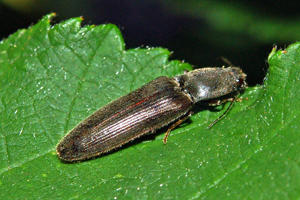
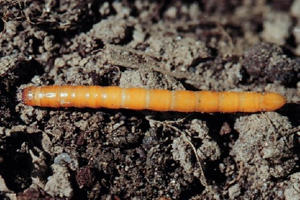
Wireworms are the larvae of beetles (beetles) from the family Elateridae. Their body is thin and elongated and is strongly chitinized, tough and resilient like wire, yellow or brown in color, with a flat head and three pairs of identical thoracic legs. The adult insects of this family are called click beetles and field click beetles because they jump and, when jumping, produce a sound similar to tapping. When placed on their back, they jump high and turn onto their abdomen. The larvae, which are elongated, have a hard chitinous covering on the segments and resemble a piece of wire. In our country about 120 species and forms are known, but 15 species have been observed as pests of cultivated plants. Wireworms are polyphagous and are widely distributed throughout the country. They attack field crops (wheat, barley, maize, sunflower, tobacco, etc.), vegetable crops, young fruit trees in nurseries, vine cuttings in rooting beds, ornamental crops, etc.
The greatest damage is caused by the larvae that are found in the soil and in the roots of the plants. During the first year of their life the larvae feed on decomposing residues, and thereafter they damage germinating seeds, roots and stems of plants. In sunflower, tobacco and vegetable crops the main root below the root collar is attacked. The affected plants most often die. The larvae also cause significant damage to potato tubers, in which they make galleries and tunnels filled with soil. Damaged potatoes are unfit for consumption.
A single beetle lays up to 500–600 eggs. The eggs are very sensitive to high temperatures and low humidity. The embryo develops slowly (20–30 days). During their development – 4–5 years – the larvae molt up to 14 times. The determining factor for their feeding is temperature. The lowest temperature at which they begin to feed is 12°C, the most favorable – 20°C. Temperatures above 32–35°C have a negative effect on the development of the larvae.
Control
Among the agrotechnical measures important for the control of wireworms are high-quality sowing, thorough tillage, destruction of weeds, especially couch grass, and hoeing of the inter-row spaces. Among chemical means, insecticides for seed treatment or granular plant protection products applied to the soil before sowing are used. Control also includes the introduction into the crop rotation of such plants (peas, millet) that are less attacked by wireworms; sowing and planting at an appropriate depth and within shortened time frames; balanced organic and mineral fertilization; liming of acidic soils and all other elements of agrotechnics that ensure optimal crop development and easier overcoming of damage.
Authorised plant protection products
Potatoes
Vydate 10 G – 2 kg/ha (use category 1),
Monceren G FS – 60 ml/100 kg, Santana 0.7 G – 1 kg/ha.
Maize, sunflower, sorghum
Colombo 0.8 MG/Belem 0.8 – 1200 g/ha, Sonido 400 FS – 125 ml/sowing unit (50,000 seeds).
Vegetable crops for seed production (field production)
Mageos – 5 g/ha
Wheat and barley
Yunta Quattro FS – 160 ml/100 kg seed