Do not underestimate pear pests in autumn
Author(s): Кирил Кръстев, агроном
Date: 25.09.2022
5173
![MultipartFile resource [file_data]](/assets/img/articles/обща-круша.jpg)
Harvest maturity of winter pear cultivars occurs in September – October, so most of these cultivars are still not harvested – Commission Beurré, Abbé Fétel, Beurré Bosc, Beurré d’Hardenpont, Passé Crassane and others. The foliage of the trees is actively photosynthesizing, providing assimilates for fruit nutrition, differentiation of fruit buds and deposition of reserve nutrients. While the danger of diseases has passed, several pests attack pear orchards until the end of the month – pear lace bug, common pear psylla, pear fruit moth. Treatments with PPPs must comply with the pre-harvest intervals of the pesticides and the harvest time.
Pear lace bug
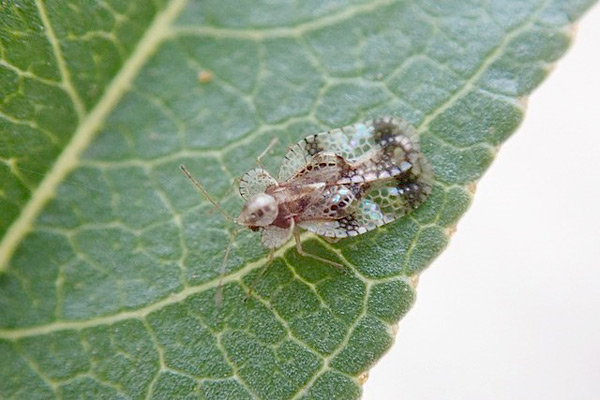
A widely distributed pest throughout the country. It attacks pear, apple, sweet cherry, sour cherry, plum, chokeberry, rose and other fruit species, as well as some ornamental tree and shrub species. It is an extremely dangerous pest in orchards where no plant protection is carried out. The pear lace bug develops two generations per year, and in a warm autumn partially a third one. It overwinters as an adult insect under fallen leaves and in cracked bark.
At the beginning of August, adults of the second generation appear. In a warm autumn, by the end of September – mid-October, a third generation also develops.
The upper side of the leaves acquires a mosaic appearance, as the insects suck out the chlorophyll grains together with the cell sap. Initially the spots are few, but gradually they increase and, under heavy infestation, they partially or completely turn yellow and may fall prematurely. If exposed to the sun, the process is significantly accelerated and the damaged areas acquire a bronze tint.
Under severe infestation by the pest, the leaves do not photosynthesize normally, they turn completely yellow and fall prematurely, the fruits remain small, and the trees become exhausted and set fewer fruit buds for the following year.
Young trees and nursery stock, as well as newly established orchards where regular plant protection is not carried out, are particularly sensitive.
After copulation, the females lay their eggs on the underside of the leaves, inserting them obliquely into the parenchyma tissue and gluing them with a sticky fluid which hardens in the air. The average fecundity is 170 eggs. The larvae hatch after 20-25 days and feed in the same way on the underside of the leaves.
Control
The pest is affected by the insecticides used for control of other pests in fruit orchards and separate control measures are usually not necessary. For chemical control, all pyrethroid insecticides are suitable – Deca EC (30-50 ml/da), Efzimetrin 10 EC (30 ml/da), Sumi Alpha 5 EC (0.02%) and others, and most bioinsecticides – Abanto (75 ml/da) and other pyrethrin products, Neem Azal T/C (300 ml/da) and other azadirachtin-based products, Sineis 480 SC (30-35 ml/da), Naturalis (100-200 ml/da). The economic injury level is 3 larvae/leaf at fruit enlargement.
Common pear psylla
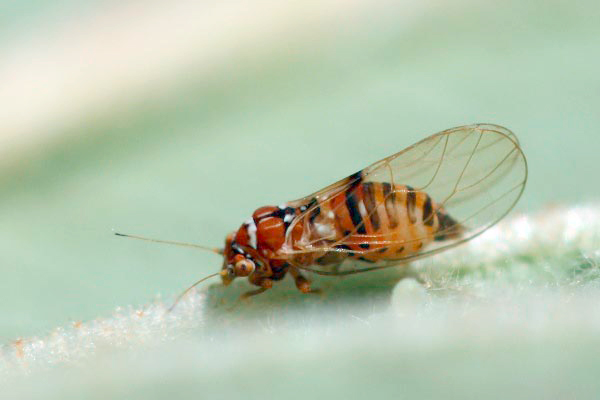
The common pear psylla is widespread at high population density throughout the country. It damages only pear. Cultivars with long and prolonged shoot growth are more heavily attacked. It develops 4-5 generations per year. It overwinters as an adult insect under the bark of the trunk and scaffold branches, in crevices and cracks of the trunk, in fallen leaves and other sheltered places, on a large number of fruit and other tree species. The appearance of adults of the fourth generation begins in the second half of August, and of the fifth – in the third ten-day period of September. Adults live for more than a month.
The common pear psylla transmits the mycoplasma disease Pear decline, in which the conductive tissue becomes blocked and parts of the branches, together with the leaves on them, dry up and die. The damaged areas increase progressively: at first only small twigs dry out, later large branches, and finally entire trees may die. This is one of the reasons for the mass dieback of entire pear orchards in our country. Unlike fire blight, the tips of the dried twigs do not bend like a hook.
During the period May–October, the psyllids lay their eggs singly or in a chain, near the leaf veins. One psylla lays over 200 eggs. The egg stage lasts from 4 to 13 days, and the larval stage – from 14 to 38 days.
The main damage is caused by the larvae and nymphs, which suck sap from buds, leaves and fruits. They form dense colonies on the terminal parts of shoots and twigs, secreting abundant honeydew, on which sooty mould fungi develop. The leaves turn yellow and curl downwards. On the attacked parts, dark spots appear and their physiological characteristics change – transpiration increases 3-4 times, water loss 6-7 times, and the intensity of respiration – about 2 times. Some biochemical indicators also change – free sugars decrease by 33.1%; phosphorus – by 47.2%, while nitrogen content increases by 30.4%. This leads to premature ageing and exhaustion of the attacked trees.
In the second half of October and the first half of November, the psyllids move to their overwintering sites.
Control
The formation of large colonies, densely covered with honeydew, must not be allowed, because it hampers the access of products to the bodies of the psyllids. You may use one of the following products: Bermektin (40-120 ml/da) or another abamectin-based product, Voliam Targo 063 SC (75 ml/da), Imidan 50 WG (150 g/da), Delegate 250 WG (30 g/da), Deca EC (50 ml/da) or another deltamethrin-based product, Movento 100 SC (0.12-0.15%), Naturalis (100-200 ml/da), Sineis 480 SC (30-44 ml/da), Flipper (1-2 l/da). The products used must be alternated to avoid resistance.
At the fruit enlargement phenophase, the economic injury level is 4-6% shoots with colonies.
The predatory bug Anthocoris nemoralis plays an extremely important role in reducing the density of pear psyllids. The recommended rate for colonization is 150-200 bugs per decare, two to four times at one-week intervals.

Pear fruit moth
It has been observed to a limited extent, but is probably distributed throughout the country. It damages only pear – cultivated and wild. It can easily be confused with the codling moth.
The pear fruit moth develops one generation per year and overwinters as a mature larva in the soil, in the projection of the crown of pear trees.
Eggs are laid only on pear fruits. Average fecundity is 60-80 eggs. Usually there are 1-2 eggs on a fruit, but at high population density significantly more may be laid. Embryonic development lasts 10-12 days.
Unlike the codling moth, the hatching larvae gnaw through the chorion of the egg – at the point where it is attached – and enter the fruit without crawling to search for suitable entry sites. The chorion remains for a long time in place without falling off.
At the entry point there are no excrements and no fruit rot, and the wound usually heals quickly. Very often this is the calyx area. The larva makes a tunnel to the seed cavity, which is straight, clean, with smooth walls. In the last two instars it completely destroys the seed cavity without passing into the flesh. One larva feeds in only one fruit, without moving to another, and due to cannibalism, from several larvae that have entered, usually only one remains.
In the area of the tunnels, the fruit cells have delayed growth and the tissue hardens. In later ripening and especially in winter cultivars, depressions of varying depth occur. Damaged fruits often drop prematurely together with the larvae. After they leave the fruits, around the wide exit hole rotten areas are usually observed. After completing their development, the larvae leave the fruits and move into the topsoil – up to 5 cm, where they spin a cocoon and remain to overwinter. They are particularly attracted to weedy intra-row areas.
Control
The population density of the pear fruit moth can be reduced to a harmless level only through agrotechnical measures – hoeing of intra-row spaces, collection and destruction of fallen fruits and wild pears.
Products registered for control of other fruit moths can be used – Affirm Opti (200 g/da), Coragen 20 SC (16-30 ml/da), Deca EC (30 ml/da) and others, but they are of low efficacy, since the larvae of this species do not crawl on the fruit surface.
More effective is the application of hormonal insecticides against the eggs – products based on pyriproxyfen (Harpun – 100 ml/da and others) and Carpovirusine (100 ml/da), Madex Top (10 ml/da), Dipel DF (50-150 g/da), Sineis 480 SC (20-37.5 ml/da).