Plant protection practices in fruit crops in August
Author(s): Растителна защита
Date: 14.08.2022
3771
![MultipartFile resource [file_data]](/assets/img/articles/ripe-apples-in-orchard.jpg)
The usually dry and hot weather in August limits the spread of a number of fungal diseases in fruit crops and vineyards, but it also causes the fruits to ripen within shortened periods.
In August, for late fruit varieties, the harmful activity of the last generation of fruit moths should not be underestimated. Conditions during the month will be favourable for an increase in mite populations. In vineyards it is necessary to monitor the occurrence and density of caterpillars of the third generation of the European grapevine moth. Plant protection sprays during the month should be carried out in the cooler hours of the day with products having an appropriate pre‑harvest interval, in line with the ripening and harvesting period of the crops.
Pome fruit species
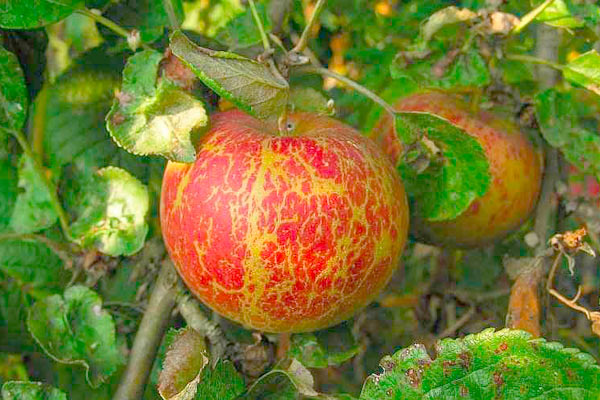
Apple powdery mildew
Apple powdery mildew
The disease develops within a wide temperature range, but above 33°C its development stops. When infected with the local form, spots with a greyish‑white coating appear on the leaves. Growth at the site of damage ceases, as a result of which the leaves become deformed, and more heavily affected leaves drop. The pathogen also attacks the fruits, where white coatings are formed. Later, the skin under the spots becomes necrotic.
To prevent local infections by powdery mildew, systematic spraying of the trees is necessary. In orchards with more severe infestation, combined treatments against pests should be carried out as well.
Authorised plant protection products: БЕЛИС ВГ - 80 g/ha; ЕМБРЕЛИА - 150 ml/ha; СКОР 250 ЕК - 0.02%; СЕРКАДИС - 15 ml/ha; ФЛИНТ МАКС 75 ВГ - 0.02%.
Fall webworm
In August, the development and harmful activity of the second generation of the pest continues. The damage caused by the caterpillars of this generation is much greater compared to that of the first generation. After feeding, the caterpillars pupate under cracked bark, on tree trunks or shallowly in the soil and remain there for overwintering.
At low population density, the nests of caterpillars are mechanically cut out, removed from the plantation and burned, and at high density chemical treatment is carried out against newly hatched caterpillars.
Authorised plant protection products: ДИПЕЛ 2 Х – 0.1%, РАПАКС - 100-200 g/ha
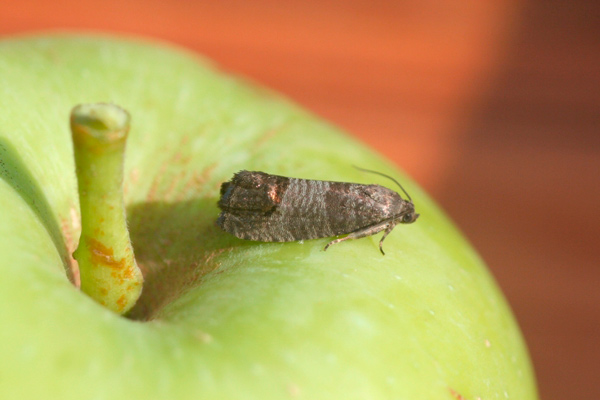
Codling moth
Codling moth
The harmful activity of the caterpillars of the second generation of the pest continues throughout August and until the end of September. For their complete development, the caterpillars of this generation damage the seeds and the seed cavity and completely destroy the fruit.
Treatment is carried out at the time of hatching and initial boring of the first caterpillars. Economic injury level (EIL) for the second generation: 1.5-2% fresh entries in the fruits.
Authorised plant protection products: ДЕКА ЕК - 30 ml/ha; ДЕЛЕГАТ 250 ВГ - 250 g/ha; ДЕЦИС 100 ЕК - 7.5-12.5 ml/ha; ИМИДАН 50 ВГ - 150 g/ha; СУМИ АЛФА ЕК (СУМИЦИДИН) - 0.02%; ШЕРПА 100 ЕВ - 300 ml/ha.
Apple leafminer
In August, the third generation of the pest develops, and in September a partial fourth generation also appears. The caterpillars of these generations mine the upper leaves in the tree crown. If heavy infestation is allowed, the trees defoliate prematurely, remain with small, poorly nourished fruits, set fewer buds for the following year and have immature one‑year‑old wood, which may be winter‑killed. If the infestation is repeated for several consecutive years, the trees become exhausted and die.
Treatment is carried out during mass hatching of caterpillars and at EIL: 2-3 eggs and mines per leaf.
Authorised plant protection products: АФЪРМ ОПТИ - 200 g/ha; ДЕЛЕГАТ 25 ВГ - 30 g/ha; ЛАМДЕКС ЕКСТРА - 60-100 g/ha; МЕТЕОР - 60-90 ml/100 l water; МОСПИЛАН 20 СГ - 20 g/ha; СУМИ АЛФА 5 ЕК/СУМИЦИДИН 5 ЕК - 0.02%.
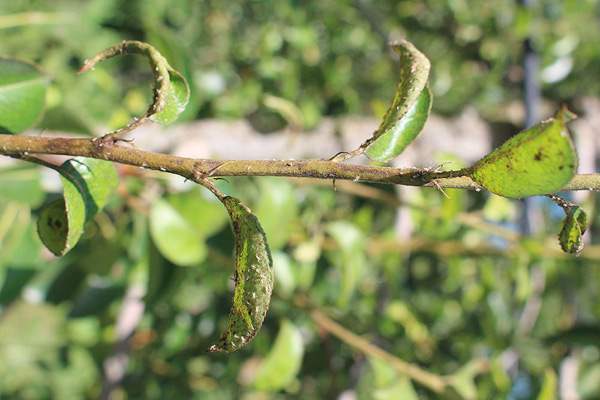
Damage by pear psylla
Pear psylla
During this month, mixed populations of adults, larvae and nymphs of the pest are observed. They form dense colonies and suck sap from the leaves, shoots and fruits, excreting honeydew on which sooty mould fungi develop. The affected leaves and shoots turn black, and the fruits lose their market value. Pear psylla causes not only direct damage but also transmits a dangerous phytoplasma disease that leads to drying out and death of pear trees.
Treatment is carried out at EIL: 4-6% shoots with colonies of larvae and adults.
Authorised plant protection products: АПАЧИ ЕВ - 37.5-120 ml/ha, МАСАИ ВП - 25 g/ha, ОВИТЕКС - 2000 ml/ha, НАТУРАЛИС -100-200 ml/ha, ЛАМДЕКС ЕКСТРА 80-100 g/ha, ДЕЦИС8 100 ЕК - 12.25 ml/ha, ВАЗТАК НОВ - 2 ml/ha, ДЕКА ЕК - 75 ml/ha.
San Jose scale
In August, the larvae of the third generation begin to be born. About one third of them enter diapause and remain to overwinter. The remaining part develop into adults that appear at the end of September. Damage to the fruits is expressed by the appearance of red, round spots with a white dot in the centre (the scale of the insect). These injuries have little economic significance.
Strategy for pest control: When a density above the EIL is established: 10 individuals/100 cm shoot or 2-3 attacked fruits, treatment is carried out against adult males and mobile first‑instar larvae.
Authorised plant protection products: ДЕКА ЕК / ДЕША ЕК/ДЕНА ЕК - 50-75 ml/ha; МЕТЕОР - 90 ml/100 l water; МУЛИГАН - 30-50 ml/ha; ОВИТЕКС - 2000 ml/ha; БЕЛПРОЙЛ-А - 0.375-1.5 l/ha.
Aphids
Adults and larvae continue to cause damage by sucking sap from the leaves and the apical parts of the shoots. In August, due to high air temperatures and low atmospheric humidity, the multiplication of aphids is slowed and they may enter into depression.
Spraying is carried out at EIL:
Apples, Pears: colonies of Aphis spp. - 10-15 per 100 shoots; colonies of Dysaphis spp. - 5 per 100 shoots.
Peaches: colonies - species of Myzus spp., Brachycaudus spp. - 5% infested shoots; colonies - species of Hyalopterus spp. - 15% infested shoots.
Plums: colonies - species of Hyalopterus spp., Phorodon - 15 per 100 branches or 15% infested shoots; colonies - species of Brachycaudus spp. - 5 per 100 branches or 5% infested shoots.
Authorised plant protection products: ДЕКА ЕК/ДЕША ЕК/ДЕНА ЕК - 30-50 ml/ha; Ефория 045 ЗК - 150 ml/ha; КАЛИПСО 480 СК - 0.02%; КАРАТЕ ЕКСПРЕС ВГ/НИНДЖА /ФОРЦА - 40-60 g/ha; ЛУЗИНДО 40 ВГ - 0.025%; МАСАЙ ВП - 25 g/ha; Мовенто 100 СК - 0.1%; ОВИТЕКС - 2000 ml/ha; ПРОТЕУС О-ТЕК - 0.05-0.06%; ТЕПЕКИ - 14 g/ha.
European red mite
The optimum temperature for mite development is 19-22°C; temperatures above 31-37°C have an adverse effect. In August, harmful activity of the summer generations of the European red mite is observed. In case of heavy infestation, the leaves turn golden‑brown and drop prematurely. The damage caused by the mites worsens the quantity and quality of the yield, as well as the nutrition of fruit buds and shoots for the following year.
Treatment is carried out at EIL:
Apple: 3-4 mobile forms per leaf.
Pear: 3-4 mobile forms per leaf - at the beginning of fruit growth; 5-7 mobile forms per leaf - after the beginning of fruit growth.
Peach - 4-5 mobile forms per leaf.
Plum - 3-5 mobile forms per leaf.
Authorised plant protection products: АПАЧИ ЕВ - 100 ml/ha, ВЕРТИМЕКС - 100 ml/ha, ВОЛИЗАМ ТАРГО - 75 ml/ha, МАСАЙ ВП - 25 g/ha, ВАЛМЕК - 50-120 ml/ha (peach), 37.5-120 ml/ha (pear), 60-96 ml/ha (apple), ВЕРТИМЕК 018 ЕК - 150 ml/ha (apple).
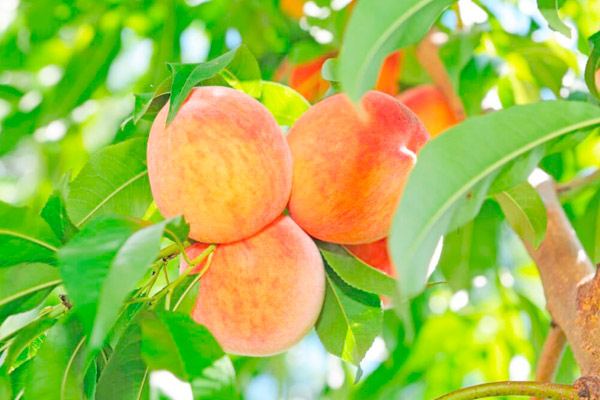
Stone fruit species
Peach powdery mildew
During the summer months, severe attacks of the disease are observed. At that time, young leaves are infected on the lower side, and numerous angular, chlorotic, local spots appear on the upper side and on shoot tips, covered on the underside with a powdery coating. The affected leaves are strongly deformed and, at high infestation, become necrotic and fall. During this period the fruits are not infected.
Treatment is carried out upon detection of the first spots. To reduce the inoculum of the pathogen for the following year, affected shoots should be cut out and burned.
Authorised plant protection products: ЛУНА ЕКСПИРИАНС - 50 ml/ha, СКОР 250 ЕК - 20-30 ml/ha, СИГНУМ - 30 g/ha, СИСТАН 20 ЕВ - 30 ml/ha, СИСТАН ЕКОЗОМ ЕВ - 65-200 ml/ha, ТИОВИТ ДЖЕТ 80 ВГ - 600 g/ha, ТОПАЗ 100 ЕК - 0.03%.
Late brown rot
During the summer months, the degree of attack by the pathogen decreases. Under favourable conditions for disease development (increased humidity and moderately high temperatures), brown spots appear on the fruits, which expand and may cover the entire fruit. The damaged tissues are brown, rotten, with concentric rings covered with yellowish‑white or ash‑grey sporulating tufts. At low humidity, the entire fruit shrivels and mummifies.
Treatment is carried out under favourable conditions for disease development and upon the appearance of the first symptoms.
Authorised plant protection products: ЛУНА ЕКСПИРИАНС - 50 ml/ha, СКОР 250 ЕК - 20-30 ml/ha, СИГНУМ - 30 g/ha, СИСТАН 20 ЕВ - 30 ml/ha, СИСТАН ЕКОЗОМ ЕВ - 65-200 ml/ha, ТИОВИТ ДЖЕТ 80 ВГ - 600 g/ha, ТОПАЗ 100 ЕК - 0.03%.
Plum fruit moth
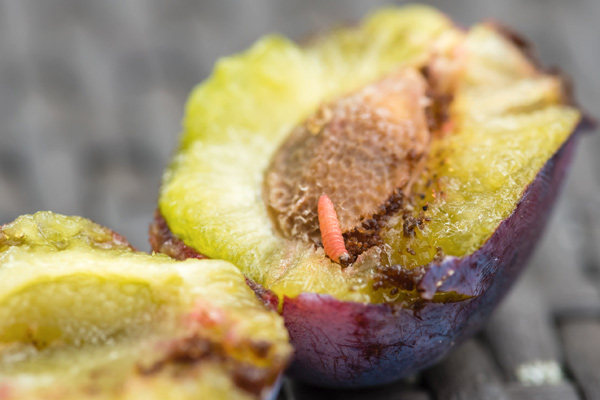
Plum fruit moth
The flight of moths, boring and feeding of the caterpillars of the second generation of the pest continues. The caterpillar damages the latest plum varieties, boring a gallery in the fleshy part of the fruit around the stone. To complete their development, caterpillars of this generation damage 1-2, and in some cases 3 fruits. The damaged fruits drop prematurely.
Treatment is carried out at the beginning of hatching and boring of the caterpillar and at EIL for the second generation: 1.5-2% fresh entries in the fruits;
Authorised plant protection products: АФЪРМ ОПТИ - 250 g/ha, ДЕКА ЕК 50-70 ml/ha, ДЕЛЕГАТ 250 ВГ - 300 g/ha, ДЕЦИС 100 ЕК - 7.5-17.5 ml/ha, ИМИДАН 50 ВГ - 150 g/ha, КОРАГЕН 20 СК - 16-30 ml/ha, СУМИ АЛФА 5 ЕК - 0.02%.
Oriental fruit moth
During the month, the development of the third and fourth generations of the pest takes place. The caterpillars of these generations damage the fruits. At the site of boring, darkening of the tissues and excrements entangled in silk threads can be seen. The damaged fruits rot, show signs of premature ripening and drop.
Treatment is carried out at EIL:
during the vegetation period – 10-15 moths/trap/week;
young orchards – 2-3% shoots attacked by caterpillars;
fruit‑bearing orchards - 5% damaged shoots or 2-4% fruits attacked by caterpillars.
Authorised plant protection products: АВАНТ 150 ЕК - 33.3 ml/ha, АГФЪРМ ОПТИ - 200 g/ha, ВОЛИАМ ТАРГО - 75 ml/ha, ДЕКА ЕК - 50-70 ml/ha, ДЕЛЕГАТ 250 ВГ - 30 g/ha, ДИПЕЛ ДФ - 75-150 g/ha, ЛАМДЕКС ЕК7СТРА - 70 g/ha, КОРАГЕН 20 СК - 16-30 ml/ha, СУМИ АЛФА 5 ЕК - 0.02%.
Peach twig borer
In August, moths of the third generation begin to fly, with emergence completed by mid‑October. The caterpillars of this generation develop entirely in the fruits. They bore from the stem end of the fruit, feed on the flesh and form wide depressions near the skin.
Treatment is carried out at EIL - 3% fruits damaged by caterpillars.
Authorised plant protection products: ДЕЦИС 100 ЕК - 8.75–12.25 ml/ha; КОРАГЕН 20 СК - 16–30 ml/ha; АВАНТ 150 ЕК - 33.3 ml/ha, АФЪРМ ОПТИ - 200-225 g/ha.
Cherry leaf sawfly
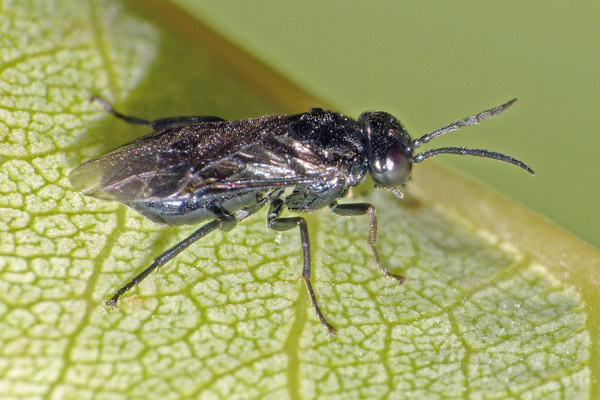
Cherry leaf sawfly
At the beginning of August, sawflies of the third generation appear, and their development continues until October. The false caterpillars chew through the upper epidermis and feed on the parenchyma of the leaves without affecting the lower epidermis and veins. The damaged leaves turn brown, dry out and fall. After feeding, the false caterpillars burrow into the soil, where they overwinter in an earthen cocoon.
Treatment is carried out against adults before egg‑laying and against false caterpillars immediately after hatching. To reduce the density of overwintering larvae, the soil is cultivated in autumn.
Authorised plant protection products: ДЕКА ЕК - 30 ml/ha.