Growing interest in cherry production
Author(s): проф. д-р Аргир Живондов, Институт по овощарство в Пловдив; ас. Сашка Савчовска, Институт по овощарство в Пловдив; гл. ас. д-р Светослав Малчев, Институт по овощарство в Пловдив; гл. експерт Светла Пандова
Date: 26.05.2022
2836
![MultipartFile resource [file_data]](/assets/img/articles/череши-заглавна.jpg)
The cherry is one of the leading structure-determining fruit species in the countries of the temperate climatic zone and is among the first fruits on the market that are typical for the European taste. According to data from Agrostatisics for the period from 2002 to 2014, an average of 22,380 t of cherries per year are produced in Bulgaria, which represents 16.21% of the total fruit production in the country. Today, cherry orchards account for 22% of the total area under fruit crops, and cherry production occupies 18%
of the total fruit production. The largest share of the harvested fruit area in 2021 is occupied by cherries – 24%, followed by plums and mirabelles – 21%. Cherry fruits are highly valued for their taste, nutritional and technological qualities, and their early ripening period, which precedes that of other fruit species. The economic significance of the crop for many farmers, including Bulgarianfarmers, is determined by the guaranteed marketing of the production at the beginning of the summer and the availability of cultivars with high productivity.
Over the past 15 years, there has been an increased interest in the country in establishing new cherry orchards, prompted by the support opportunities offered to agricultural producers under various European programmes.
Nevertheless, the latest trends in European agriculture towards environmentally friendly practices, the threats arising from climate change, and the increasing consumer requirements regarding fruit quality pose challenges to the cherry sector. In order for Bulgarian cherry growers to be competitive, they must have at their disposal a wide range of cultivars covering a longer season for supplying fresh fruit with good transportability and excellent external appearance and taste qualities. There is a need for the development and introduction of new, promising modern cultivars and rootstocks, resistant to biotic and abiotic stress factors, adapted to the climatic and soil conditions of the country and meeting the requirements of the market-oriented economy, which will lead to the restoration of the competitiveness of Bulgarian fruit growing.
To address part of these problems, a breeding programme on cherry was launched as early as 1987 at the Fruit Growing Institute in Plovdiv, whose main objectives are the continuous renewal and enrichment of the cultivar assortment, in line with market trends and the changing consumer preferences. Over more than 30 years, a rich first-generation hybrid fund has been established, as well as a considerable second-generation one.
According to averaged FAOSTAT data, 2013, for the last five years the cherry crop has accounted for about 2% of the total production of fruit in the world. This ranks it seventh after strawberry and apricot.
Despite their relatively small market share, cherry fruits are preferred by consumers in Europe, as they are among the first fresh fruits on the market that are typical for the continent. For the period 2001–2010, as well as today, the main producers are Turkey, the USA and Iran, which are constantly increasing their annual output.
Production in the European Union is relatively stable – with Italy, Spain, Russia, Romania, Ukraine and France standing out as leading producing countries.
A large part of the production of Turkey, the USA and Chile is exported to Russia, Germany, Canada, Austria and the United Kingdom. It is interesting to note that cherry imports and exports in Austria are almost equal, which indicates a good balance in production and year-round market supply.
Over the past ten years, the price of cherry production has been gradually increasing, without significant fluctuations over the years. The most attractive prices are in Japan, Norway, Australia, New Zealand and China.
Production and problems in Bulgaria
Data on cherry production in Bulgaria for the period 1961–2011 show a constant increase in planted areas, with a stagnation in the establishment of new orchards observed between 1981 and 2000.
After promising opportunities for farmer support under various programmes emerged, the trend of establishing new orchards increased sharply after 2000.
Despite the increase in cherry acreage, the quantity of production has remained constant over the years, with even a slight decline in the last decade.
Unfortunately, a rather worrying trend is observed in cherry production in Bulgaria. For the period from 1961 to 2011 there has been a constant decrease in yield per unit area, compensated to some extent only by the increase in the area under cherries. This is definitely an indicator of the lack of an appropriate strategy and good agricultural practices. What are the main problems underlying this trend?
- Orchards are still being established under non-irrigated conditions, on vigorous seedling rootstocks, which results in extensive-type plantations with tall trees, large canopies, wide planting distances and a high requirement for manual labour.
- For new plantations, in most cases cultivars are used that have insufficient fruit size and quality or that ripen during the main cherry ripening period, when the price is lower and competition is stronger.
- The renewal of the cultivar composition in the country is carried out mainly through the import of planting material from neighbouring countries. This planting material is often of questionable quality and varietal authenticity.
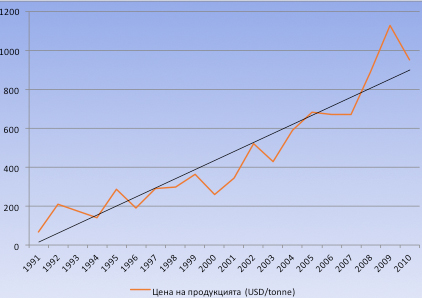
Price of cherry production in Bulgaria for the period 1991 to 2010 (FAOSTAT, 2013)
Despite the strong competition from our neighbouring countries – Turkey and Greece, where the ripening period is earlier compared to Bulgaria, cherry remains a very attractive crop, bearing in mind the constant
increase in price, the guaranteed market and the early marketing of the production during the year.
To increase the competitiveness of Bulgarian producers, it is necessary to breed and introduce new cultivars that meet the contemporary consumer trends for fruit quality and are well adapted to the growing area, with different and extended ripening periods and resistance to biotic and abiotic stress factors.