Plant stress indicators
Author(s): проф. Андон Василев, от Аграрния университет в Пловдив
Date: 03.03.2020
4509
![MultipartFile resource [file_data]](/assets/img/articles/заглавна-растение.jpg)
Plant stress is one of the main factors limiting agricultural crop yields and reducing the quality of plant production. The possibilities for counteracting stress are limited and mainly involve the selection of more tolerant varieties (and hybrids) and the application of various agrotechnical measures, including products with anti-stress effects. Products with such properties can be formulated as plant protection products with extended physiological action, foliar fertilizers, growth regulators, etc. They can be applied before the onset of stress (preventively), as well as when visual signs of disturbances in plant growth and development are present (curatively).
This publication briefly presents suitable indicators of plant stress. These indicators are traditionally used in the scientific work of the team at the Department of Plant Physiology and Biochemistry at the Agricultural University of Plovdiv to assess the quality of new varieties, hybrids, and products from leading companies.
Plant stress usually has a chronic, rather than lethal, character and manifests visually in the form of chloroses, necroses, and other disturbances in plant growth and development. It is necessary to emphasize that stress impact can also occur without visible negative manifestations, but always with a reduction in growth rate. Plants respond to stress impacts with a complex of non-specific and specific reactions aimed at eliminating negative effects and adaptation. The engagement of significant energy and substrate resources to overcome stress inevitably leads to the suppression of physiological processes related to growth, such as photosynthesis, water exchange, mineral nutrition, etc. The degree of suppression of these processes provides an idea of the sensitivity of the respective variety to the stress impact, as well as the efficacy of the applied products with anti-stress properties.
Under stress impacts, the physiological status of plants transitions from one stationary level to another. The degree of deviation of physiological processes from the stationary level, the time to reach a new stationary level, and the degree of recovery provide an idea of the plant's tolerance to the stress factor. The smaller the deviations from the "norm" and the faster and more completely the pre-stress stationary level is restored, the more tolerant the specific genotype (variety, hybrid) is, and correspondingly, the more effective the preventive or curative action of the applied anti-stress product.
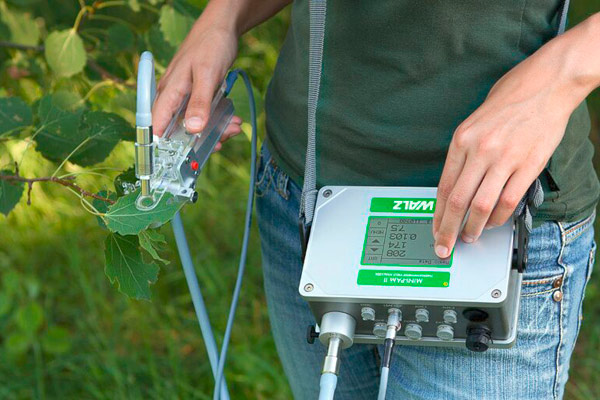
Measuring chlorophyll fluorescence with the MINI-PAM fluorometer
The need to monitor the physiological status of plants dynamically requires the use of non-destructive analyses, i.e., those that do not disrupt their integrity and can be determined directly in field conditions. Leaf gas exchange and chlorophyll fluorescence are the most commonly used non-destructive analyses in eco-physiological research. The high sensitivity of their parameters and the speed of the analyses allow for obtaining a significant volume of information in a short time under real climatic conditions.