Diagnosis of general symptoms
Author(s): доц. д-р Венета Каназирска
Date: 29.03.2022
3250
![MultipartFile resource [file_data]](/assets/img/articles/визуална-диагностика-общи-симптоми.jpg)
Each plant species is unique and has specific requirements regarding the nutritional spectrum – optimal level and minimum level of nutrients. Nevertheless, under nutritional stress (real or induced), there are visual symptoms common to all plants, for the identification of which the following terminology is used:
Chlorosis
Chlorosis is the yellowing of plant tissue due to limited chlorophyll synthesis in the leaves and reduced photosynthetic activity. It may spread over the entire leaf surface, along the leaf margins, or form spots and/or stripes. In some cases, it is accompanied by premature leaf fall, small leaves, drying of the tips of the shoots, and death of the active roots. Nutrient deficiencies may occur because there is an insufficient amount in the soil or because the nutrients are unavailable due to a high pH (alkaline soil).
Interveinal chlorosis
The symptoms are yellowing of the interveinal tissue, while the veins themselves remain green (veins, representing vascular bundles that mechanically support the leaf and conduct the nutrients).
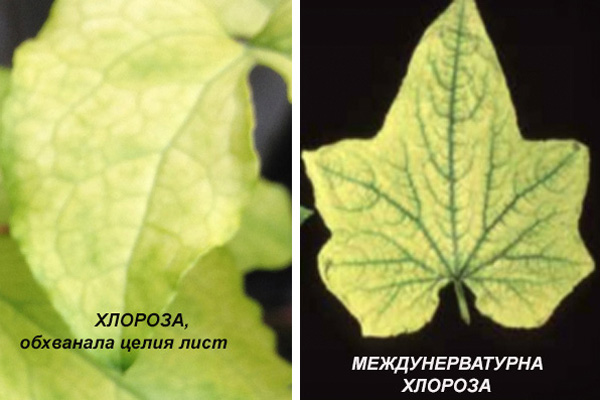
Chlorosis and interveinal chlorosis
Necrosis
This is the irreversible cessation of the vital activity of the cells, as a result of which the tissue turns brown and dies. It occurs on different parts of the plant (leaves, stems, fruits, petioles, roots) in the form of spots or may cover a large part of the plant tissue.
Anthocyanin coloration
It is expressed in the accumulation of the pigment anthocyanin, which gives the leaves a red-violet to purple coloration.
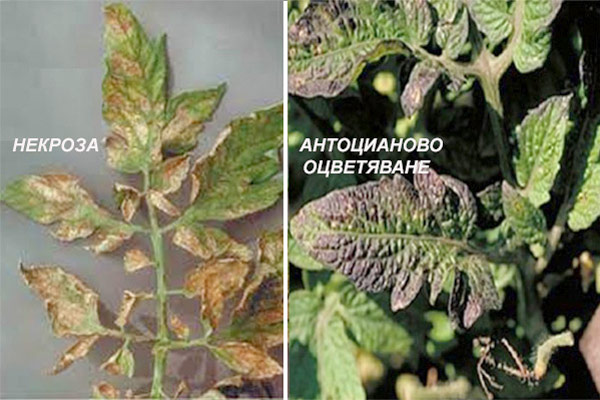
Necrosis and anthocyanin coloration of the leaves
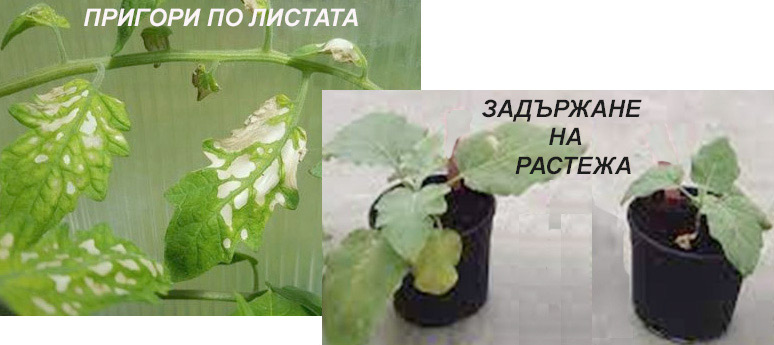
Leaf scorch symptoms
Leaf scorch is the browning of the leaf periphery. In some cases, the symptoms may progress inward between the veins as spots and the entire leaf may dry out.
Local symptoms
These are symptoms that are confined to a single leaf, part of a leaf, or part of the plant.
Retarded or arrested growth
The symptoms are expressed in a reduction in the height of the affected plants. In some cases, the plant acquires a bushy appearance – it becomes stunted.
Leaf scorch and growth retardation
Attention! For correct visual diagnosis, it is important to know the morphological characteristics of the healthy plant, in order to assess possible deviations in the external appearance of the plants, their growth and development, and in the quality of the produce and yield.
The first step in visual diagnosis is to identify the symptoms (chlorosis, necrosis, anthocyanin coloration, stunted growth, etc.) and to determine where the first symptoms appear – old leaves or young leaves and young parts of the plants. This clarification provides information on whether the cause of the problem lies in the mobile or immobile nutrients:
Mobile elements
These are elements that undergo reutilization (re-use) in the plant organism – nitrogen (N), phosphorus (P), potassium (K), chlorine (Cl), magnesium (Mg) and molybdenum (Mo). In case of deficiency, they are translocated from the ageing and dying organs and tissues to the younger and more active ones, and subsequently to the reproductive organs. Therefore, the first signs of deficiency of the mobile elements appear on the lower leaves.
Immobile elements
These are those that do not undergo reutilization in the plant organism – iron (Fe), calcium (Ca), manganese (Mn), zinc (Zn), copper (Cu), nickel (Ni), sulfur (S) and boron (B). Therefore, their content in the older organs and tissues is higher and the first signs of deficiency appear on the young leaves and parts of the plants.
An important step in visual diagnosis is to determine the area of symptom expression – the whole leaf, the leaf periphery, the interveinal tissue, the venation.
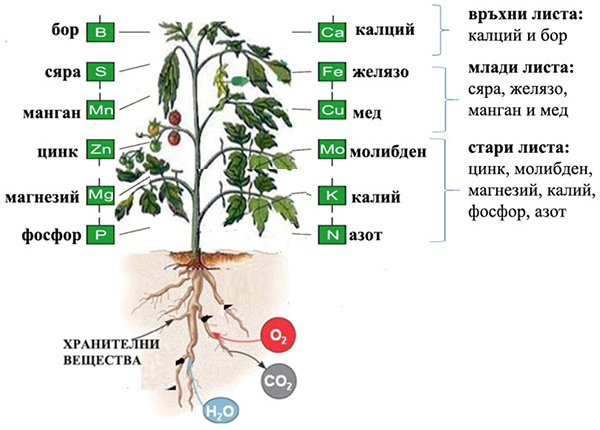
Mobility of nutrients and location of the first deficiency symptoms
When identifying morphological changes in plants, the following should be taken into account:
- If only the venation of the leaf is yellow, the cause is not related to the nutritional regime.
- In case the morphological changes affect individual plants but spread to groups of plants, the cause lies in a past treatment of the soil or the plants.
- If the plants are under nutritional stress, all plants of a given species and age in the same environment tend to develop similar symptoms at the same time.