Lozova pŭstryanka – Yno (Theresimima) ampelophaga Bayle.
Author(s): проф. д.с.н. Ангел Харизанов
Date: 12.06.2019
9451
The vine moth was first reported as a grapevine pest by Pallas for the conditions in Crimea as early as the 18th century and was initially studied by Bayle – Barelle, and later by Passerinnio in Florence. In France it was reported by Milliere in 1882 in vineyards in the Maritime Alps. Later it was found to be harmful in Italy, Spain, Portugal, Greece, the countries of Eastern Europe, the Middle East and elsewhere. In Bulgaria it has been known to damage grapevine since the end of the 19th and the beginning of the 20th century, but for many years it remained almost unknown due to its low population density and insignificant damage. Only during the period 1978-1985 did it spread and cause significant damage to grapevine. A similar phenomenon of such a late mass occurrence of the pest has been observed in Italy, Greece, Hungary, France and other countries.
In Bulgaria the species is distributed throughout the country, but it multiplied massively in many regions after 1978 and caused significant damage to vines in commercial vineyards in the regions of Plovdiv, Pazardzhik, Stara Zagora, Sliven, Yambol, Pleven, Ruse and elsewhere. In some of the regions the damage covered several thousand decares of vineyards and resembled winter frost injury.
Nature of damage and economic importance
The main damage is caused by the overwintered larvae. They bore into the buds as soon as swelling begins – at the end of March – the first half of April and eat out the entire interior. Only the bud scales remain. The damaged buds resemble frost-injured ones, but they show a small hole. These buds do not develop, and after 15-20 days the dormant buds start to develop. The damage occurs in patches, which expand and increase every year, covering several tens of decares. One larva damages from 4 to 15 buds, depending on the variety and the temperature in April. When the buds are strongly swollen or have begun to develop, the larvae feed on the inflorescences without affecting the vegetative parts. In such cases the shoots develop normally but are unfruitful. Damage is most severe in a cool April, when bud development proceeds slowly and in later-developing varieties. The varieties Rkatsiteli, Pamid, Cabernet Sauvignon, Merlot and Gamza are severely damaged. With leaf development, the larvae feed on the leaf margins or chew irregular holes in the leaf blade. Damage by the larvae to the buds adversely affects the growth and development of the vines and fruiting.
Brief morphological characteristics
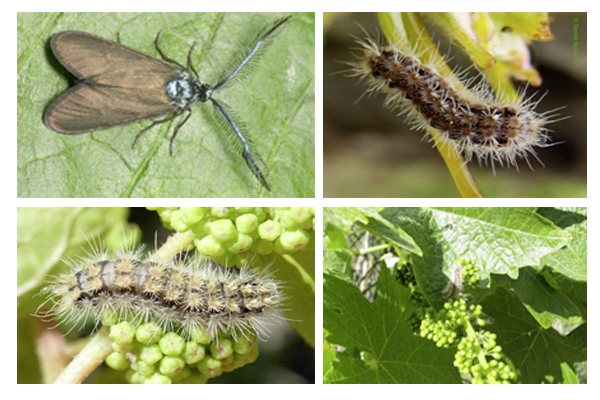
The forewings of the moth are bronze-greenish or bluish with a bronze sheen. The body is dark blue with a metallic sheen and about 12 mm long. The antennae of the male moths are very well developed, feathery, and those of the females are filiform. With wings spread, the moth is 20-25 mm long. The egg is elongated-oval with a sculptured chorion, pale yellow after oviposition and darkening later. Its length is 0.5-0.7 mm and its width 0.3-0.5 mm. The larva is light grey. The body is covered with densely arranged yellow and whitish hairs. On the dorsum there are 4 rows of brown warts with long orange hairs. The length of the larva is 15-20 mm. The pupa is light yellow, with yellow spots on each segment and enclosed in a loose white silken cocoon. A few days before moth emergence it turns yellow-brown to brown-grey. A characteristic feature of the larva is that in a resting state it is arched in a bow shape.
Biology, ecology and phenology
In Bulgaria the species develops 2 incomplete generations per year and overwinters as a larva in the second and more rarely in the third instar in a silken cocoon under the bark of the grapevine, in fallen leaves and other plant residues and in dry places. With an increase in air temperature to 10-14°C – usually towards the end of March – the first half of April and the beginning of bud swelling, the larvae begin to migrate to the buds. At temperatures above 18-20°C all larvae move to the buds in only 6-10 days, and at 12-16°C – in 12-20 days. When the vines are shaken, the larvae on the buds (those that have not yet bored in) fall onto the soil surface, assume a bow-shaped form and remain motionless. Depending on the area and under normal spring conditions, the larvae complete their development from the end of May to the second half of June. Under laboratory conditions the overwintered larvae develop in 37-50 days, on average 42-46 days (temperature 20±5°C), and under natural conditions in different agro-ecological regions of the country – from 49 to 62 days, on average 51-54 days. They pupate mainly in the soil and to a limited extent under the bark of the trunk and arms or in other protected places. Characteristically, in the soil under clods, in cracks or shallowly near the surface, the larvae pupate upright with the head upwards in a loose silken cocoon. Often mass pupation coincides with full flowering of the vines. The pupal stage lasts 4-17 days, on average 10 days under laboratory and 6-21 days under natural conditions. First-generation moths fly from mid and the second half of June, with a peak at the end of June – beginning of July and ending at the beginning of August. They are diurnal insects. They show highest activity (flight, feeding, copulation, oviposition, etc.) from 9:00 to 11:00 hours. The moths suck nectar from flowers of plants of the family Asteraceae, with a preference for Achillea millefolium. Pheromone communication between 21:00 and 23:00 hours is weakly expressed and is most active also between 9:00 and 11:00 hours in the morning. Attraction of males by females is possible in sunny, warm and calm weather. Bulgarian specialists, in co-authorship with Hungarian scientists, synthesized sex pheromones with very high specificity and attractiveness (Subcher, Harizanov, 1990). The moths copulate immediately after emergence, and oviposition begins 1-5 days after copulation. They lay the eggs on the underside of the leaves in groups of 171-443 per group. According to literature data, fecundity is higher and reaches 450-700 eggs. The moths live 4-20 days, on average 8-9 days. The egg stage lasts 5-14 days, on average 10 days. A few days after hatching, the larvae live gregariously on the underside of the leaves around the egg cluster. Then they move to medium-aged young leaves, several together or singly, or are dispersed by the wind to other vines. Up to the third instar they finely skeletonize the leaves by feeding on the lower epidermis and parenchyma; in the 4th and 5th instars they chew the leaf blade in the form of holes and along the margins, and in the 6th (last) instar they coarsely skeletonize the leaves, leaving only the main veins intact. Part of the larvae (up to 60% and more) develop to the second, more rarely to the third instar and enter diapause, in which they overwinter. The larvae that hatch latest enter diapause. The remaining part of the larvae develop in 33-80 days, on average 46 days, and pupate in the same places where the overwintering larvae pupate. As early as 1988-1989 it was established that from eggs laid by the end of June larvae hatch of which 41-44% enter diapause, and from eggs laid from 10 to 25 July up to 85% of the larvae enter diapause. The pupal stage lasts 6-15 days, on average 10 days. Second-generation moths fly from the second half of August to the beginning of October. Their behaviour is similar to that of the first generation, but they live for a shorter period – 3-11 days, on average 5-6 days. Oviposition begins in the second half of August and continues until the second half of September. One moth lays 149-364, on average 213 eggs. The egg stage lasts 7-16 days, on average 11 days. The larvae feed up to the second, third instar, move to the overwintering sites, spin a silken cocoon and overwinter in it.
Control
The eggs are highly parasitized by species of the genus Trichogramma, and the larvae – by the specific endoparasitoid Apanteles lacteicolor Vier (Harizanova, 1993). In addition, the eggs are eaten by lacewings, predatory bugs, predatory ladybirds and other predator species, and the larvae – by ground beetles, spiders, birds and others. In a wet and cool spring up to 90% or more become infected and die from nuclear polyhedrosis – general type.
By route, visual and shaking methods, the migration of overwintering larvae to the buds, their population density and health status are determined in April and May. Products are applied against the overwintered larvae when their numbers exceed the economic injury level: in wine grape varieties – before budburst – 1 larva per 1 vine; after budburst – 2 larvae per 1 vine. In table grape varieties – before budburst – 1 larva per 2 vines; after budburst – 1 larva per 1 vine. Decis 100 EC is applied – 0.04%, with a pre-harvest interval of 7 days, or other registered products during the period of migration of the overwintering larvae onto the buds and from bud to bud. Products used against the European grapevine moth and grape berry moths are also toxic to this pest.