

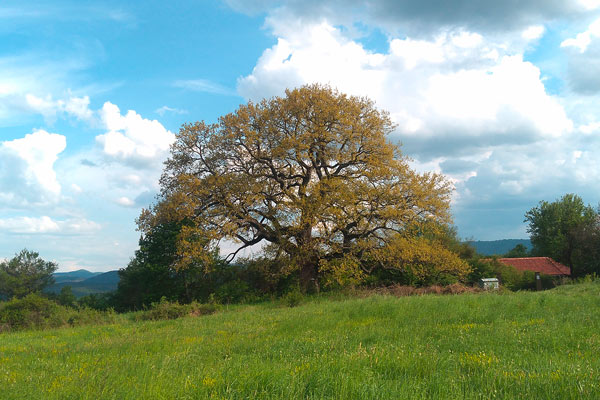
In the contest „European Tree of the Year” there is once again a participant from our country this year. The centuries-old Turkey oak from the village of Rani lug is Bulgaria’s nomination for the „European Tree of the Year” competition, which has been held since 2011. Voting will take place from 1 February to 28 February 2019. The results will be announced at the award ceremony for the winners of the competition, which will be held in Brussels on 19 March 2019.
The Turkey oak by the village of the marshes – Bulgaria’s nomination in the „European Tree of the Year” 2019 competition
The impressive Turkey oak* rises not far from the church of “St. Nicholas”. It is the pride of the local people and creates an incredible atmosphere by the church, which dates back to the 15th century. The first monastery school in the village was founded there in 1859. The Tran region is known for having preserved many old names of its settlements. “Rani lug” is one of them – “lug” means „marsh; lye“ and tells us more about the characteristic areas in the surroundings at the time when the village was founded and named.
The „European Tree of the Year” competition
The purpose of the competition is to draw attention to interesting old trees as a significant natural and cultural asset that we must value and preserve. Unlike other competitions, for the „European Tree of the Year“ beauty, size or age are not important, but rather the story and the connection with people. The aim is to find trees that have become part of the community. The organisers believe that the issue of protecting trees as bearers of the local spirit needs to become the subject of an international debate.
The „European Tree of the Year“ competition was first organised in 2011 as a continuation of the popular „Tree of the Year“ contest, which has been held in the Czech Republic by the „Partnership“ foundation for many years. The European competition is the final round of the contest, in which the winners of the national competitions participate.
Voting
Online voting continues until midnight on 28 February, and the winner will be announced at an official ceremony in Brussels on 19 March. The competition features 15 trees from 16 different countries. During the last week (from 22 to 28 February) the voting will be hidden and the results will not be visible on the web pages. In order to avoid a purely national element, participants in the voting must choose two entries – in addition to their native tree, they may also cast their vote for another one of their choice.
Bulgaria is taking part for the fourth time with the centuries-old Turkey oak from the village of Rani lug in the „European Tree of the Year“ contest. In 2014 the Old Elm in Sliven became the winner in the competition.
You can vote for the „European Tree of the Year 2019” HERE
*The Turkey oak (Quercus cerris) is a broadleaved deciduous tree with a strongly developed root system that penetrates deep into the ground. The Turkey oak is relatively undemanding with regard to environmental conditions, tolerating both high and low temperatures. Under extremely low temperatures, however, the cold may cause it "frost cracks" – freezing of the water in the tissues and the formation of cracks in the stem, through which pathogenic organisms then penetrate. It grows on almost any type of soil, but develops best on grey forest soils and cinnamon-coloured forest soils. The Turkey oak is a drought-tolerant species and thrives well in drier and warmer conditions.
The Turkey oak reaches a height of up to 30 – 35 metres. Its bark, grey in colour, is recognisable by its noticeably coarser furrowing (compared with Quercus robur, for example). The leaves of the Turkey oak are simple and elongated, divided into 6 – 12 lateral lobes.