

![MultipartFile resource [file_data]](/assets/img/articles/weihnachsstern-2021.jpg)
The Christmas star or Bethlehem star is called so not only because it blooms at Christmas, but also because its bracts form the shape of a star. The homeland of this remarkable flower is the tropical regions of Mexico and Guatemala, but the plant gained its true fame in America and Western Europe, where it has become a symbol of the Christmas holidays.*
One of the sure signs that Christmas is approaching is the appearance of the poinsettia (Euphorbia pulcherrima) in all flower shops, homes and city decorations. And although the tropical regions of Mexico and Guatemala are considered the homeland of the plant, the flower with the crimson leaves has become a traditional Christmas symbol in America, Western Europe, and for several years now also in Bulgaria. The poinsettia, as the commercial name of the plant is, blooms at Christmas time and its bracts form the shape of a star. This is why it is called the Christmas star, as well as the Bethlehem star. The flower is so popular that it even has its own day named after it. Thus, on 12 December every year, the World Poinsettia Day is celebrated.
Description
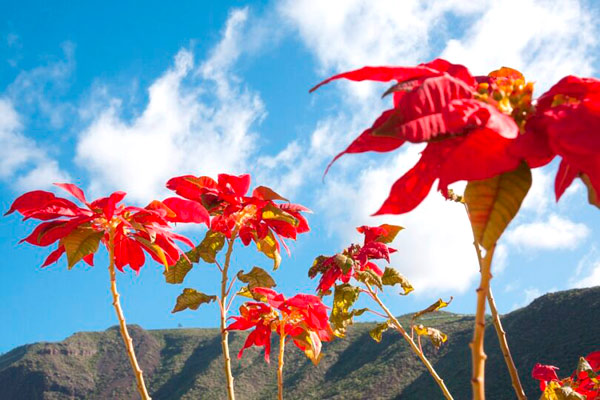
In its wild state, the poinsettia is an evergreen shrub with a height of up to 3–4 m, unlike the ornamental indoor hybrids, which reach a height of only 30–40 cm.
Its leaves are elliptical with clearly defined veins and long petioles. At the tops of the stems the leaves change and form a rosette, which turns red and resembles a “star”.
The actual flower consists of several small florets located in the centre of the coloured rosette. It belongs to the family Euphorbiaceae.
The first plants were brought to Europe in 1843 in a pot, with a stem only 40 cm high. As an ornamental pot plant it was bred for the first time in America and since then has become popular throughout the Western world.
Floricultural business
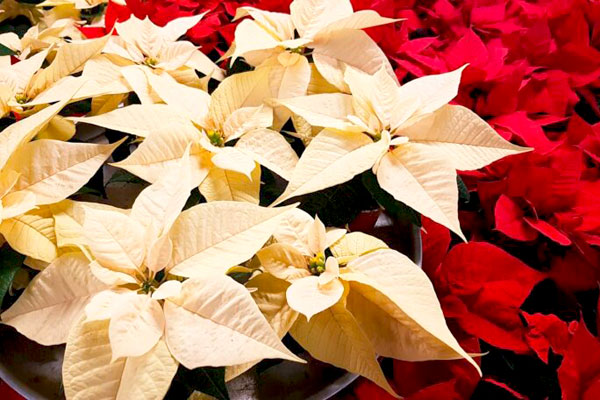
Due to the great interest and demand, floriculture companies in the USA, the Netherlands and Germany are constantly working on new selections. In addition to the classic reds in their various shades, poinsettias with white, yellow, pink and marbled colours are also offered on the market.
One of the three largest producers of poinsettia is Syngentaflowers. It offers more than 30 different poinsettia hybrids on the market. Approximately 20% of the total market for the plant in America and Europe is accounted for by the global agro-concern.
The major breakthrough on the European floriculture market for Syngentaflowers came in 2008, when Josef Fischer joined the company. Father and son Fischer were the first to start offering Pelargonium cultivars resistant to bacterial blight caused by Xanthomonas, as well as the well-known hybrid Tango poinsettia (Poinsettia). Josef Fischer is one of the first in the floriculture industry to relocate mass production of garden and indoor flowers as early as the beginning of the 1970s to the Canary Islands because of the favourable climate there.
For several years now, Syngentaflowers has been working mainly on offering hybrids that require a lower growing temperature in order to save costs. This also affects growing in household conditions. Traditionally, the growing temperature for poinsettia is about 21°C to 24°C, but there are also hybrids on the market that are grown at 18°C.
Cultivation
The poinsettia is an exceptionally beautiful but demanding flower to grow. The most common cultivars in household conditions are Freedom, Cortez, Star and Lilo and their various colour forms. In recent years, the cultivar Millennium has also gained popularity – with large red flowers, also bred by Fischer.
The poinsettia develops foliage in summer, when the day is long, and begins to bloom in winter (December–February), when the day is shorter. The plant needs sufficient light and temperatures of 17–21°C at night and 20–24°C during the day. Direct sunlight in the room, draughts or proximity to heating appliances should be avoided.
Diseases and pests
The poinsettia is attacked by many pests. Its leaves have a delicate epidermis and often fall victim to greenhouse whitefly and aphids. In controlling whitefly, at least three plant protection products with active substances from different groups should be used, as recommended by plant protection specialists. There is no universal product for treatment, because the whitefly changes very quickly, its life cycle is 7 days and within a short period it can destroy the plant.
The plant is also very susceptible to root diseases – fungal and bacterial infections, and therefore it is advisable that the soil used should be as clean as possible. If there are infections in the soil, the roots of the flower quickly rot and its leaves dry out. The reason for this is the inability of the roots to absorb water properly.
Treatment involves very quickly removing the plant, cutting off the diseased parts of the roots and treating with a fungicide. Then the pot with the poinsettia can be placed in a warm and shady place and a polyethylene cover can be made to reduce evaporation, because otherwise the plant may lose its leaves.
Christmas legend
The crimson flower originally comes from Central and South America and was already popular with the Aztecs from the 14th to the 16th century. The wild-growing form of the plant was used by them not only as an ornament, but also as a medicinal plant and dye. Many legends surround the “Star of the Aztecs”, such as that it was the favourite flower of the Aztec ruler Montezuma. He believed that the upper leaves of the plant had been moistened by drops of blood from a local goddess who died of a broken heart, hence the red colour of the upper leaves. The poinsettia was brought to Europe at the beginning of the 18th century by the explorer Alexander von Humboldt.
The appearance of the flower in the land of the Aztecs is associated with a beautiful Christmas legend. On Christmas Eve a poor girl very much wanted to leave some kind of gift in front of a statue of Jesus Christ in a small Mexican town, but she had nothing to give. “Jesus will accept any gift as long as it is from the heart,” her father comforted her. Then the girl picked dry flowers from the field and placed them prayerfully before the statue of the Saviour, and on Christmas Eve the dry bouquet blossomed into large scarlet flowers.
* The article was updated on 17.12.2024.