

Candidatus Liberibacter solanacerum (=Liberibacter solanacearum) Liefting, Perez-Egusquiza & Clover
The North American bacterium Candidatus Liberibacter solanacearum ("Ca. L. solanacearum") mainly attacks species of the family Solanaceae, such as potatoes and tomatoes, the damage to which reduces yields and lowers the quality of fruits and tubers. Due to the deterioration of the taste and commercial appearance of tubers (Munyaneza 2012) intended for chips, losses for the potato industry in New Zealand (2008–2010) amount to 57 million euro, which increase by 400–680 euro per ha annually. In North America and New Zealand the bacterium causes damage both under greenhouse and field conditions.
In Europe, the countries of the Mediterranean basin are at risk. There are reports of the bacterium being detected on carrots in Finland, Germany, France, Austria, Norway, Sweden, Belgium, Estonia and Spain. In Spain it has been confirmed on celery (2014) and on potatoes (for the first time in 2016). Being transmitted by vectors – the species Bactericera cockerelli (the pest is included in Annex No 1, Part A, Chapter I of Ordinance No 8 of 27.02.2015 on Phytosanitary Control) and Trioza apicalis, there is a serious risk of its wide spread also in Europe.
The bacterium has the status of a quarantine pest, included in list A1 (2012) (species that are absent from the region) of the European and Mediterranean Plant Protection Organization (EPPO).
Hosts
Primary hosts are potatoes (Solanum tuberosum), tomatoes (Solanum lycopersicon), eggplant (Solanum melongena), sweet pepper (Capsicum annum), chili (Capsicum frutescens), secondary hosts are carrots (Daucus carota), parsnip (Pastinaca sativa), celery (Apium graveolens), celeriac and some weed species such as Solanum dulcamara, S. eleagnifolium, S. americanum, Lycium barbarum.
Geographical distribution
Europe: Belgium, Estonia, Finland, Germany, United Kingdom, Italy, Norway, Greece, Spain, Portugal and Sweden.
North America: Mexico, USA – Arizona, California, Colorado, Kansas, Nebraska, Nevada, New Mexico, Oregon, Texas and Washington.
Central America: Guatemala, Honduras, Nicaragua.
Africa: Morocco
Asia: Israel
Oceania: New Zealand.
Pathways of spread
The bacterium is transmitted with infected plants for planting from the family Solanaceae, tubers – potatoes, root crops and seeds of carrots (Bertolini et al., 2014) and celery.
From infected to healthy plants during the growing season, "Ca. L. solanacearum" spreads in potatoes mainly through the vector potato psyllid Bactericera cockerelli (Munyaneza et al., 2007; Munyaneza, 2012; EPPO, 2013), and in carrots and celery respectively through the vectors Trioza apicalis (Nissinen et al., 2014) and Bactericera trigonica (Teresani et al., 2014; Teresani et al., 2015).
The bacterium can also be transmitted by grafting and can be preserved in weed vegetation, e.g. dodder (Crosslin & Munyaneza, 2009; Secor et al., 2009; Munyaneza, 2012; Haapalainen, 2014; Munyaneza, 2015).
The main pathways of spread are: fruits from the family Solanaceae: tomato, pepper, eggplant, tamarillo, cape gooseberry in the presence of green mass; plants for planting from the family Solanaceae (except seeds); seed potatoes (including microplants and microtubers), and secondary are: plants for planting, such as mint (Mentha spp.), Micromeria chamissonis, , Nepeta sp. and sweet potato (Ipomoea batatas); wild hosts (weeds), which accompany pots and containers; and others on which the vector occurs but does not reproduce, including lettuce, sunflower, pea, bean, vetch, sugar beet, turnip and others.
Symptoms
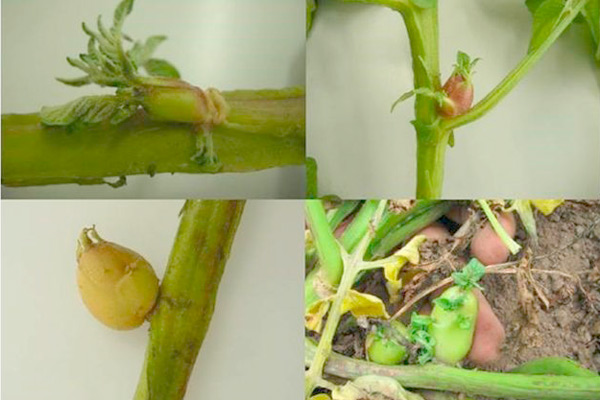
On the above-ground plant parts of potatoes and other species of Solanaceae the symptoms resemble those caused by phytoplasmas – stunting and reduction of leaf mass, chlorosis and anthocyanin coloration of leaves, shortening and thickening of internodes, formation of leaf rosettes and aerial tubers. This is followed by necrosis of the shoot tips and early leaf fall. The fruits are small and of poor quality. In tubers the bacterium causes the conversion of starch into sugar, which caramelizes during frying and leads to dark brown discoloration (“zebra chips”).
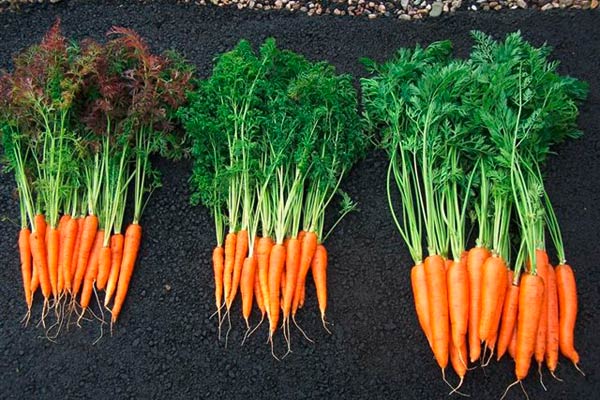
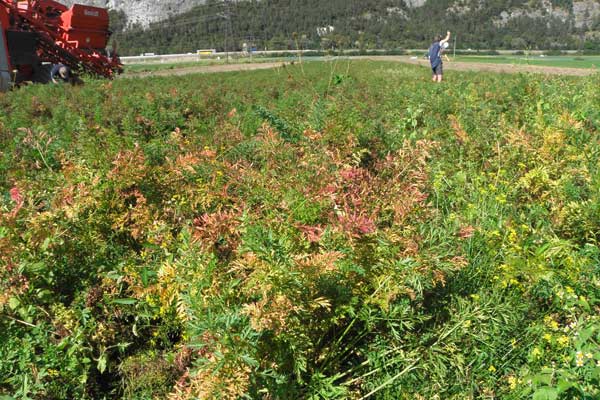
In tomato and pepper apical growth of shoots and leaves, chlorotic and curled leaves, shortened internodes, subsequent necrosis of the shoot tip and formation of small and deformed fruits are observed. On carrots and celery yellowish, bronze or violet coloration of leaves, stunting and proliferation of roots are observed.
Inspections, sampling and diagnostics.
Visual inspections in carrot crops are carried out only after the complete formation of the above-ground part of the plants. Symptomatic plants are uprooted whole (above-ground part and root crop) and sent for analysis. For potatoes, analysis is carried out only on tubers.
Suspect samples are tested for the presence of infection by the pathogen under laboratory conditions using molecular tests.
Control measures
- Use of healthy seed and planting material.
- Prohibition of imports of seed potatoes from Third countries.
- Prevention of the multiplication and spread of vectors by means of yellow sticky traps and insecticidal treatments.
- Destruction of infected plants at the site of infection.
In case of suspected occurrence of such a disease, contact plant protection specialists at the Regional Food Safety Directorates.
In preparing this material, information from EPPO was used