

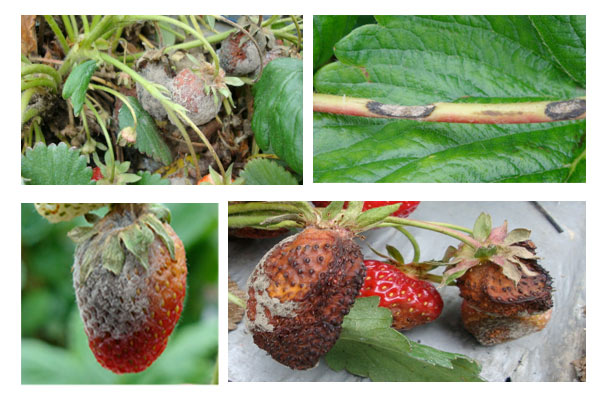
Strawberry exhibits sensitivity to various groups of diseases, and under the conditions in Bulgaria those of fungal nature are of primary importance. Under climatic conditions favourable for their development and in the presence of shortcomings in plant protection, fungal pathogens may prove to be an important limiting factor for future production. Statistics show that the rainiest period of the year coincides with the stage of the host that is highly susceptible to them – fruit ripening. Under these circumstances, all unilateral or “fire-fighting” decisions for crop protection are doomed to almost certain failure. The answer to template questions such as “What should I spray with?” is far from sufficient to achieve good results; it is essential to know the diseases in detail and in depth. A good grower must necessarily be familiar with the symptoms, biology and favourable conditions for the development of the main pathogens in strawberry.
Grey mould (Botrytis fruit rot) is the most dangerous disease of strawberry. All cultivars in practice exhibit sensitivity to the pathogen; under conditions favourable for the disease, control is extremely difficult and losses may encompass the entire production.
Damage is observed in the form of soft, light brown rot, located at the calyx end or in the contact zone between an infected and a healthy fruit. In denser beds, similar symptoms are observed at the base of leaf petioles or flower stalks; they bend downwards and dry out. Less frequently, necrosis is observed on the petals of the flowers, resembling damage from late spring frost. In wet weather, all affected parts are covered with abundant grey mould consisting of mycelium and spores of the fungus.
Initial infections of grey mould may occur early in the spring at the base of young and still tender leaf petioles and peduncles; dense beds contribute to more severe infection. The most important infections for the development of the fungus on the fruits take place during flowering; after this phase it passes into a latent and inactive form until the beginning of sugar accumulation in the fruits. In reality, grey mould is not a particularly aggressive parasite and after flowering it can infect only in cases of contact between infected and healthy fruit or in the presence of mechanical injuries that serve as an “entry point” for the spores and mycelium of the fungus.
As already mentioned, fully resistant cultivars to grey mould do not exist; nevertheless, differences in their reaction are observed. Popular cultivars such as Senga Sengana are known for their excellent processing qualities, but also for their strong susceptibility to grey mould. Slightly higher levels of resistance are observed in some cultivars with firmer consistency such as Onda, Alba and Albion, but under heavy rainfall none of them can be protected if special measures are not taken. Sanitary measures, such as removal of all infected fruits and residues from the field at short intervals together with harvesting, are extremely important and in some cases more effective than chemical control. Growing on polyethylene mulch and well-shaped raised beds is a standard measure for control of both weeds and strawberry diseases. At present, only two typical fungicides are registered in our country and, according to our data, effective against grey mould – Switch WG and Cantus. All field trials with strawberries carried out in recent years at the Agricultural University in Plovdiv have shown unsatisfactory efficacy of products with the active substance methyl thiophanate or those from the strobilurin group. Grey mould is a pathogen with high reproductive potential and the ability to rapidly develop resistance to chemical agents; therefore, it is imperative to take all preventive measures to avoid this. It is recommended to alternate fungicides with different modes of action on the fungus, and one and the same fungicide should not be applied more than twice during a single vegetation period. It is very important not to allow high infection pressure by implementing a complex of control measures.
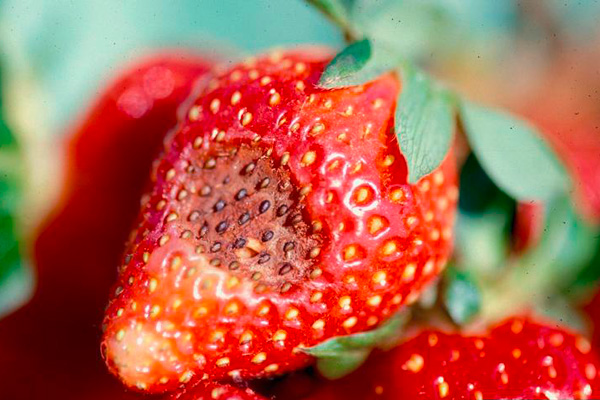
Anthracnose is still insufficiently well known to growers. The first symptoms can be found on vegetative parts (leaf petioles, peduncles, runners) even before flowering, in the form of small, light brown spots without a well-defined margin. These necrotic spots gradually elongate and form the typical for anthracnose dry, black (charcoal-like), elliptical and slightly sunken lesions with clearly defined borders. Subsequently, they may become lighter in the centre, encircle the affected organ in a ring-like manner and interrupt its nutrition, causing wilting or breaking. A distinguishing feature of anthracnose compared to other diseases is the formation of whitish to black, dot-like acervuli on the surface of the affected plant organs. In wet weather, a pink to orange sticky exudate with spores oozes from the acervuli, which dries into a crust when temperatures rise. The most important and easily detectable are the damages on the fruits. The first lesions are observed on still unripe fruits, where single or grouped, rounded, small (1–3 mm), dark brown to black, slightly sunken spots develop. As the strawberries ripen, the spots retain their shape and colour, but increase in size, reaching 10–15 mm. Single spots resemble a depression caused by pressure with a thumb, and after coalescence they may cover a larger part of the fruit, causing its overall deformation. Eventually, the fruits blacken and mummify, remaining attached to the drying fruiting branches. A characteristic feature of the spots is that they form relatively quickly; in some cases, apparently healthy fruits may be harvested, but after one night or day a large number of black spots may appear as a result of infections that occurred earlier in the field.
Biology and development. Anthracnose survives in plant residues for up to one year or in overwintering perennial plants; long-distance spread is mainly through planting material or spores carried on packaging, clothes and workers’ hands. Within the plantation, the infection may spread over a distance of 1 to 3 metres by rain. In protected cultivation structures, plants are protected from the spread of infection by rain droplets. It is possible that anthracnose is transmitted and develops asymptomatically on the main host, as well as on other cultivated and weed plants. Before infecting, spores are able to germinate and produce new daughter microspores, and the infection pressure can increase in a short time; this is one of the reasons for the “explosive nature” of anthracnose outbreaks. Warm and humid weather (t > 20o C and 12 hours of leaf wetness) favours the development of the disease from a climatic point of view, while from a phenological point of view the most susceptible are ripening fruits, young runners, leaf petioles and peduncles. In principle, everbearing strawberries are more vulnerable due to the accumulation of infection during prolonged fruiting. When there is sufficient rainfall, high temperatures are not a limiting factor for anthracnose and it is a potential problem throughout the vegetation period, whereas grey mould is encountered mainly in spring and autumn.
The resistance of popular commercial strawberry cultivars is not a sufficient guarantee for protection against the disease; nevertheless, trials and observations in the country show differences between individual cultivars in this respect. Certain resistance of the fruits has been established in Senga Sengana, Idea, Tetis, Onda and Honeoye; they are highly susceptible in Marmolada, Ciabella, Elsanta, Camarosa, Patty, Queen Elisa, Albion. In some cultivars, lower levels of infection are observed on the vegetative parts; examples in this respect are Maja, Senga Sengana and Albion.
Planting healthy planting material is of primary importance for anthracnose control. It is entirely possible that symptoms are not detected while the infection is present; therefore, good practices in the nursery are the main guarantee for the phytosanitary status of the plants. Measures for disinfection of the seedlings have a partial effect on the final result. Removal of infected fruits from the field and their destruction are extremely important measures.
Chemical control of anthracnose is difficult due to the limited range of fungicides with proven efficacy. In recent years, a number of field trials with fungicides have been carried out at the Agricultural University in Plovdiv; they have demonstrated good to very good efficacy against the disease of the chemical products Switch WG and Cabrio Top. Flint Max, Captan and Banko have shown weak to satisfactory efficacy. Growers, however, should not rely on Quadris, Cantus, Chorus and fungicides based on methyl thiophanate when controlling anthracnose in strawberry. Chemical treatments prior to flowering can be omitted due to the limited number and very high cost of fungicides; control usually starts at flowering and continues depending on the pre-harvest intervals, residual activity of the products and the risk of infection. Flowering sprays with Switch WG may have excellent efficacy also against grey mould; Cabrio Top is more suitable after this period, since it acts only on anthracnose and after flowering the risk of grey mould infection decreases. The quality of treatment is extremely important; the two mentioned products show good effect if applied immediately after rain when a new infection has occurred. In some countries worldwide, a forecasting model is successfully used for anthracnose control; its application requires a meteorological station and field climate data.
Leaf spot (white leaf spot) is a widespread disease; it appears annually in our country, often on a mass scale, but is less dangerous than anthracnose and grey mould. It attacks mainly the vegetative parts and very rarely the fruits.
The initial symptoms appear as small purple-red spots on young leaves; subsequently the spots enlarge, their centre becomes necrotic and may even fall out of the leaf blade, while a clearly expressed red halo forms at the periphery. Under severe infection, the leaves scorch, the plants are weakened and this has a negative effect on the subsequent yield. Similar spots are found on sepals, leaf petioles and peduncles, and more rarely on the fruits.
Cultivar resistance varies greatly, and correct cultivar choice may prove to be a reliable means of control; highly susceptible cultivars are Belrubi, Idea and others. Preventive measures, including mowing and removal of leaves after harvest and planting healthy planting material, are of great importance. According to literature data, there are many fungicides with high efficacy against the pathogen; trials in Bulgaria have shown excellent efficacy of Score EC, Impact SC and Mirage EC. Unsatisfactory efficacy has been demonstrated by Switch WG and Banko, which are used for control of other diseases.
Powdery mildew occurs mainly in strawberries grown under greenhouse conditions or in the field in micro-regions with high atmospheric humidity and highly susceptible cultivars. Infected leaves curl upwards “like a small boat” and are covered mainly on the lower surface with white powdery mycelium. As the disease develops, the leaves scorch and acquire a red-purple hue. Similar manifestations occur on the flowers. The fruits become hard, covered with mycelium and have no market value.
The causal agent of the disease survives as mycelium in the buds; in recent years it has been proven that overwintering fruiting bodies, called cleistothecia, are also formed. Mass spread of the fungus occurs via summer spores, which can be carried by wind over long distances. In the presence of moderate atmospheric humidity (rain is not required!) and suitable temperature, the spores successfully infect. Of interest are new studies abroad, according to which young leaves and fruits progressively increase their resistance to powdery mildew. In leaves, the susceptible phase lasts until the leaf blade is fully expanded, while in fruits the fungus attacks during flowering and at fruit size up to that of a fingernail. After the fruit clears in colour, the risk of infection is minimal and shortly after that it no longer exists. The acquisition of so-called “age-related resistance” is a phenomenon known also in other crops such as grapevine, and it can be used to develop appropriate strategies for control of the causal agent of the disease.
In standard control schemes, the use of fungicides against powdery mildew under field conditions is not mandatory. Cultivars with higher susceptibility to the disease, such as the cultivar Alba, which has become popular in our country, in combination with a suitable microclimate may be at risk and need to be treated with fungicides. A characteristic feature of the pathogen is that it can infect about 4 weeks before visible symptoms are established; therefore, effective control includes early treatments from the beginning of vegetation. Delayed control after the appearance of the first symptoms can only slow down the development of the disease for a certain period of time and increase the risk of resistance development to systemic products. The first treatments may be carried out with fungicides based on sulphur, which in principle has slightly weaker activity than some systemic products, but resistance of the fungus to sulphur has not yet been established anywhere in the world. However, sulphur should not be applied during flowering in order to avoid damage. The risk of severe fruit infection is greatest during flowering and the appearance of young green fruits, which necessitates the application of the most reliable systemic fungicides during this period. In the “colour clearing” stage of the fruit, treatment is inappropriate in view of the age-related resistance acquired after this stage and the approaching harvest. The last sprays should be carried out with products having longer residual activity and suitable pre-harvest interval. Under favourable conditions, after fruit harvest and possible mowing of the leaves, control continues. The risk of powdery mildew always exists and is usually higher during cooling and strong secondary growth in autumn.
Verticillium wilt is a highly harmful disease with the potential to destroy a large part of the plantation. Its occurrence is difficult to predict; improperly applied irrigation practices and fertilisation may additionally provoke the disease. Plants are most severely attacked in the first year of their development; the first symptoms can be established immediately after planting, but more often they appear during periods of peak stress such as fruiting. The symptom complex includes necrosis at the leaf margins and in the interveinal areas, after which the leaves completely dry out. The inner leaves remain green and fresh until the plant dies. By this feature, the disease differs from Phytophthora crown rot, in which all leaves die simultaneously. In cultivars with strong runner formation capacity, death of the main crown may be observed, but visually healthy new crowns may form and bear fruit in the following season. When the stem or root is cut, darkening of part of the outer vascular tissues is observed.
Biology and development. The disease is preserved as infection in overwintering plants, plant residues or resistant structures – sclerotia, which can survive in the soil for 4–5 years.
Hosts of Verticillium wilt are crops such as tomato, pepper, potato, alfalfa and others; all of them should be avoided as preceding crops. Nitrogen fertilisation should be balanced and slightly reduced when symptoms occur. Planting healthy seedlings is absolutely necessary, but unfortunately, in recent years observations have shown that even imports from licensed nurseries in Europe are not free from infection. In countries with intensive strawberry production and lack of areas free from infection, intensive work is being carried out to create cultivars resistant to Verticillium wilt. Successful breeding results in this respect are the cultivars Albion, Idea, Senga Sengana and others. Chemical control against the disease has unproven efficacy and high cost.
Phytophthora crown and root rot. The disease is very dangerous in the presence of infection and highly susceptible cultivars. Infected plants may develop throughout the plantation, but usually those with aboveground symptoms occur in patches located in areas with waterlogged soil. Plants with severely rotted roots often stop growing and wilt in hot weather. In some cases, young leaves turn blue-green, while older ones acquire a reddish or yellowish tint. Affected strawberry plants form few fruits and runners and eventually die. Those with less pronounced root damage may not develop symptoms above the soil surface. Young roots rot from the tip towards the crown; lateral roots may detach and in this way the root resembles a “rat’s tail”. A characteristic feature is also the reddening of the central cylinder of the root and crown.
Biology and development. Infection may be introduced into the field by diseased, often asymptomatic planting material. Some plant species such as raspberry can also contaminate the soil. Transfer of such soil during tillage or with planting material, as well as by surface water, represents an additional source of infection. Once established, the fungus survives as persistent structures called oospores or as mycelium in plant residues. Favourable conditions for the development of the pathogen are created under soil waterlogging, when infectious zoospores are released.
It is necessary to plant healthy planting material and maintain soil free from infection, and to avoid, as far as possible, highly susceptible cultivars such as Elsanta and others. Abroad, disinfection of seedlings, treatments via drip irrigation or overhead application are recommended; the active substances metalaxyl and aluminium fosetyl are mentioned, but data for strawberry in Bulgaria are lacking.