

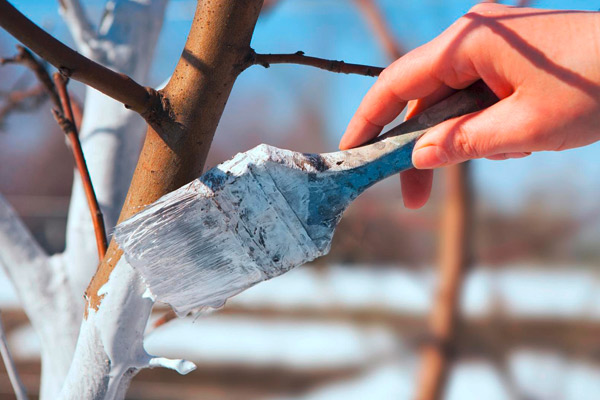
In February–March, attention should be intensified towards protecting the trunks and main scaffold branches from sunscald, because the sun’s rays begin to become increasingly stronger. This sunscald represents damage to the bark. Initially, it appears as a longitudinal strip with a changed colour, gradually becomes sunken, then cracks and a canker is formed, which is the result of the large difference in the heating of the outer and inner layers of the trunk. This difference also occurs as a consequence of the sharp temperature fluctuations during the day. After repeated exposure, numerous cankers develop, after which the bark separates and the so‑called “bark peeling” occurs in pome fruit species.
To protect the trees from the adverse effects of the sun’s rays during the late winter season, it is necessary to spray the trunks with 2.5% limewash already in autumn or during winter. This treatment may be repeated again in early spring.
After a warming period at the end of winter, freezing of the buds of the trees is often observed. Frozen vegetative and flower buds turn black and do not develop; it is also possible for the pistils to be partially frozen, because flower buds are more sensitive. Cherry, peach, apple, and pear are particularly vulnerable to cold. In peach, the freezing of the buds also affects the area around them, where resin is exuded and tumours are formed. All frozen parts must be removed from the trees in a timely manner, and the wounds should be coated with oil‑based paint. Whitewashing of the trees also has a beneficial effect in protecting them from spring frost damage.