

The second month of the year is the month of seedlings. Their protection from diseases and pests is an important element of the vegetable growing technology. The type and quality of the seedlings we produce determine what kind and how many vegetables we will harvest.
Good Agricultural Practices (GAP) aim at the production of healthy seedlings with high quality indicators, without risk of soil and water contamination, which ensure a good start. Planting such seedlings saves at least one treatment with plant protection products (PPP) after transplanting to a permanent place. Therefore, the production of healthy, pest-free and hardened seedlings is of primary importance.
GAP do not allow seedling production to be carried out in greenhouses together with the previous crop. The requirements of plants regarding environmental conditions are different. The risk of pathogens and pests passing from the old to the seedling plants is very high. Therefore, seedling production must be carried out in a specialized isolated seedling compartment, in which conditions are created corresponding to the biological requirements of the young plants – light, temperature, moisture, and compliance with phytosanitary requirements. Seedling premises are cleaned of plant residues from the previous vegetation, as well as weeds and volunteers. If seedlings are grown in trays, flats or pots and these are placed directly on the soil, the surface must be well leveled. A polyethylene film is laid on it, which isolates the seedling containers from the soil and does not allow the passage of pathogens and pests.
Diseases in seedling production
Tomato seedlings may be affected by damping-off, late blight, early blight, leaf mold and gray mold. Cucumber seedlings may be attacked by powdery mildew and downy mildew. Pepper seedlings are most often attacked by early blight.
Damping-off of seedlings
It occurs in all vegetable crops grown from seedlings – tomato, pepper, cucumber, eggplant, lettuce, etc. It develops year-round in the production of seedlings for various production purposes. It appears when the conditions for plant development are unfavorable – low air and soil temperatures, waterlogging, excessive nitrogen fertilization, etc. Pathogens can affect already swollen seeds and cause their rotting. Sometimes they attack very young, not yet emerged sprouts, which die very quickly. Since these processes take place in the soil, the damage cannot be observed. Seedlings that emerge under such conditions are poorly established. It is caused by fungi of the genera Pythium, Phytophthora, Fusarium, Pyrenochaeta lycopersici and Colletotrichum atramentarium, which have different temperature requirements.
Upon occurrence, the first diseased plants are removed and destroyed outside the seedling compartment; patches with diseased plants are drenched with a 2% solution of copper sulfate or ammonium nitrate – 3-4 l/m2; the remaining plants are watered with a mixture of 0.1% Topsin M WP + 0.1% Propamocarb 722 SL (20-50 ml/plant depending on the growth stage).
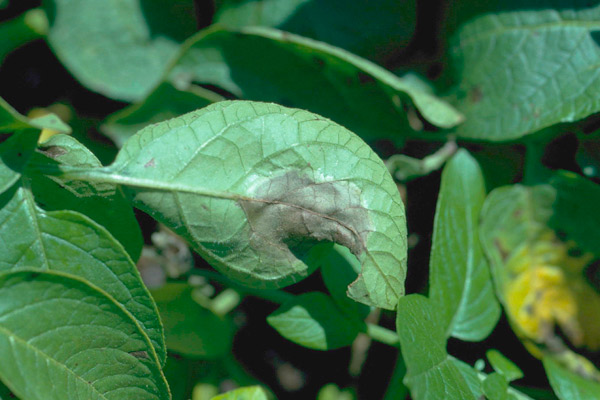
Late blight (Phytophthora infestans)
There is a risk of attack by this disease in the presence of high air humidity. Symptoms are watery spots of irregular shape on the oldest leaves, covered on the underside with a sparse whitish growth – the sporulation of the fungus. Later they turn brown and dry out. In case of severe attack, the entire leaf mass may die. The spots on the petioles are dry, dark brown, and on the stem – large and watery, encircling it completely. At high air humidity, a sparse whitish sporulation appears on them.
Registered plant protection products (PPP): Acrobat R – 0.25%; Acrobat Plus WG – 200 g/ha; Valbon – 180-200 g/ha; Verita WG – 0.15%; Vincare WG – 200 g/ha; Vitene Triplo R – 400-450 g/ha; Dithane DG – 200 g/ha; Dithane M-45 – 200 g/ha; Equation Pro – 0.04%; Karyol Star – 60 ml/ha; Consento SC – 200 ml/ha; Corsate M DF – 0.25%; Quadris 25 SC – 0.075%; Cupertine M – 400 g/ha; Cuproxat FL – 0.3%; Lieto – 40-45 g/ha; Mancozeb 80 WP – 0.25%; Manfil 75 WG – 210 g/ha; Copper oxychloride 50 WP – 0.25%; Melody Compact 49 WG – 185 g/ha; Orvego – 70 ml/ha; Pencozeb 80 WP – 200 g/ha; Pencozeb 75 WG – 210 g/ha; Pergado Cu 27 WG – 500 g/ha; Polyram DF – 0.2%; Proxanil – 250 g/ha; Revus 250 SC – 0.05%; Ridomil Gold MZ 68 WG – 250 g/ha; Ridomil Gold R WG – 500 g/ha; Sankozeb 80 WP – 200 g/ha; Sinstar – 70-80 ml/ha; Sphinx Extra – 180 g/ha; Funguran OH 50 WP – 0.15%; Champion WP – 0.15%.
Early blight (Alternaria porri f. sp. solani)
Attack by this pathogen occurs in the presence of high air humidity. On the leaves of tomato and pepper small watery spots appear, reaching 5-7 mm in diameter. Later they dry out, become dark brown to black with a concentric structure, merge and the leaf scorches. The spots on the stem and petioles are similar, with the characteristic concentric structure. At high relative air humidity, the affected areas are covered with a black coating from the sporulation of the fungus.
Registered PPP: Acrobat Plus WG – 200 g/ha; Antracol 70 WG – 0.15%; Vitene Triplo R – 400-450 g/ha; Dithane DG – 200 g/ha; Dithane M-45 – 200 g/ha; Karyol Star – 60 ml/ha; Consento SC – 200 ml/ha; Corsate M DF – 0.25%; Quadris 25 SC – 0.075%; Ortiva Top SC – 100 ml/ha; Pencozeb 80 WP – 200 g/ha; Pencozeb 75 WG – 210 g/ha; Polyram DF – 0.2%; Ridomil Gold MZ 68 WG – 250 g/ha; Sankozeb 80 WP – 200 g/ha; Sinstar – 70-80 ml/ha; Score 250 EC – 0.04%; Cidely Top – 100 ml/ha
Leaf mold (Fulvia fulva)
On the upper side of the leaves relatively large, light spots appear with irregular shape and indistinct margins. Later they turn yellow. At high air humidity, their lower surface is covered with a light coating of the sporulation of the fungus, which later darkens and becomes velvety brown. When the number of spots on one leaf is significant, they merge and the leaf scorches. Under favorable conditions, the plants may become defoliated. The disease develops at high air humidity.
Registered PPP: Signum – 100-150 g/ha; Sinstar – 70-80 ml/ha; Cidely Top – 100 ml/ha.
Gray (Botrytis) rot (Botrytis cinerea)
It attacks plants in all stages of their development. On the petioles and tips of the leaf blades, light brown elongated spots appear. At high air humidity, the spots are covered with abundant gray-brown mycelium and sporulation of the fungus. A favorable environment for the development of the disease is high air humidity.
Registered PPP: Arvax 50 WG – 150-200 g/ha; Driza WG – 150 g/ha; Prolectus WG – 120 g/ha; Rebut WG – 150-200 g/ha; Signum – 100-150 g/ha; Fontelis SC – 240 ml/ha.
Downy mildew (Pseudoperonospora cubensis)
This disease is of great importance in cucumber growing throughout the entire vegetation period. On the upper side of the leaves, yellowish spots appear with irregular shape, limited by the veins. In wet weather they are watery, and their lower surface is covered with a sparse gray-violet coating of the sporulation of the fungus. Later the spots enlarge, merge and the entire leaf scorches. At high air humidity in the seedling compartment, the disease can cover the entire plant in a short time and severely reduce the yield.
Registered PPP: Aliette Flash – 0.3%; Bordeaux Mix 20 WP – 375-500 g/ha; Verita WG – 0.15%; Galben 8 M 65 – 0.25%; Equation Pro – 0.04%; Infinito SC – 120-160 ml/ha; Corsate M 44 WG – 0.3%; Corsate Z DF – 0.25%; Kocide 2000 WG – 100-155 g/ha; Quadris 25 SC – 0.075%; Mancozeb 80 WP – 0.25%; Polyram DF – 180-200 g/ha; Ridomil Gold MZ 68 WG – 0.25%; Timorex 66 EC – 0.5-1.0%; Champion WP – 0.15%.
Powdery mildew of cucumber (Podosphaera xanthii)
On the leaves, small light spots of irregular shape appear, dusted on the upper side with a white powdery coating of the sporulation of the fungus. Later the spots merge. The leaves scorch. Spots can be observed on both the upper and lower surfaces of the leaves and on the petioles. In case of severe attack, the plants become defoliated. It appears under limited light and low air humidity.
Registered PPP: Vivando – 20 ml/ha; Domark 10 EC – 50 ml/ha; Collis SC – 50 ml/ha; Ortiva Top – 100 ml/ha; Systhane EcoZome EW – 65-165 ml/ha; Timorex 66 EC – 0.5-1.0%; Topas 100 EC – 0.025%; Flint Max 75 WG – 20 g/ha; Cidely Top – 100 ml/ha.