

The preparation of the National Programme of Measures for the Control of the potato tuber moth Phthorimaea operculella is required with the aim of reducing the losses caused by the pest in the country through the establishment of a package of measures for monitoring and control. The present programme is intended for specialists – agronomists and agricultural producers, in their activities related to the protection of plants from the pest.
The potato tuber moth (Phthorimaea operculella Zell) is a dangerous pest of cultivated and wild species of the family Solanaceae. The pest originates from South and Central America and is distributed in more than 90 countries worldwide. It possesses an extremely wide ecological plasticity and adaptability to various climatic conditions. The potato tuber moth causes significant losses both in the field during the vegetation period and after harvest in potato stores. The pest attacks mainly potatoes and tobacco, but it can also feed on eggplant, tomatoes, peppers and weed plants.
In Bulgaria, the potato tuber moth was established for the first time in 1950 on potatoes in the vicinity of the town of Petrich (Stanev, Kaytazov, 1960). In 1960
the pest was detected in the regions of Plovdiv, Haskovo, Stara Zagora, Blagoevgrad, Kyustendil, Pazardzhik, Smolyan and Kardzhali. In 2008, an expansion in the distribution of the species towards the southwestern and central southern parts of the country was established, as well as an incursion into the southeastern and northeastern parts. The regions of distribution of the potato tuber moth in Bulgaria are: Blagoevgrad, Varna, Kyustendil, Pernik, Samokov, Ihtiman, Pazardzhik, Plovdiv, Smolyan, Kardzhali, Haskovo, Stara Zagora, Burgas, Balchik and Dobrich.
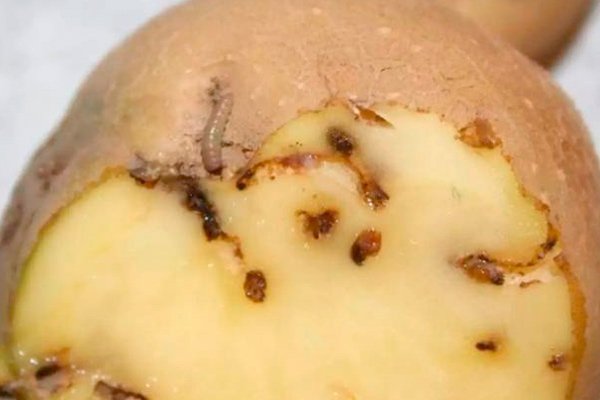
The potato tuber moth causes damage in the larval stage on plants in the field and on potato tubers in storage facilities. Certain differences are observed in the nature of the damage to the individual plants and plant parts:
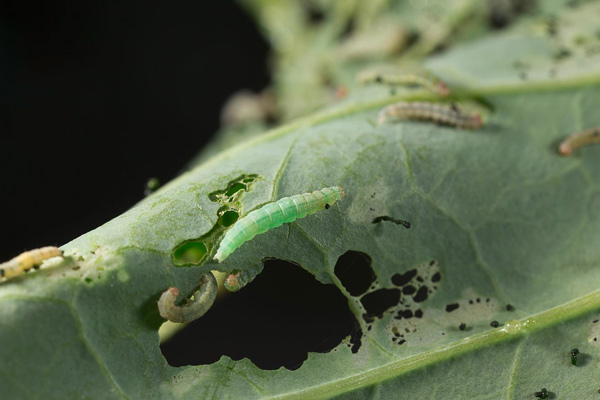
Potatoes – heavily infested leaves dry up and die. The larvae leave such leaves and enter the stem, boring galleries that are directed downwards towards the tubers. With the penetration of the larvae into the stem, the damage increases because the part of the plant located above the damaged area begins to wilt. On the leaves – the newly hatched larvae penetrate the plant tissues, where they feed, forming mines. When held against the light, the mines are translucent and larvae and frass can be seen inside them. The larvae then move into the stem tissues and the stem dies. On the tubers – they are attacked in the period from “wilting of the foliage” until harvest or during storage in potato stores.
It is not possible to identify the damage caused by the potato tuber moth solely on the basis of leaf damage, because the leaf mines formed by the larvae of the potato tuber moth Phthorimaea operculella and the tomato leafminer Tuta absoluta are identical.
Visual identification of the species is possible by the difference between the larvae. They differ in the coloration of the prothoracic shield and the first thoracic segment, which in the potato tuber moth Phthorimaea operculella are uniformly brown, while in Tuta absoluta the entire body is whitish to green in colour, and on the prothoracic shield there is a clearly pronounced darker figure in the shape of an arc.
Pest control
Agrotechnical measures in potatoes
1. Use healthy planting material.
2. Plant the tubers at a depth of 18–20 cm.
3. Use varieties that form tubers at a greater depth in the soil.
4. Carry out regular soil cultivation.
5. The final ridging should provide at least 5 cm of soil above the tubers. Tubers at a depth greater than 4–5 cm are not attacked by the potato tuber moth.
6. Maintain optimal soil moisture – prevent the formation of cracks.
7. Harvest the potatoes in a timely manner – the tubers should be lifted before the stems have dried, and the lifted tubers should be taken immediately into storage facilities. The longer the dry stems and unlifted tubers remain in the field, the greater the risk of damage. Harvested potatoes must not be left overnight in the field. If this is unavoidable, they should be covered with a tarpaulin to prevent egg laying by the moths on the tubers.
8. Destroy plant residues in the field (by burning or deep burial in the soil).
9. Destroy all tubers with visible damage (boiling, treatment with insecticides and burial at a depth of more than 30 cm in the soil).
In storage facilities:
In storage facilities with a controlled temperature regime, tubers should be stored at a temperature of 3–4 °C. At this temperature, the main part of the pest population in all developmental stages dies. Since the potato tuber moth is highly sensitive to low temperatures, complete protection of the tubers is possible at the optimal storage temperature. At temperatures below 10 °C the pest does not develop.
On farms with a high level of agricultural practice, the potato tuber moth does not cause damage of economic importance either in the field or during tuber storage. The population density of Phthorimaea operculella increases at the end of the potato growing season, and the longer the dry stems and unlifted tubers remain in the field, the higher the likelihood of infestation.
All plant protection products that are placed on the market and used for the control of the potato tuber moth Phthorimaea operculella in Bulgaria must be authorised by an order of the Executive Director of the Bulgarian Food Safety Agency in accordance with the requirements of Article 14 of the Plant Protection Act.
The National Programme has been developed on the basis of Article 6, item 2 of the Plant Protection Act by the Bulgarian Food Safety Agency – Directorate “PPCP” (Plant Protection and Control of Plant Protection Products), Directorate “PPPRT” (Plant Protection Products, Fertilisers and Soil Improvers) and the Central Plant Quarantine Laboratory. It uses materials, scientific studies, data, tables, presentations and photographic material from EPPO (European and Mediterranean Plant Protection Organization), Oregon State University, the All-Russian Plant Quarantine Centre and others.
The National Programme of Measures for the Control of the Potato Tuber Moth (Phthorimaea operculella Zell) in potatoes can be found HERE.