

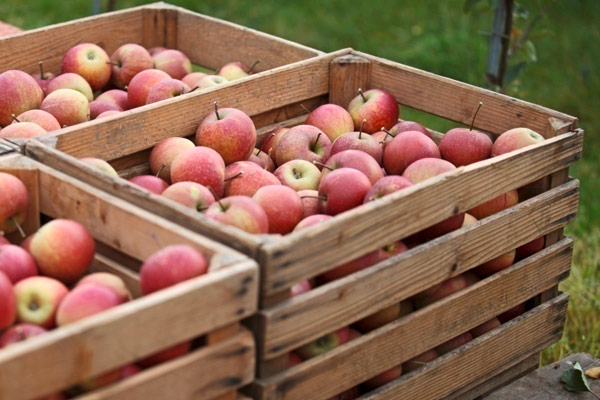
After harvesting, only the highest-quality fruits are selected for storage. Nevertheless, during the storage period they are exposed to various factors and are attacked by a number of infectious and non-infectious diseases. These diseases can completely destroy the produce, as they develop well at a temperature of 0°C.
Infectious diseases:
Soft rot caused by fungi of the genus Penicillium
Gray mold caused by fungi of the genus Botrytis
Bitter rot Trichothecium roseum
Core rot caused by fungi of the genus Alternaria
Sooty blotch Paltaster fructicola,Geastrumia polystigmatus,Leptodontum elatius
Flyspeck Zygophiala jamaicensis
Non-infectious diseases:
Bitter pit
Jonathan spot
Soft rot caused by fungi of the genus /Penicillium/
On affected fruits, yellow to light brown, sharply delimited spots develop, with watery and soft tissues, an unpleasant moldy odor and an alcoholic taste. The rot rapidly penetrates in depth and encompasses the entire fruit. It softens and is easily crushed when pressed. Under humid conditions, a dense mold growth can be observed on the decayed parts of the fruit. Rotting around the seed cavity is observed only after cutting the fruits.
Gray mold caused by fungi of the genus /Botrytis/
The disease manifests itself by the development of brown spots on the fruits, whose tissue is firm and the fruit retains its shape. Under conditions of high humidity, a fine white coating of mycelium and spores of the fungus forms on the damaged fruits. The disease develops in foci due to its rapid spread to adjacent fruits.
Bitter rot /Trichothecium roseum/
Usually the fruit appears healthy externally, but when it is cut, it can be seen that the tissue around the seed cavity is affected by brown rot. In the cavities of the core a white, cotton-like mycelium is visible, on which pink clusters of fungal spores are scattered. A characteristic feature of this rot is the bitter taste and unpleasant moldy odor.
Core rot caused by fungi of the genus /Alternaria/
When the fruits are cut, dark rot can be observed in the area of the seed cavity and around it, accompanied by the formation of a gray mold coating. The disease appears after a prolonged storage period at low temperature followed by holding at room temperature.
Sooty blotch /Paltaster fructicola,Geastrumia polystigmatus,Leptodontum elatius/
They appear in the form of superficial, merging and indistinctly delimited blotches on the fruits, with an olive-green to brown color.
Flyspeck /Zygophiala jamaicensis/
It develops as clearly distinguishable black dots, grouped together in clusters of varying size.
Bitter pit
Small, hard and rounded brown pits of dead cells with a spongy consistency and bitter taste form under the skin of the fruits. Bitter pit appears when the calcium content in the fruits is reduced.
Jonathan spot
Small brown spots appear on the fruits, which later become sunken. The flesh beneath the spots dries out and from there pathogenic fungi penetrate, causing decay. The disorder develops as a result of impaired gas exchange during fruit respiration.
Strategy for disease control during fruit storage
For good storage of fruits, it is of great importance that they be harvested at technological maturity, by careful picking (if possible during the cooler hours of the day), with intact fruit stems, preserved waxy bloom and removal of pest-infested and injured fruits. Storability and quality of the fruits are greatly improved if immediately after harvest they are transported and stored at temperatures from -0.5°C to 1°C and under conditions of good ventilation.
To prevent the risk of the above-mentioned diseases during storage and to maximally extend the storage period – for apples from 90 to 240 days, for pears from 60 to 90 days – the following conditions must be ensured in the fruit stores:
1. Different cultivars should be stored in different rooms or in separate crates. The fruits of some cultivars have a negative effect on the storage of other cultivars, causing physiological disorders – browning of the flesh, of the fruit peel, etc. Cultivars that ripen earlier can accelerate this process when stored together with cultivars that reach physiological maturity more slowly.
2. Optimal temperature. Lowering the temperature suppresses respiration. The faster the fruits are cooled after harvest, the longer they will be stored. Apples are stored at 0°C, and pears at -1°C ± 1.5°C. Large temperature fluctuations adversely affect quality.
3. Relative air humidity. Air humidity should be maintained at about 90–95% to avoid fruit wilting. At lower humidity the fruit skin wrinkles, especially when the fruits are harvested before the required maturity. Air humidity can be increased by spraying the floor and walls with water or by placing containers with water. Very high humidity may cause condensation on the walls and favor the development of different types of rot.
4. Gas composition of the air. The composition of the air also affects the processes of aging and the occurrence of physiological disorders and rots. They appear when the oxygen content decreases and the carbon dioxide (CO2) content increases. The optimal oxygen content depends on the temperature. At 0°C the oxygen content should not be below 2–3%.
5. Air circulation. Air movement ensures uniform distribution of temperature, humidity and gas composition. The temperature, humidity, composition and circulation of the air must be controlled throughout the entire storage period.