

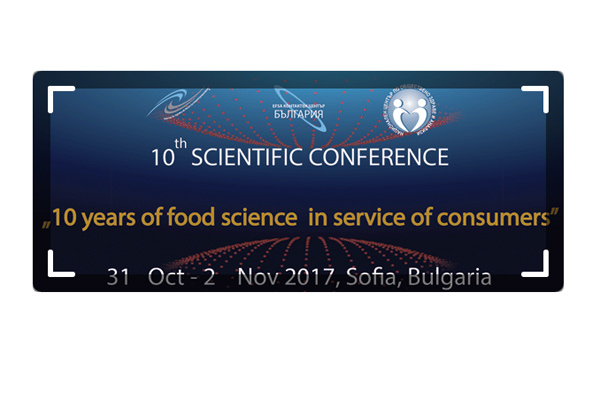
The 10th Anniversary Scientific Conference of the Bulgarian EFSA Focal Point at the Risk Assessment Center on Food Chain was organized jointly with the National Center of Public Health and Analyses - National Reference Laboratory for Genetically Modified Organisms and was held from 31 October to 2 November 2017, at the Grand Hotel Sofia, Sofia.
On the basis of the regulation of the European Food Safety Authority (EFSA) for the preparation of independent scientific analyses of risks related to food and feed, the Risk Assessment Center on Food Chain in Bulgaria was separated from the then functioning common risk management authority – the Bulgarian Food Safety Agency (BFSA) in 2016. Thus, on the territory of the country, risk assessment and risk management were clearly distinguished, which, according to European legislation and standards, is a reliable step towards full and high-quality control of each stage of the food chain.
“Risk assessment along the food chain must be based on scientific knowledge and reliable facts, be carried out separately from risk management in an independent, impartial and transparent manner for society, and serve as a basis for taking adequate legislative and control measures, management decisions and policies,” stated the Deputy Minister of Agriculture, Food and Forestry Dr. Tsvetan Dimitrov at the opening of the anniversary scientific conference “10 Years of Food Science in the Service of Consumers“.
At the opening of the anniversary conference on 31 October, Dr. Yanko Ivanov, Director of the Risk Assessment Center on Food Chain, presented the activities of the Center and its importance for strengthening consumer confidence and expanding cooperation between science and business in view of the global challenges related to food safety – changes in the distribution area of vector-borne diseases, the expansion of the geographical horizons of the economy and tourism, novel foods, new vaccines, new technologies for rearing animals and cultivating plants. According to the Director of the Risk Assessment Center, the introduction of the new competences of the Center regarding the approval, renewal and review of the approval of active substances, antidotes and synergists, as well as the provision of recommendations to institutions and businesses concerning the training of their staff in connection with the identified risks along the food chain, will be priorities in the coming years. The National Reference Laboratory for Genetically Modified Organisms is also celebrating 10 years since its establishment.
The following scientific areas were subject to discussion: “Food Chain Safety“, “Epidemiology and Animal and Plant Health“ and “Safety of Products of Modern Biotechnologies”.
Sergio Rodeia from the European Food Safety Authority (EFSA) acquainted the representatives of the scientific institutions with the new types of grants and tools for information exchange.
Within the framework of the conference, innovative plant breeding methods from the AgroBioInstitute, Sofia, were also presented. The Institute of Roses and Essential Oil Crops, together with the Institute of Microbiology and the Institute of Neurobiology, presented a comparative analysis of the phytochemical composition and pharmacological potential of aromatic products from the Bulgarian Rosa alba L. and Rosa damascena Mill.
The poster session, as part of the three-day conference, also attracted interest. The Institute of Plant Genetic Resources “K.
Malkov“ – Sadovo acquainted the attendees with the possibilities for the use of pea (Pisum sativum L.) for food and feed and with in vitro propagation of plant material from wild chickpea species. During the three-day conference, issues related to food safety, animal and plant health and the safety of products of modern agricultural biotechnologies were discussed. Leading scientists, research organizations and laboratories, agricultural branch organizations, as well as representatives of EFSA and FAO, took part.
All presentations and poster topics can be found HERE