

.jpg)
During this period intensive harvests are carried out, therefore plant protection products with short pre-harvest intervals must be selected.
Main harmful organisms
Diseases
Tomatoes, peppers
Late blight on tomato (Phytophthora infestans)
Early blight on tomato and pepper (Alternaria porri f. sp. solani)
Blight on pepper (Phytophthora capsici)
Powdery mildew on pepper (Leveilula taurica syn. Oidiopsis taurica)
Stolbur (Phytoplasma)
Cucumbers, watermelons, melons
Downy mildew (Pseudoperonospora cubensis)
Powdery mildew (Podosphaera xanthii, Erysiphe cichoracearum)
Angular leaf spot (Pseudomonas syringae pv. lachrymans)
Other vegetables
Downy mildew on cabbage (Peronospora parasitica)
Pests
Tomatoes, peppers, eggplants
Aphids (Aphididae)
Thrips (Thrips tabaci, Franklinella occidentalis)
Glasshouse whitefly (Trialeurodes vaporariorum)
Cotton bollworm (Helicoverpa armigera)
Tomato leaf miner (Tuta absoluta)
Two-spotted spider mite (Tetranychus urticae)
Cabbage
Cabbage moth (Mamestra (Baratra) brassicae)
Large white butterflies (Pieris spp.)
Diamondback moth (Plutella maculipennis)
Potatoes
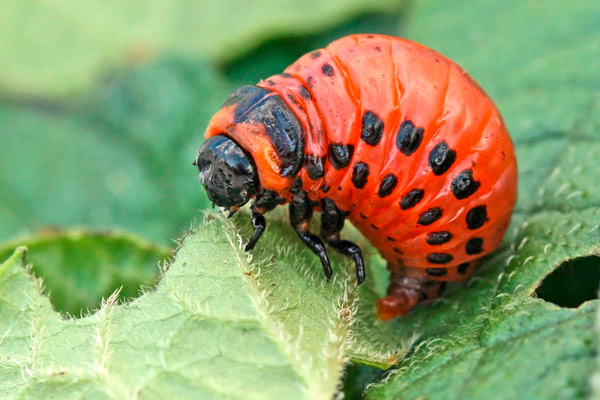
Colorado potato beetle (Leptinotarsa decemlineata)
Early blight (Alternaria porri f. sp. solani)
The disease starts from the oldest leaves. Small watery spots with a size of up to 5–7 mm in diameter appear on them, which later dry out, become dark brown to black with a concentric structure, coalesce and the leaf scorches. The spots on the stem, leaf and flower petioles are similar, with the characteristic concentric structure. They may completely encompass the affected parts and cause their drying above the site of injury. The spots on the fruits start from the stem end and also have a concentric structure. For yield reduction, the spots on the flower petioles are of particular importance, as they can cause flower drop. At high relative air humidity the affected areas are covered with a black mould of the fungal sporulation.
Pest control strategy:
Preventive treatments with plant protection products in the presence of favourable conditions for the development of the pathogen.
Authorised plant protection products:
antracol 70 wg – 0.15%; acrobat plus wg – 200 g/ha; vitene triplo r – 400-450 g/ha; ditan dg – 200 g/ha; ditan m-45 200 g/ha; difcor 250 sc – 50 ml/ha; karyal star – 60 ml/ha; consento sc – 200 ml/ha; corsate mdf – 0.25%; quadris 25 sc – 0.075%; cupertine m – 400 g/ha; ortiva top sc – 100 ml/ha; pencozeb 80 wp – 200 g/ha; pencozeb 75 wg – 210 g/ha; polyram df – 0.2%; ridomil gold mz 68 wg – 250 g/ha; sankozeb 80 wp – 200 g/ha; sinstar – 70-80 ml/ha; score 250 ec – 40 ml/ha; folpan 80 wdg – 150 g/ha; cidely top – 100 ml/ha.
Colorado potato beetle (Leptinotarsa decemlineata).
The adults and larvae cause damage by feeding on the leaves of potatoes. Initially the larvae feed around the hatching site, scraping off the lower epidermis of the parenchyma. In case of severe infestation the potatoes are completely defoliated and their yields decrease. The most dangerous are the damages caused during flowering and tuber formation.
Pest control strategy:
Regular field inspections.
Authorised plant protection products:
actara 25 wg – 6 g/ha; alverde 240 sc – 20 ml/ha; biscaya 240 od – 20 ml/ha; vaztak new 100 ec – 10 ml/ha; dantop 50 wg – 4-6 g/ha; calypso 480 sc – 10 ml/ha; coragen 20 sc – 6 ml/ha; mospilan 20 sp – 6 g/ha; nexxid 015 cs – 30 ml/ha; nurelle d – 80 ml/ha and fury 10 ec – 10 ml/ha.