

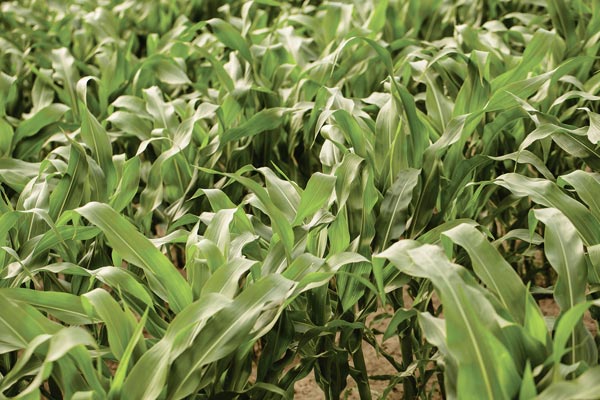
The intensive use of agricultural land through intensive crop rotation has two main objectives: to increase the vegetative potential of the field or to obtain two or more harvests from one field, which of course leads to higher income within a single farming year. Under Bulgarian conditions, this can be achieved by growing preceding crops or a second crop. The only limiting factor is the low amount of precipitation during the summer period, but when this factor is eliminated through irrigation or irrigated agriculture, or when its impact is low thanks to sufficient soil moisture accumulated before compaction, the cultivation of a second crop is economically and agrotechnically beneficial. In Bulgaria, maize is most often grown as a second crop, usually after barley or an early-maturing rapeseed variety. The use of maize as a second, post-harvest crop is an important source of additional plant production (grain or silage).
Traditionally, changes in climatic conditions are regarded as extremely negative processes. However, climate change also provides opportunities that Bulgarian agriculture often does not take advantage of. The 2016/2017 campaign is characterized by a rainy spring, and the end of June and July are also expected to be rainy. In many parts of the country, soil moisture remains relatively sufficient and no droughts are expected at the beginning of the summer – this is a very good opportunity for sowing maize as a second crop. The use of maize as a second, post-harvest crop is an important source of additional plant production, but it also increases the vegetative potential of the fields by extracting nitrates from the soil and preventing their leaching by winter and summer precipitation, thus utilizing already existing potential. In addition, maize as a second crop contributes to the reduction of soil erosion and weed infestation of the fields and can be used as feed for livestock, and under a favorable summer or irrigated agriculture, it can also provide excellent grain production.
In recent years it has become evident that for crops such as maize, when speaking about profit, the early-maturing hybrids of Syngenta deliver excellent results – the company offers the latest generation of early and very early maize hybrids, which are well adapted to local agro-climatic conditions and have a short growing season. With sufficient soil moisture or rainfall/irrigation after emergence, they provide very satisfactory income within the same farming year. Here we can distinguish Ariozo FAO 240, which has a high yield potential comparable to hybrids from the medium-early group, while also having a short growing season. In recent years Ariozo has proven to be suitable not only for silage when sown as a second crop, but also for grain production, and it provides very good grain yields (550 kg/da), even under non-irrigated conditions. Precisely because of this, Ariozo has firm supporters and every year it expands its acreage as both a first and a second crop.