

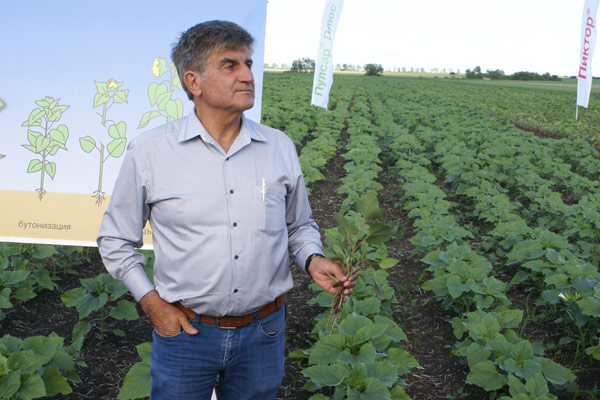
At the demonstration and trial plot in the town of Saedinenie, one of BASF’s four platforms in the country this spring, the Bulgarian team of the German agrochemical company presented “in the field” to a large partner audience – about 400 farmers from Central Southern Bulgaria – its new corporate conceptual project PRECISION IN CROP PROTECTION FOR PROFITABLE AGRICULTURE. Special participants in the meeting were Dr. Josef Haber, a global expert in fungicides for cereal crops, Prof. Svetoslav Bobev and Prof. Tonio Tonev from the Agricultural University in Plovdiv, part of the academic leadership in phytopathology and herbology in our country
The project PRECISION IN CROP PROTECTION FOR PROFITABLE AGRICULTURE creates the impression that BASF eliminates all unnecessary activities and focuses its expertise and professional competences on continuously improving performance, so that every crop protection product bearing the BASF brand always generates the required added value, high profit margin and satisfaction from work. Ms. Gortcheva pointed out that the right choice depends on many more factors. The changing climatic and phytosanitary environment generates various situational phenomena – turbulences, deficits, invasions, increased activity of one or another pest. A risk management tool is needed, which is part of the concept of precision. That is to say: rationality, pragmatism, awareness and knowledge. In no case should the choice be standardized. In the context of the key phrase right choice, Ms. Gortcheva made a brief historical review of the groups of active substances used for formulating fungicidal products in cereal crops. The beginning, more than 50 years ago, was set with triazoles, followed by strobilurins /discovered by BASF in 1996/ and reaching the SDHI fungicides. The goal is ambitious – expanding the spectrum of activity (incl. action on plant physiology – to overcome stress factors and increase yield), as well as avoiding resistance. In Western Europe, resistance to strobilurins creates serious problems. In countries with a clearly expressed continental climate – Poland and the countries of Eastern Europe (incl. Bulgaria) – this negative factor is still far from the critical threshold. In this case, Ms. Gortcheva stressed, under no circumstances should we underestimate the dynamics of changes in the spectrum of diseases and the behavior of the pathogenic potential. Forty years ago the main disease was powdery mildew. From Western Europe, following the spread of their wheat and barley varieties towards the eastern part of the continent, there began the expansion of an invasive pathogenic complex, until recently unknown in our country – net blotch (Drechslera), septoria, yellow rust… In other words, summarized Ms. Gortcheva, the phytosanitary situation is changing, and the high-quality agrochemicals of the world’s leading company in fungicide production – BASF – provide sufficiently effective solutions. One thing remains – the right choice!
At the meeting in the town of Saedinenie, BASF’s two major innovations were also presented – the fungicide Systiva and the herbicide Pulsar Plus. Systiva, part of the AgCelence concept, is a seed treatment fungicide for control of soil-borne and foliar diseases in barley and wheat. It controls all economically important diseases, incl. septoria leaf blotch, powdery mildew, net blotch, various rots, stripe disease, snow mold. The active base (Xemium) is from the new SDHI fungicide group. Thanks to the new generation of systemic activity, Systiva is absorbed by the seed coat, destroying infection on it and in the embryo of the seed. With the emergence and growth of the cereal plant, Systiva moves within it. Systiva overcomes hydrophilic and lipophilic barriers, which allows rapid movement and accumulation in plant tissues. The duration of action reaches several months. The crops enter the stem elongation stage free from diseases, and usually the use of a high-class foliar fungicide is not necessary. Depending on climatic conditions, varietal structure and infection pressure, the first spring treatment can be applied as late as the flag leaf stage! A real opportunity opens up for growing the crop with only one fungicide treatment in spring. Systiva ensures better development of the root system and a fast start of the crop in autumn. It improves the process of photosynthesis, delays ethylene formation, which prolongs vegetation and increases yield. It helps overcome the consequences of abiotic stress factors. Systiva is an extremely effective tool for prevention and risk management against the increasing activity, aggressiveness and composition of the infection background, provoked both by the invasion of pathogenic organisms and by foreign breeding and the adaptation of varieties to the local climatic environment. Systiva is an important part of BASF’s vision for precision crop protection. Prof. Svetoslav Bobev’s opinion on Systiva, who has tested the product: “A large part of harmful pathogens are transmitted by seeds and plant residues. The aim of every farmer is that the seed for sowing should be free from any infection.”
Dr. Josef Haber, a global expert in fungicides for cereal crops, added: “Systiva is a major technological breakthrough, proof of the powerful capacity of a new generation of agrochemicals to address challenges in a decisive way. For me, Systiva is a foliar fungicide used to treat seeds together with a seed disinfectant.”
On the DEMO platform in the town of Saedinenie, farmers also saw the effect of Clearfield Plus, BASF’s new technology launched this spring in Bulgaria for controlling the entire weed complex and the parasitic weed broomrape in sunflower. Prof. Tonio Tonev, who has tested the product Pulsar Plus, pointed out several facts. Pulsar Plus significantly enhances herbicidal efficacy and reduces herbicide stress. It is one step more effective than the well-known Pulsar in controlling perennial weeds with root suckers – field bindweed, wild hemp – but despite this, these highly problematic weeds can be most successfully controlled in autumn with non-selective herbicides.
The role and position of BASF in Bulgarian agriculture has been discussed on many occasions. And there is always more to add on this topic. The Bulgarian market is a target market for the German company. This is an indisputable privilege. All corporate innovations arrive here and the company’s team in Bulgaria is responsible for their positioning and successful establishment.
You can read more details about the event in issue 5/2017 of the magazine “Crop Protection”.