

In recent years, farmers have been concerned about the occurrence and spread of diseases, mainly in ornamental shrubs, certain leafy vegetables and herbs (for dishes and preserves). The monitoring carried out shows that disease agents have appeared which are not yet known in practice and for which the literature information is insufficient.
Rust (Puccinia malvacearum) on hollyhock (Alcea rosea)
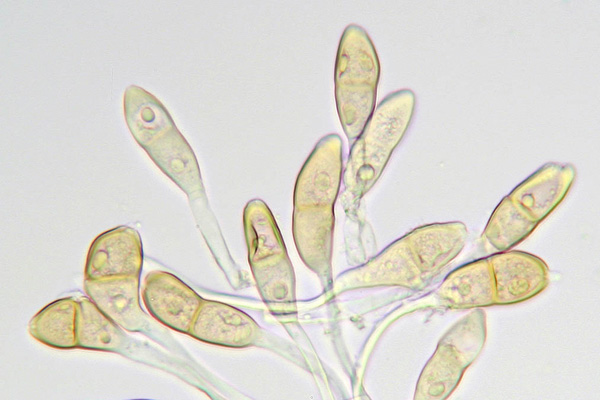
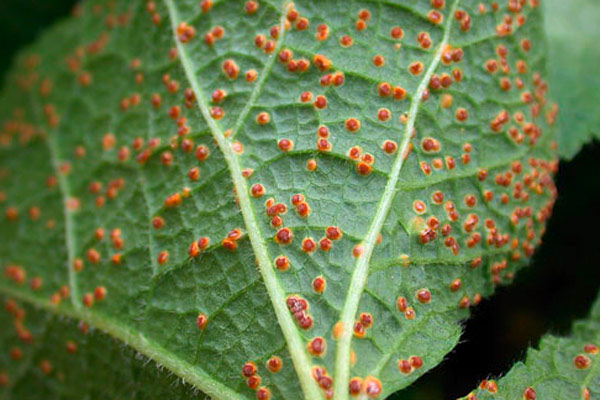
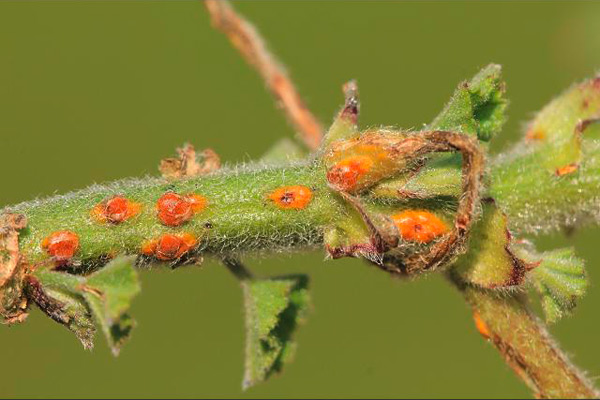
The disease develops on the leaves, stems and flowering organs. This rust is autoecious (Borcean et al., 2016), completing its full cycle on hollyhock. Early in spring, pycnidia and aecia of light yellow colour appear on the young growth. Later, brown and black sori develop on all aboveground organs. Initially, they are visible as small swellings resembling warts. After the epidermis ruptures, a powdery mass of urediniospores and teliospores is exposed. Under severe infestation the leaves turn yellow, wilt and scorch. The tips of the flowering organs also wilt and droop. Rust often compromises yields and the quality of the oil, which is used in the pharmaceutical industry.
Control:
- In autumn, the plants should be cut at the base of the stems and, together with the leaves, burned.
- The site should be treated with sulphur and copper sulphate (blue vitriol) in a 1:1 ratio, at 50–60 g/m².
- During the vegetation period, spraying should begin as soon as the young growth appears, with Folicur 250 EW - 0.08%. Preventive treatments with sulphur-containing products may also be applied.
*The article was updated on 07.06.2024