

In recent years, farmers have been concerned about the occurrence and spread of diseases, mainly on ornamental shrubs, some leafy vegetables and herbs (for dishes and preserves). The monitoring carried out shows that disease agents have appeared which are still unknown in practice and for which the literature information is insufficient. In the period 2015–2016, studies were conducted on vegetation that was severely affected by diseases.
Common lilac (Syringa vulgaris)
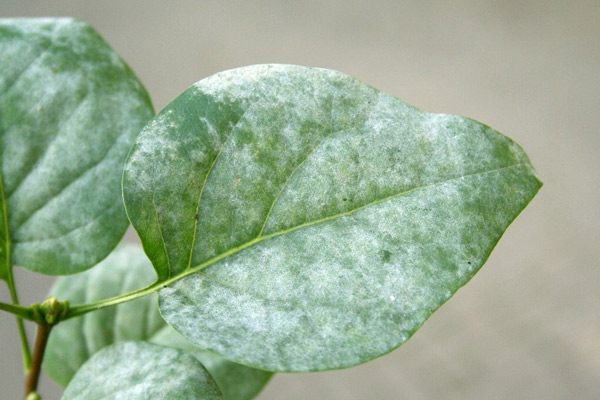
Powdery mildew /Microsphaera syringae/ – a new pathogen on lilac. The disease is easily detected on the plants. Initially, a white, and later greyish, loose mycelial coating appears on the upper surface of the leaf blade (Fig. 1). Usually the first symptoms develop around the main veins and then the mycelium spreads rapidly over the leaf blade. Subsequently, the leaves turn brown, and those that are severely affected become necrotic and fall off. Powdery mildew also parasitizes young shoots and floral organs. On the mycelium of the fungus, cleistothecia of the pathogen are formed.
Brown leaf spots /Gloeosporium syringae/ – a new pathogen on lilac.
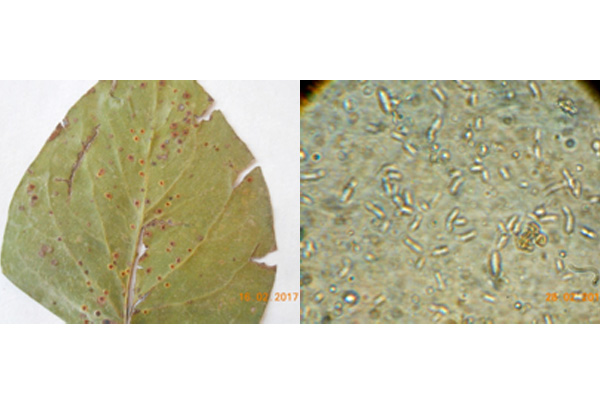
The disease spread more extensively in 2016. On the upper side of the leaves, rounded, light brown, slightly sunken spots are formed, bordered on the sides by a darker, slightly raised rim (Fig. 2). In the necrotic tissues the acervuli of the fungus are found.
Grey leaf spots /Septoria syringae/ – a new pathogen on lilac.
Light brown spots with a darker rim and a light grey centre, dotted with black specks – the pycnidia of the pathogen – are formed on the leaves.
Control of diseases on lilac should be primarily preventive:
Diseased shoots should be cut out and burned;
After leaf fall, leaves should be collected and burned;
There are no registered fungicides for the control of lilac diseases. For preventive spraying against powdery mildew, sulfur-containing products can be used. If such are not available on the market, a wettable sulfur can be prepared according to the following recipe: for 10 L of solution, mix 200 g sulfur powder with 20 g washing powder or liquid laundry detergent (20–30 ml). The mixture is stirred well to a paste-like consistency. Then water is added up to 10 L with continuous stirring. The effectiveness is increased if 8–10 g potassium permanganate or 50–60 ml clear formalin is added.
Winter spraying against powdery mildew can also be carried out with potassium permanganate alone – 30–40 g, with the addition of 10–20 g baking soda.
In cases of mixed infection of leaf spots and powdery mildew, before and after flowering, spraying can be carried out with Topsin M – 0.1% or Bordeaux mixture 1%, combined with clear formalin – 0.5%.