

The main objective of the programme is to clarify the current status of Drosophila suzukii in Bulgaria and to determine the potential limits of its distribution and the crops at risk in the country. The development of a control programme to prevent and limit the spread of Drosophila suzukii in the country is envisaged.
The present programme has been developed by a team of scientists from the N. Poushkarov Institute of Soil Science, Agrotechnologies and Plant Protection, the University of Forestry and experts from the Bulgarian Food Safety Agency, using the results of a large number of scientific publications from Europe, Asia and America, as well as their own studies.
Drosophila suzukii Matsumura (Diptera: Drosophilidae) is a species of the temperate and subtropical climatic zones. It originates from Southeast Asia and has successively spread to many countries in Asia, North America and South America. In Europe, D. suzukii was first established in Spain in 2008. Within a few years, the species spread to almost all countries on the continent.
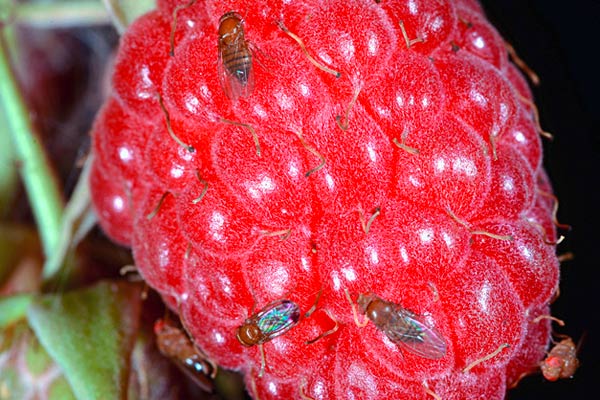
The females of D. suzukii lay their eggs on healthy, ripening fruits that have not yet fallen. The main damage is caused by the larvae, which feed on the fleshy part of the fruits. Within a few days, the fruits become deformed, soften and become unfit for sale.
D. suzukii has characteristics that make it an especially dangerous pest for fruit production in Bulgaria and worldwide, since the species has: 1) high reproductive potential and a rapid development cycle with up to 13 generations per year; 2) high biological plasticity and tolerance to a wide range of climatic conditions (from the equator to the northern parts of the temperate climatic zone and from sea level to the alpine zone in the mountains); 3) significant potential for spread mainly
through infested fruits (in Europe 1400 km in one year); 4) a large number of
hosts (over 90 cultivated and wild-growing species, many of which occur in Bulgaria); 5) it causes significant economic damage to the fruits of stone and berry crops.
The most preferred hosts are blueberries, raspberries, strawberries, blackberries, cherries, peaches, apricots, plums, grapes, etc. Without the implementation of appropriate measures, damage caused by D. suzukii amounts to $500 million per year in the Western states of the USA. Studies carried out in 2013 show that total losses in the eastern parts of the USA are estimated at $27.5 million. In Oregon, peach growers have observed losses of up to 80% in some
orchards, and losses of up to 20% have been established in raspberries. In California in 2009, about 1/3 of the cherry production was destroyed, with high losses also established in plums. In 2010 in France and Italy, losses from D. suzukii amounting to 80% in strawberries and raspberries were recorded. The losses from attacks by D. suzukii on 40,000 decares of berry crops in the province of Trento, Italy, were estimated at € 500,000 for 2010 and at € 3
million for 2011. In 2010 in Switzerland and France, significant damage to blueberries was observed, and in 2012–2014 in Switzerland and Germany to some grape varieties such as Merlot, Pinot Noir, Sauvignon Blanc, etc.
The present programme has been developed by Prof. Dr. Olya Karadjova, Prof. Dr. Slavimira Draganova, Prof. Dr. Rumen Tomov, Dr. Zhenya Ilieva, Mariyana Laginova, Ivanka Ivanova, Snezhana Prodanova, Nikolay Rosnev, Lazar Chavdarov and is intended for plant protection specialists.
The National Programme for Phytosanitary Control and Management of Drosophila suzukii Matsumura in Bulgaria can be found HERE