

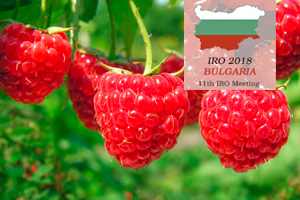
Between 6 and 9 May 2018 in Arbanasi, Veliko Tarnovo, the 11th conference of raspberry producers from around the world will be held. The International Raspberry Growers Association (The International Raspberry Organisation), headquartered in Santiago, Chile, organises such conferences every two years, with the aim of exchanging experience among the leading raspberry-producing countries. The soft fruit market will grow at a rapid pace, including in Bulgaria, where in recent years a slow but steady increase in raspberry production has been recorded.
The global soft fruit market has been growing in recent years
The trends for increasing the market of producers of “superfruits” (a group which includes strawberries, raspberries, blackberries, blueberries, blackcurrants, redcurrants and even goji berries) show a significant growth on a global scale. Soft fruits are becoming a mass taste through the continuously growing trade in food products that meet the need for a healthy lifestyle in the EU, USA and China. Another reason for their expansion is the absence of the main characteristic from the past of the fruit and vegetable market, namely the elimination of their seasonal availability as an obstacle to the sustainable increase of their year-round consumption. The market for these fruits is acquiring a universal character and complements the traditional fresh consumption with other commercial dimensions – primary processed (frozen), dried, extracts, juices, oils, jellies, jams, preserves and highly specialized ingredients for other food products. According to estimates by InteliAgro based on ITC (International Trade Center) data, the market for fresh consumption still dominates with 75% of the international trade in soft fruits.
As of 2015, the largest share falls to strawberries – 40%, but blueberries are rapidly catching up, while raspberries and blackberries occupy third place – with one quarter of the trade and an average annual growth rate of 16% over the last five years.
Bulgarian raspberries
Over the past 10 years Bulgaria has managed to establish itself as a raspberry producer in Europe after countries such as Poland and Serbia, which occupy some of the leading positions in exports of frozen soft fruits. In the report presented at the conference of the International Raspberry Growers Association in Serbia in 2016 by Bozhidar Petkov, Chairman of the Bulgarian Raspberry Growers Association, in 2015 our country harvested 6,550 t of raspberries from 1,513 ha on farms ranging in size from 20 ha to 80 ha. Statistics show that there has been a slow but steady increase in the production of this fruit over the past 10 years.
For the time being, Bulgaria exports mainly frozen raspberries, whose total share in exports amounts to 80% of production.
Thanks to its valuable qualities, the raspberry is increasingly spreading throughout the country. It is grown almost everywhere, using innovative methods (raspberry growing technology presented by the Swiss Diefenbach in 2009), including special mulching films that prevent weed development and increase productivity, and a method of growing raspberries (raised beds). The use of “raised beds” for planting the crop has distinct advantages in the even distribution of soil moisture and the prevention of soil erosion during periods of heavy rainfall, as well as the preservation of soil structure during drought.
Varieties
Of greatest importance for the industrial production of raspberries in our country are the primocane (everbearing) varieties, whose first crop is set on the upper parts of the newly grown canes of the current spring, usually at the end of summer. Usually the second crop is immediately in the following spring.
Lyulin – a Bulgarian variety, bred by L. Hristov in 1982. The plants are of moderate vigour. The canes are upright, thick, of medium height. The fruits from the summer-autumn crop begin to ripen in August and the harvesting period continues until the end of September. They are medium to large, rounded-conical, red. The flesh has good to very good taste and technological qualities. It is recommended for summer-autumn harvesting. The summer-autumn productivity is high – up to 1,0001,500 kg per decare under irrigated conditions and up to 700 kg without irrigation.
They are used for fresh consumption and are particularly suitable for processing and freezing. The cultivation of this variety makes it very promising, especially for areas not higher than 550-600 m in Northern Bulgaria and up to 650-700 m in Southern Bulgaria, with a warm and prolonged autumn and evenly distributed rainfall (650-700 mm). It is resistant to Didymella and Coniothyrium.
Heritage – bred in the USA in 1969 and still considered one of the achievements in the global breeding of primocane raspberry varieties.
The plants are moderately to strongly vigorous. The canes are upright but tend to bend over, of medium thickness, light cinnamon-coloured with a slight reddish hue, covered with coarse prickles. The fruits are medium-sized, rounded to rounded-conical, dark red. The flesh is firm, tender, with a very good sweet-sour taste and pleasant aroma. They are also suitable for freezing, as well as for processing into compotes, juices and jams. Productivity is very high – up to 1,000 kg per decare under irrigated conditions and 650-700 kg under non-irrigated conditions. It is resistant to winter frosts, as well as to high temperatures and air and soil drought during fruit ripening. It is susceptible to anthracnose and less susceptible to Didymella. The variety is suitable for cultivation in regions with a cooler and more humid climate in the second half of the summer, mainly for the summer-autumn crop and necessarily under irrigated conditions.
Other varieties that are harvested in Bulgaria are: Willamette, Meeker, Shopska Alena, Bulgarski Rubin. The Institute of Agriculture – Karnobat also offers the Bulgarian varieties Iskra, Samodiva, Kostinbrodska and Esenna Pozlata, which was bred in 1984 for amateur cultivation and is suitable only for direct consumption. Its ornamental qualities deserve the attention of the amateur gardener as well.
For the first time in Bulgaria, an innovative technology for organic production of raspberries of the varieties Willamette and Lyulin has been developed, which was awarded the prize “Gold Medal” at AGRA 2017 for the created “Technology for organic production of raspberries“. The scientific product can be used by producers or cooperative associations engaged in the production of organic raspberry fruits. The technology for organic production includes environmentally friendly methods and means for controlling raspberry pests: assessment of the risk of diseases caused by soil phytopathogenic fungi of the root system and stem pests before establishing an industrial plantation. The advantages of the developed technology are not limited only to produce of excellent quality, but also significantly reduce the use of biofungicides and insecticides.
Organic raspberry production is increasing by 3% each year of the total area.