

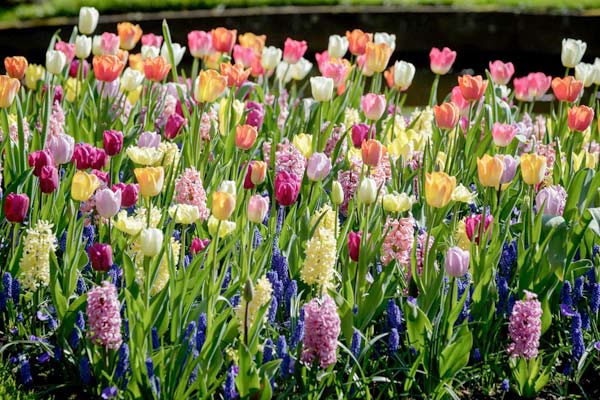
For his loyal service at the court of Suleiman I the Magnificent, the renowned Austro-Hungarian diplomat Busbecq received from the sultan’s secret gardens several bulbs of tulip (Tulipa), hyacinth (Hyacinthus) and lilac (Syringa). With the help of the botanist Clusius, these exotic bulbs soon appeared in the gardens of the Habsburg palaces, where the scholar succeeded in cultivating the plants, breeding new colours and shapes of the tulip’s cup and later spreading them to the Low Countries as well. There they gained their worldwide fame. The Latin name tulipa comes from the Turkish word tulbent. It denotes a fine fabric used to wrap the sultan’s turban, which resembles the flower.
In the time of the Habsburgs
At the risk of disappointing some of you who believe that the homeland of the beautiful flower is the Netherlands, we shall tell you about its journey from Central Asia, through the secret gardens of Sultan Suleiman I the Magnificent, to the Netherlands, which is the mecca of the plant’s diversity in shape and colour.
After spending nearly 6 years in Constantinople as ambassador of the Habsburgs, in 1562 Ogier Ghiselin de Busbecq returned to Vienna, where his friend Charles de l’Écluse (in Latin Carolus Clusius) was eagerly awaiting him. The Fleming, considered responsible for the appearance of the beautiful flower in Europe, studied botany and medicine in Paris and London and, before being appointed chief botanist of the Austro-Hungarian Empire, devoted himself to travels which enriched his remarkable collection of rare plant species.
For his loyal service at the court of Suleiman I the Magnificent, at the end of his mandate Busbecq received from the sultan’s secret gardens several bulbs of tulip (Tulipa), hyacinth (Hyacinthus) and lilac (Syringa). These were the long-awaited gifts which, with the help of the botanist Clusius, soon appeared in the gardens of the Habsburg palaces. Charles de l’Écluse succeeded in cultivating the plants, selecting new colours and forms and later disseminating them in the Low Countries as well, where they gained their worldwide popularity. He was also the first to notice the “mosaic disease”, manifested in beautiful light stripes and lines on the flowers and leaves. The stripes are caused by an infection with a virus living on the green peach aphid.
In fact, by the end of the 16th century the Netherlands had become a centre for the cultivation of bulbous plants, especially tulips. The real craze for the flower escalated in 1637, when the value of a single bulb was 10 times higher than the skilled income of a master craftsman of that time. During this period, the most expensive tulips were those of the “Semper Augustus” variety.
Gardens of the tulip
The kitchen garden
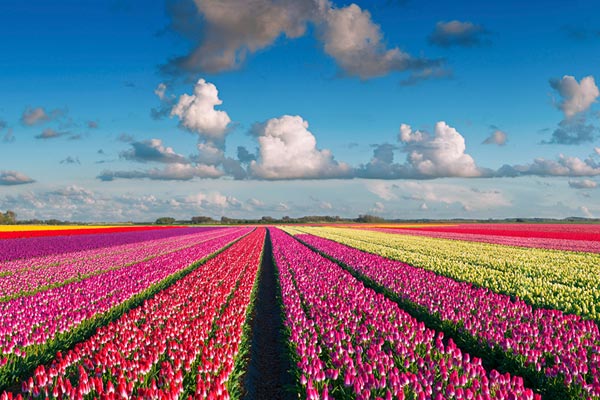
Today in Keukenhof, the Netherlands, there are fairy-tale fields, coloured in the tulip’s diverse hues all the way to the horizon. This is also the largest bulb-flower garden in the world, formerly known as the hunting park of Castle Hainaut, where Countess Jacqueline of Holland personally engaged in the cultivation of flowers, spices and herbs. Hence the name of the place – Keukenhof (The Kitchen Garden). The gardens are open only 2 months a year in spring – this year you can visit Keukenhof from 23.03 to 21.05.2017. The gardens were created in 1949 as an exhibition of Dutch growers of tulips.
The home of tulips is located near the town of Lisse between Amsterdam and The Hague and welcomes nearly 800,000 visitors per year. The area of the park is 32 hectares, and the length of the paths is 15 km, enough to lose yourself, at least for a while, in the fairy-tale world of tulips.
Tulip Museum in Amsterdam
The National Tulip Day is held every year in Amsterdam on the third Saturday of January. On that day a garden with 200,000 tulips appears on Dam Square and the tulip season is officially opened. And if you wish to learn more about the history of the tulip, the small Tulip Museum in Amsterdam will answer all your questions.
Tulip Festival in Istanbul
In one of the tulip’s earliest homelands – Istanbul, every spring the colourful Tulip Festival is held. In April the city is immersed in the multicoloured gardens of the bulbous plant. Tulips are everywhere – in parks, private gardens, fairs and exhibitions. The most impressive tulip displays can be seen in Emirgan Park, Gülhane Park and Yıldız Park in the European part of Istanbul. Tulip gardens were famous until the 18th century, when during an uprising the city lost its colourful bulbs. In our time the festival has been restored and in 2017 it will be held for the 12th consecutive time.
The tulip travelled the long road to fame from the high mountains of Central Asia, through the famed gardens of Sultan Suleiman I the Magnificent, the lands of the Habsburgs and reached the Netherlands, which proclaimed it its national symbol. Today the country is the largest exporter of flowers and controls nearly 80% of the trade in tulips.