

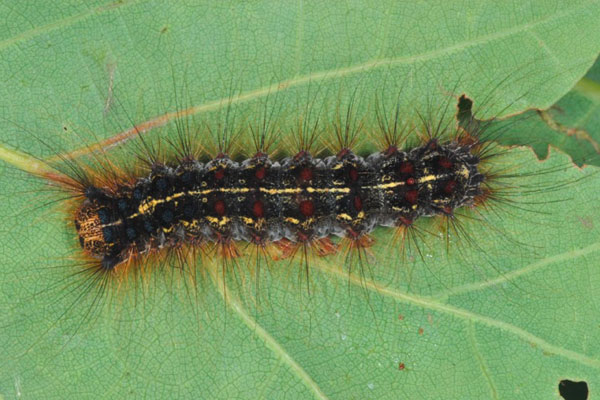
The National Programme of Measures for Control in Case of Gypsy Moth (Lymantria dispar L.) Calamity is aimed at limiting the damage caused by the pest in the agriculture and forestry sectors. It is intended for experts and specialists in the field of plant protection, experts and specialists in forest protection, as well as agricultural producers.
The gypsy moth is naturally distributed in the Palaearctic zoogeographical region – Europe, Asia, Japan and North Africa. Two races of the species are known – European and Asian. Morphologically they do not differ, but there are specific characteristics in their behaviour and ecology. The main distinguishing feature is that the female moths of the Asian race are able to fly, whereas those of the European race only crawl.
In 1869 the European race was accidentally introduced from France into North America – in the area of Boston, Massachusetts. Due to the absence of natural enemies in the newly occupied territories, the gypsy moth spread rapidly and acquired the status of a major pest of broadleaf vegetation.
Today the species is widely distributed in the northeastern regions of the USA and Canada, but it is continuously expanding its range to the west and south. In 2003 the gypsy moth also penetrated New Zealand, where a programme is being implemented for eradication of the population and prevention of new invasions.
The gypsy moth is a polyphagous species – the European race is trophically associated with 250–300, and the Asian race with over 450 plant species. It attacks almost all fruit and forest species, but both races prefer various oak species (Quercus spp.).
In Bulgaria the gypsy moth is distributed throughout the entire country. It appears periodically and causes severe damage not only to fruit trees, but also to forests. The damage to oak stands in the lowland and forest regions up to 600–800 m above sea level is particularly severe. Mass outbreaks occur after droughts with higher summer temperatures and low precipitation.
Objectives of the National Programme
1. Limitation of the spread and damage caused by the gypsy moth to agricultural crops and forest resources;
2. Determination of the actual damage in case of gypsy moth calamity to agricultural crops and forests;
3. Assessment of the economic impact in case of pest calamity;
4. Development of monitoring for the development of the gypsy moth;
5. Development of measures for effective control of the pest;
6. Provision of financial support to legal and natural persons affected by the calamitous multiplication of the gypsy moth;
The full Programme of Measures for Control in Case of Gypsy Moth (Lymantria dispar L.) Calamity can be found HERE