

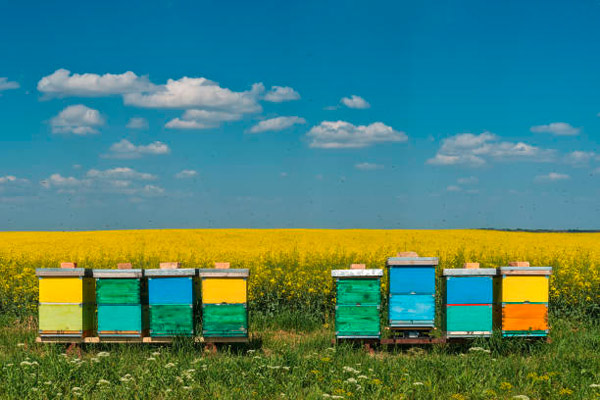
The association “Bio City Sofia” has opened a “Bee Museum” in Sofia – next to the “G. M. Dimitrov” metro station. It will host scientific meetings of beekeepers and observations of experimental hives. The museum will operate year-round starting from February, when it will be opened for free public access.
A small bee museum has opened in Sofia. It is the first one in Bulgaria in an urban environment and aims to enhance general awareness and knowledge about bees and their role not only in maintaining biodiversity in the big city, but also in the interrelation between human activity and the drastic decline of bees on a global scale.
The structure is in the shape of a honeycomb, made of clay, with a green roof on which, in spring, there will be flowers for the bees.
The museum will operate year-round starting from February, when it will be opened for free public access. It will host scientific meetings of beekeepers and observations of the experimental hives. In the small house there is a specially constructed hive with an additional window through which all visitors can observe the life of the bees. There is also an extensive collection of photographic and informational materials on the subject.
According to one of the founders of the association “Bio City Sofia”, bees also have their place in the city. “In fact, honey is produced in Sofia, and what should be known is that urban honey is purer than that outside the city. The reason for this is the widespread use of pesticides in conventional agriculture,” said for Radio Sofia Petar Valchovski, who is the chairman of the association “Bio City Sofia”.
Behind the association “Bio City Sofia” stand four enthusiasts who believe that the processes of urbanization are distancing people from their natural environment. Along with this, contemporary man does not know what the role of biodiversity is and how it can be preserved for future generations. The urban way of life also includes the generation of a huge amount of waste and environmental pollution with pesticides, which often lead to a reduction in the bee population. Therefore, through projects such as the “Bee Museum in the City”, the association is trying to take a small step towards changing the current situation and to inspire people to build an alternative and environmentally friendly way of life.
More on the topic:
The Bee Museum in the village of Prilep will present the history of honey and its healing properties