

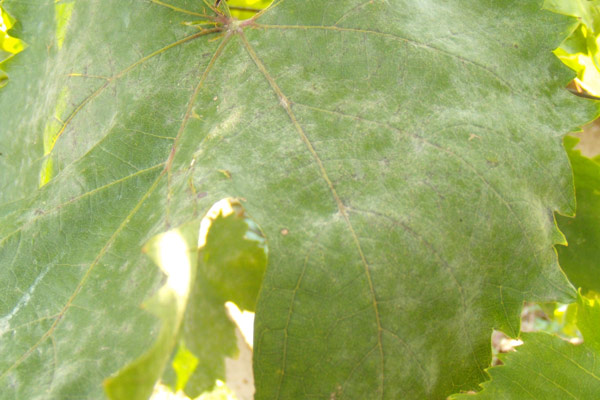
In recent years, there has been a trend of more widespread occurrence and significant losses of the grape yield caused by powdery mildew. The main prerequisites for this are omissions in certain elements of the vineyard cultivation technology and recommendations for the control of powdery mildew that are often not in line with the biological characteristics of the pathogen. At this stage, more detailed and comprehensive information is needed on the development and forecasting of the disease, with a view to scientifically based management of the control measures.
Control measures
The biological characteristics of the pathogen require that control be carried out from the stage of shoot emergence to the beginning of berry ripening. When infection is present on the main internodes (2–3 spots per internode), the first treatments are carried out early, at shoot height of 2–4 cm, with systemic fungicides. The purpose of the treatment is to destroy the overwintering mycelium in the buds and on the young shoots.
Authorised plant protection products
Treatments are carried out depending on the dynamics of disease development. Critical phenological stages for protecting grapes from powdery mildew are from flowering to the beginning of berry ripening. Under favourable weather conditions and recorded mycelial growth on the leaves and especially on the clusters, treatments are intensified at 10–12-day intervals with systemic fungicides:
Bayfidan 250 EC - 0.01%; Bayfidan 312 SC - 12 ml/da; Bumper 25 EC - 0.02%; Vivando - 20 ml/da; Dinali 090 DC - 50–65 ml/da; Domark 10 EC - 25–30 ml/da; Indar 050 EW - 0.06%; Cabrio Top - 0.2%; Collis SC - 0.04%; Quadris 25 SC - 0.075%; Orius 25 EW/Dynasty 25 EW/Tebumax 25 EW - 0.04%; Systhane Ecosom EW - 0.2–1.5 l/ha; Strobi DF/Discus DF - 0.02%; Talendo 20 EC - 20–25 ml/da; Talendo Extra - 7.5–25 ml/da; Topaz 100 EC - 0.015%; Top Plus 70 WP - 0.1%; Falcon 460 EC/Impuls Super EC - 30 ml/da; Flint Max 75 WG - 0.016%; Folicur 250 EW/Horizont - 0.04%; Folpan 80 WDG - 0.1% + Ardent 50 SC - 0.015%; Shavit 25 EC/Tridemol 25 EC - 0.01%; Shavit F 72 WDG - 0.2%.
Among the sulphur-containing products, dusting sulphur (3–4 kg/da) is widely used in practice, mixed with synergistic substances in a ratio of 80:20 for dusting with tractors and 1:1 for aerial application. Dusting is carried out in the presence of dew and at temperatures from 10–12 to 25–28°C. At higher temperatures, sulphur causes scorching. Among wettable sulphur preparations, the following are used: Acoidal 80 WG – 0.25%, Kumulus DF – 0.2–0.3%, Solfoliquid – 0.3%, Thiovit Jet 80 WG – 0.2% (applied after flowering), etc. Preventive, prophylactic sprayings are carried out with sulphur-containing products.
In case of more widespread occurrence of the disease, clear formalin – 0.4–0.5% may be used, alone or in combination with another fungicide. It is advisable to carry out treatments in the afternoon, when daytime temperatures begin to decrease.
The results of sprayings are more effective when combined with the performance of green pruning operations.
Biological control
In organic production, control is carried out through green pruning operations and the use of sulphur-containing products and Timorex 66 EC (tea tree extract) – 0.5%.