

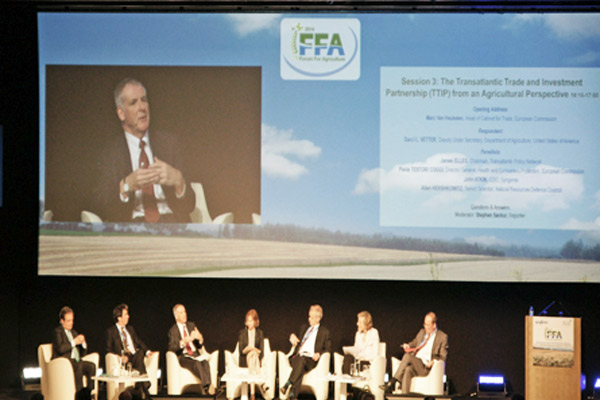
7th Forum for the Future of Agriculture, Brussels 2014: Transatlantic Trade and Investment Partnership (TTIP). Europeans are facing a dilemma as to whether the new agreement will be able to meet the high expectations and whether it will preserve the legislation already created in its current form. The threat of a global economy of the Chinese type, which would dictate the rules of world trade, puts Europe in a position to renounce autonomous decision-making.
One of the main modules of the Forum for the Future of Agriculture in Brussels was dedicated to the Transatlantic Trade and Investment Partnership (TTIP), which is a free trade agreement between the EU and the USA. Negotiations started in mid-2013, went through several rounds, and their finalisation is expected at the end of 2014. After that, the 28 governments will have to approve the agreement for negotiation within the Council of EU Ministers.
The project envisages the expansion of the world economies, with this figure amounting to EUR 120 billion for the EU, EUR 90 billion for the USA and approximately EUR 100 billion for the remaining world economies, liberalisation of one third of world trade and the creation of millions of new jobs. Commissioner Karel De Gucht promises that the agreement will bring each family in the EU EUR 545 per year. In the USA, the purchasing power of a typical American family is expected to increase by USD 900.
Fifteen working groups have been formed, each covering a different area.
The objectives of the agreement are focused on several aspects:
- elimination of customs duties, which in practice have almost been abolished in recent years, with the exception of agricultural ones;
- liberalisation of constitutional and legal norms, rules and provisions that limit the scope of economic competition, defined as a supreme, fundamental and inalienable freedom.
- the procedure for the settlement of disputes between investors and states. This clearly contentious point will open the doors for large corporate companies to impose their rights at national level. Thus, legal disputes will no longer be resolved through national jurisdictions, but through private structures called “arbitration mechanisms for dispute settlement”. If any of the investors considers that he has been discriminated against by the government, he may turn to a private commercial tribunal composed of three judges. The first is appointed by the state itself, the second – by the investor company, and the third is jointly appointed by the parties or is chosen from the list of eligible candidates. This tribunal will in particular have to take decisions on huge compensations that the investor may claim if he considers that some new law will adversely affect his profits. The tribunal’s decisions will not be subject to appeal. This means that, on the one hand, national judicial systems will prove powerless and, on the other, the fear of large compensations will significantly restrict the legislative freedom of governments.
Criticism
The lack of transparency in the discussion modules between Washington and Brussels is evident, given that the negotiation mandate is also not public. The USA has forbidden the EU to show the documents on the American position even to the members of the European Council and the European Parliament – although these same documents have been shared with 600 industrial lobbyists in the USA, opponents claim. The European Commission is trying to reject the criticism by holding numerous briefings and discussions with NGOs.
In the last session of the Forum for the Future of Agriculture, the focus was above all on the harmonisation of standards in European and American agriculture. John Atkin, Chief Executive Officer of Syngenta, pointed to the large differences in food and health standards as the main obstacle to world trade. “Reducing the complexity of the harmonisation procedure will benefit not only trade, but also consumers.”
This is precisely the challenge of the given agreement – to harmonise standards in contentious areas such as agriculture, pharmaceuticals and financial services. European law ensures a relatively more liberal regulation of the financial sector compared to the strict laws in force in American banks. At the same time, Europe pursues a policy of restricting GMOs and the import of meat produced with growth hormones. The European Commission assures that it will not sink the existing European laws and that it will be strict but fair. The official position is that GMOs are not the subject of negotiations with the USA, but there may be regulatory cooperation. European law already allows some GMOs to be sold in the EU if they are approved by the European Food Safety Authority. So far, 52 GMOs have been authorised. These were also the key points emphasised in the discussion by Paola Testori Coggi, Director-General for Health and Consumers in the EC.
The agreement, which has not yet entered into force, is already the subject of serious criticism, growing tension and speculation. In practice, most customs duties have already been abolished as a result of various previous trade agreements. This opens the door wide to focusing on non-conventional barriers, such as exemptions from provisions relating to fracking, GMOs and financial resources and the tightening of measures under copyright laws.
Of course, German chemical and pharmaceutical enterprises rely on the agreement to simplify the procedures for placing their products on the American market. State-subsidised agriculture will be able to sell overseas the surpluses of dairy products and pork. Therefore, until recently, the German government was considered the driving force behind the preparations for TTIP. As the fate of other trade agreements shows, they do indeed help economies to grow, which unfortunately does not affect all players. For example, the consequences for citizens of the North American Free Trade Agreement between the USA, Canada and Mexico (NAFTA), which was signed 20 years ago, turned out to be quite unfavourable. In the USA, millions of industrial jobs were cut, and thousands of Mexican maize producers were left without means of subsistence, as their production could not compete with exports from the USA, where the state pursues a policy of generous subsidies for the agricultural sector. Trade volumes increased many times over, but only the large corporations benefited from this.
One of the most important aspects of managing the challenges shaping modern agriculture is to continue along the path towards achieving a multilateral trade agreement, which is “the most effective and the most equitable” and “will help address food security”, according to Pascal Lamy, former Director-General of the World Trade Organization and Honorary President of the North-European Jacques Delors Institute.
In Europe, at present, the problems related to the growing climate change, as well as the introduction and observance of strictly regulated environmental measures guaranteeing the sustainability of agriculture and the environment, are highly valued. In this sense, Europeans are facing a dilemma as to whether the new agreement will be able to meet the high expectations and whether it will preserve in its current form the legislation already created. The threat of a global economy of the Chinese type, which would dictate the rules of world trade, puts Europe in a position to renounce autonomous decision-making.