

The sunflower hybrids offered by Syngenta have a high yield potential. This potential can be realized provided that certain requirements in the cultivation technologies are observed, which include control of various types of weeds, diseases and pests.
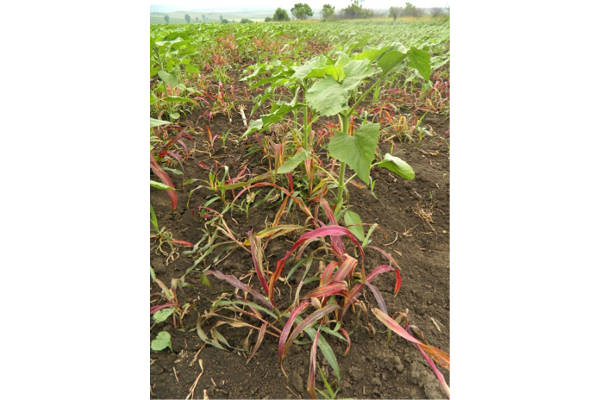
Sunflower is highly sensitive to weed infestation and the combination of agrotechnical and chemical measures in weed control delivers the desired results for clean stands. The application of herbicides in sunflower is a key part of its cultivation technology. Depending on the need and the specific situation in the field, the correct approach in choosing a product is of essential importance for achieving the desired results. If, during the vegetation of sunflower, annual and perennial grass weeds occur at high density, an antigraminaceous herbicide is applied: Fusilade Forte® – a systemic, foliar, selective herbicide for the control of annual grass weeds at a rate of 80 ml/da against annual grass weeds and at a rate of 100–130 ml/da against perennial grass weeds. Application is recommended at the 3rd–5th leaf stage of the weeds and volunteers and at 10–20 cm height of rhizome johnsongrass. Thanks to its ISO-Link technology, Fusilade Forte® is completely absorbed by the leaves of the weeds and very quickly spreads throughout the entire plant, penetrating deep into the rhizomes of perennial weeds, which determines its excellent efficacy against perennial weeds such as johnsongrass and couch grass, as well as against late spring weeds: redroot pigweed, barnyard and blood millet species, goosegrass species and others. The development of susceptible weeds stops immediately, the first symptoms appear after a few days, and their death – after approximately 2–3 weeks. The formulation with Link technology also contributes to improved rainfastness and increased selectivity. Rainfall occurring 1 hour after treatment does not affect the efficacy. Fusilade Forte® is highly selective to sunflower, allowing the plants to develop their yield potential. By eliminating competition from economically important grass weeds, the crop develops better and realizes its yield potential more successfully.
Herbicides applied in maize during vegetation are both an effective corrective solution and a main measure for the control of johnsongrass and grass weeds. Here, Elumis™ OD is recommended – a broad-spectrum, post-emergence, selective, dual-system herbicide. Elumis™ OD controls all economically important weeds and has proven to be extremely reliable in the control of rhizome johnsongrass, field bindweed and creeping thistle, overgrown weeds, and even bramble (necrosis of the leaf mass). No pre-harvest interval is required and it has a “flexible” dose and a long period of application. Another very important quality is that Elumis™ OD is a foliar herbicide with additional soil activity and the possibility of application up to the 7-leaf stage of maize. It is characterized by the typical “soft” action of Syngenta herbicides, i.e. its application does not stress the crop and does not affect yield. An additional advantage, besides the application stage up to the 7th–8th leaf, is the flexible rate of 150–200 ml/da in a single application. A rate of 175 ml/da is fully sufficient to cope with weed infestation in more severe cases. Successful control and effect with Elumis™ are also achieved thanks to its OD formulation – it enables the spray solution to cover the leaf mass even of weeds with a waxy leaf coating (such as common lambsquarters), ensures rapid penetration and guarantees efficacy even under rainfall. The product is offered at a very attractive price in the 2015 season.

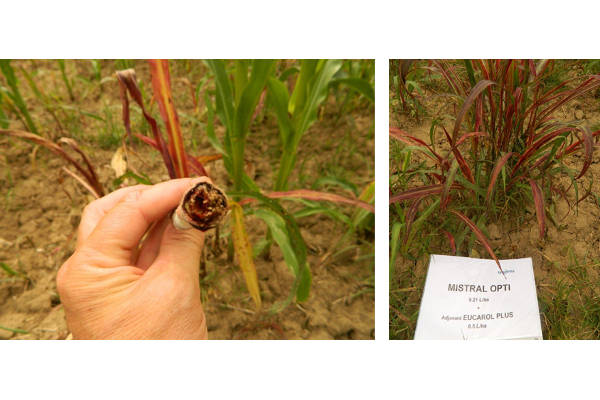
If you have used Camix® as a pre-emergence treatment and at a later stage during maize vegetation there is a second flush of grass weeds and johnsongrass, you should use Mistral Opti® in order to avoid excessive accumulation of mesotrione. Mistral Opti® successfully controls annual and perennial grasses, including rhizome johnsongrass, and some annual broadleaf weeds. It has a wide application window: from the 1st to the 8th leaf stage of the crop, the 2nd–4th leaf stage of the weeds or johnsongrass height of 15–25 cm. Mistral Opti® is characterized by rapid initial action, low application rate and high selectivity, with no problems for the following crop in the crop rotation; in addition, it is offered in cost-effective packs with Casper® and Peak® for simultaneous control of broadleaf weeds. A very important addition: in 2015 Mistral Opti® is provided with a bonus Eucarol Plus – an innovative adjuvant, at a low rate of 50 ml/da, which provides a new level of effectiveness in the control of grass weeds under both dry conditions and excessive rainfall. With Eucarol Plus the efficacy and duration of residual activity are increased under unfavorable climatic conditions. Eucarol Plus is a four-component adjuvant, which provides the following practical advantages: the lipophilic component enhances penetration into the cells and increases rainfastness; the non-ionic component improves spreading on the leaf surface and also enhances penetration; the anionic component acts as a wetting agent, aiding spreading and with emulsifying functions; the antifreeze agent improves activity at low temperatures.
Off topic: an innovation from Syngenta for pest control in maize during vegetation – Ampligo® for the control of European corn borer (Ostrinia nubilalis)! This pest causes significant damage under monoculture production, but in recent years it has also caused damage to conventionally grown fields where crop rotation has been observed, with losses reaching a serious percentage and significantly reducing yield. It is advisable for farmers to pay attention to this measure as well and, where possible, to take action with Ampligo® at a rate of 30 ml/da.
PR material