

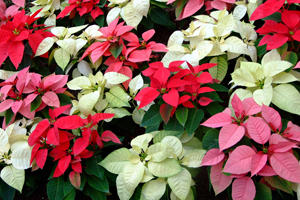
The Poinsettia is a plant from the Euphorbiaceae family, whose leaves are most often colored bright red. In 1843, the Poinsettia, as the plant is also called, was brought to the European continent. Although it is a Christmas symbol in Western Europe and America, its native home is considered to be the tropical regions of Guatemala and Mexico. Interest in it in Europe is enormous, which has necessitated continuous work by floriculture companies on its selection. Interestingly, the plant is recorded as an invasive weed in some parts of Africa, India, and the Canary Islands.
Structure and Chemical Composition of the Poinsettia
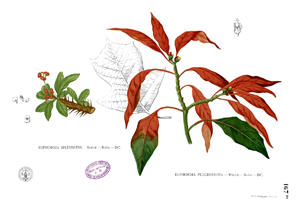
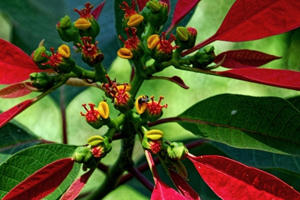
The Poinsettia grows as a shrub, reaching a height of 3-4 meters. Wild-growing species are found, which are evergreen, also with a height of up to 4 meters. Hybrid ornamental species, grown in pots, have a growth height of 30-40 cm. The leaves have an elliptical shape, a length of 12 to 20 cm, very well-defined leaf veins, and long petioles. The leaves located at the tops of the plant develop in the form of a rosette and turn red - as if forming a star. There are varieties in which the leaves are colored white, marbled, pink, yellow, white-cream, various shades of green, or are bicolored. In the middle of these leaves, at the tip of the branch, the plant's true flowers sprout. They are very small and bloom from December to February. The true flower is a cluster of several small florets, located in the center of the colored leaf rosette. They are about 1 cm long, have serrated edges, and have one or two large, yellow glands attached. The fruits are three-part capsules, measuring 1.5 by 1.5-2 cm. They contain seeds with an egg-shaped form, a smooth or slightly rough surface, and a pale gray color. Toxic substances, such as diterpene esters, have been discovered in the plant's milky sap. The bracts contain: resin, yellow and red pigment, essential oil, tartaric acid, gallic acid, glucose, sucrose, starch, salts. The bark of the plant contains red pigment. And the leaves contain: alkaloids, saponins, sulfur, fats, amylodextrin, and formic acid.
Folk Medicine
The Poinsettia is believed to have antibacterial action. Extracts from fruits, leaves, stems, and flowers show moderate antibacterial effects on Micrococcus pyogenes, E. coli, and P. aeruginosa. A methanol extract from the whole plant, containing phytochemicals (terpenoids, flavonoids, alkaloids, saponins, steroids), showed remarkable activity against E. coli, S. aureus, S. typhi, and P. aeruginosa. Poinsettia extracts containing alkaloids, terpenoids, saponins, glycosides, reducing sugar, and amino acid, removed a significant amount of free radicals and exhibited moderate antibacterial activity against K. pneumonia, S. epidermis, B stearothermophilus, and S typhimurium. The plant's milk is used to treat fever, to relieve pain, to stimulate milk production, as an antibacterial and emetic (vomiting-inducing) agent. In the folk medicine of Mexico and Guatemala, it is applied topically for treating skin lesions such as warts, for toothache, and as a depilatory agent. For pain, poultices from the plant's leaves are used topically. The juice from the leaves was used by the Aztecs for fever.