

![MultipartFile resource [file_data]](/assets/img/articles/листо-акар-август.jpg)
Spider mites (family Tetranychidae) are among the dangerous and widespread microscopic non-insect pests of agricultural crops, vegetables, fruit trees, and flowers. This family includes phytophagous species with a cosmopolitan distribution, causing significant yield losses, especially under warming climatic conditions. Spider mites, also known as web-spinning mites or "red spiders," include over 1,200 species worldwide, 100 of which are dangerous pests. They are among the economically important pests that are difficult to control on vegetable crops. The family Tetranychidae is divided into two subfamilies, Bryobiinae and Tetranychinae, and includes at least 71 genera. The most common species belong to the genera Tetranychus, Eutetranychus, Oligonychus, and Panonychus. Representatives of the family Tetranychidae are small mites (about 0.4 mm long, with four pairs of legs and no antennae), with an elongated oval body shape and well-expressed sexual dimorphism. Males have a smaller body with a pointed posterior end. The legs are proportionally developed. Body coloration varies from green to yellow when active, or bright orange during periods of dormancy. Under magnification, two dark spots are visible on either side of the body in adults. The development of mites passes through the stages: egg, larva, nymph, and adult. Mite eggs are most often round, yellow, or translucent spheres, resembling small pearls. Larvae are the size of eggs, have three pairs of legs, and are light yellow with rounded bodies. Nymph coloration varies from light yellow or green to red or orange. They are smaller than adults but also have four pairs of legs. Some species produce abundant webbing, under which they live in colonies. Mites form webs when their populations are at high density, which protects them from natural enemies and fluctuations in environmental conditions. The webs also help the mites spread to new hosts. The presence of webbing is a useful indicator for distinguishing web-spinning mites from other vegetable pests, such as aphids and thrips. This family includes the most harmful species to cultivated plants, such as the two-spotted spider mite, the European red mite, the Atlantic spider mite, and others.
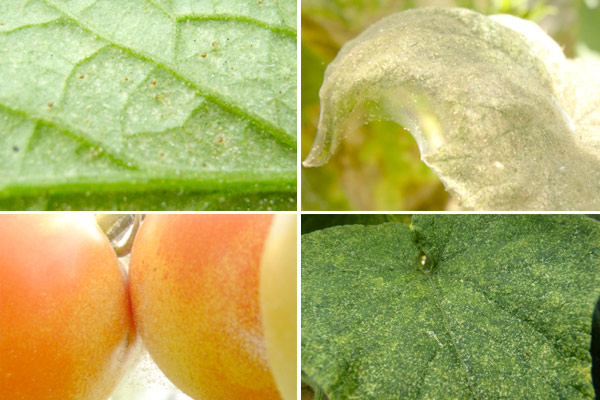
In vegetable crops, both in greenhouses and in the field, the most common species is the two-spotted spider mite (Tetranychus urticae Koch). This polyphagous pest can feed on hundreds of wild and cultivated plants and cause significant damage.
Life cycle
The two-spotted spider mite has four developmental stages, like the other members of the family: egg, larva, nymph (protonymph, deutonymph), and adult. In regions with cold winters, it overwinters as adult females at the base of host plants, in the surface soil layer, under debris, or on weeds in and around fields. With rising temperatures the following spring (from 10 to 12оС), activity resumes, and overwintered mites migrate to host plants to lay eggs on the leaves. In controlled environments such as greenhouses, populations can remain active all year round. A single female can lay about 190 eggs. Colonies of the two-spotted spider mite tend to be found on the underside of leaves. When food becomes scarce, this species can migrate to new areas and hosts by crawling or using its web. It is often spread through seedlings, produce, packaging, plant debris, and other means. This mite can survive in a wide range of temperatures from 10-40°C. When overwintering outdoors, T. urticae withstands low temperatures; at -10оС, its mortality reaches only 10%. The duration of the life cycle depends on environmental conditions (temperature, humidity), food, and other factors. Dry conditions favor its development, and its entire life cycle is completed in 10 days or less under hot and dry conditions. Mites develop intensively at higher temperatures and lower atmospheric humidity, which is why they multiply massively most often in midsummer and during the second half of the growing season. The number of generations varies from 12 to 15, and under greenhouse conditions about 20. Their intensive multiplication in cultivation facilities is usually evidence, an indicator of significant errors in crop cultivation technology. When the day length shortens to less than 13 hours, reproduction may cease, and the mite enters diapause. The two-spotted spider mite can attack many ornamental and vegetable plants. Vegetable hosts include tomatoes, cucumbers, eggplant, beans, peppers, zucchini, melons, leeks, and others.
Damage
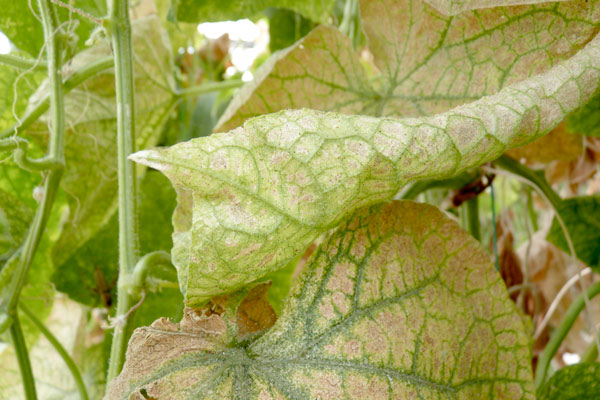
Two-spotted spider mites feed by piercing plant cells with their piercing-sucking mouthparts and removing the cell contents, depleting them of chlorophyll. This reduces photosynthetic production and the overall productivity of plants. Feeding results in injuries on the upper surface of leaves, which appear as white, gray, or yellow small spots. Damaged leaves look mottled like marble. The leaves of heavily infested plants may turn yellow and eventually dry out and drop prematurely. Often, immature females form a silken ball of webbing. The spider mite prefers older leaves with reduced water content and aged, dried-out plants. Silken webs can also cover entire plants. If control is not carried out, the plants may die.
Monitoring
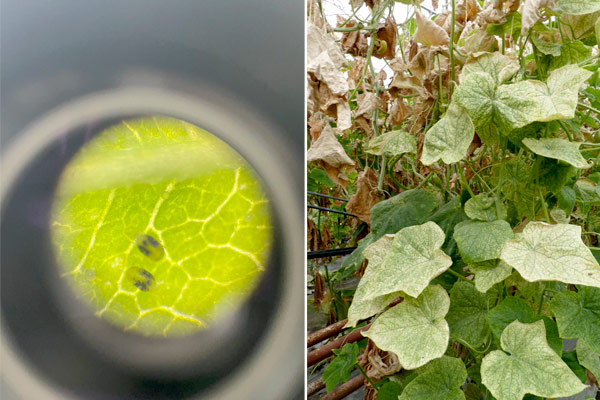
Plants can be inspected for feeding damage, mites, or cast skins. The underside of leaves can be checked for mites weekly by taking plant samples and observing them under a binocular microscope. Localized spraying can be effective when individual plants or infestation patches are found in the field. When spot spraying, a buffer zone outside the area with established mites should also be treated.
Biological control
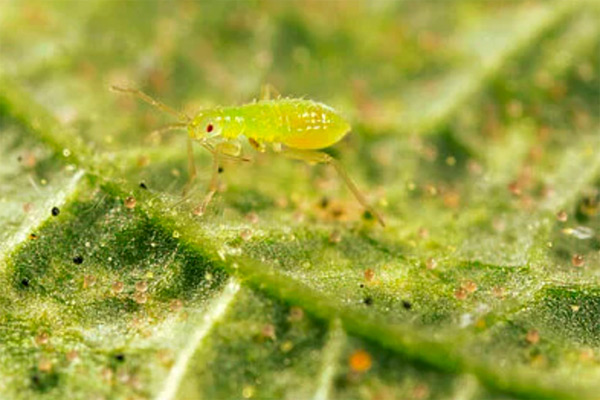
Macrolophus pygmaeus (Hemiptera:Miridae)
There are various beneficial insects and predatory mites that provide natural control of the two-spotted spider mite. These may include Stethorus spp. (Coleoptera:Coccinellidae), predatory bugs Orius spp. (Hemiptera:Anthocoridae), Macrolophus pygmaeus (Hemiptera:Miridae), predatory mites Phytoseiulus persimilis (Acari:Phytoseiidae), and others. Some predators occur naturally, while others are commercially available for release as biocontrol agents in greenhouses or other enclosed spaces. It should be noted that predatory mites require high humidity, and their release is not effective for controlling the two-spotted spider mite outdoors.
Chemical control usually involves acaricides. However, repeated applications at intervals of 7 to 10 days are necessary, as most plant protection products used against the two-spotted spider mite do not have ovicidal activity. Repeated applications can be expensive, promote resistance in the pest population, and have a negative impact on natural enemies. Pesticides with different modes of action can be alternated to prevent resistance, and the use of broad-spectrum pesticides should be avoided whenever possible. The following plant protection products can be used to control the two-spotted spider mite: Treatment with registered PPPs: Apache EF 30-100 ml/ha; Butik 30-100 ml/ha; Bermectin 15-100 ml/ha; Valmek 15-100 ml/ha; Laota 15-100 ml/ha; Limocide 200 ml/ha; Naturalis 100-200 ml/ha; NeemAzal T/S 0.3%; Nissorun 10 WP 50-75 g/ha; Nissorun Plus 120 ml/ha; Requiem Prime 500-1000 ml/ha; Shirudo 15 g/ha; Flipper 1-2 l/ha. An extremely effective, cheap, and traditional means of mite control is Sulfur WG 300 g/ha. Treatments should begin when the pest appears at the economic threshold level.
In our country, along with the two-spotted spider mite, the Atlantic spider mite (Tetranychus atlanticus McGregor) also occurs, which has similar biological characteristics. The two species are sometimes found simultaneously in mixed populations, have a similar appearance, and cause identical damage.
Successful control of spider mites requires an integrated approach. Rational use of agrotechnical, biological, and chemical measures: Use healthy and mite-free seedlings; Destroy weed vegetation that serves as a reservoir for the pest; Maintain optimal water regime, as droughts favor mite development; Mechanically remove aged and dried-out plants, especially at the end of the growing season, using polyethylene bags. Mites can appear in crops and remain unnoticed for a long time due to their small size and the fine punctures they make. Sometimes, by the time the damage is detected, it is too late for successful control, necessitating 2-3 or more treatments. This pest reproduces rapidly under favorable conditions and can significantly expand its range within a few days. Remember, regular scouting is the first step towards effective control!
References
- Atanasov N., M. Vitanov, E. Loginova, E. Ilieva, 2005. Integrated protection of greenhouse crops from diseases and pests. Sofia, Videnov&sin and PantaNeo Publishing House, 159.
- Bahariev, D., B. Velev, S. Stefanov, E. Loginova, 1992. Diseases, weeds, and pests of vegetable crops, Zemizdat, 338.
- Razuvaeva A. V., E. G. Ulyanova, E. S. Skolotneva, I. V. Andreeva, 2023. Species identification of spider mites (Tetranychidae: Tetranychinae): a review of methods. Vavilov Journal of Genetics and Breeding. 27(3):240-249. DOI 10.18699/VJGB-23-30
- Assouguem, A., Kara, H. M. Mechchate, Y. B. Korkmaz, S. Benmessaoud, A. Ramzi, K. R. Abdullah, O. M. Noman, A. Farah, A. Lazraq, 2022. Current Situation of Tetranychus urticae (Acari: Tetranychidae) in Northern Africa: The Sustainable Control Methods and Priorities for Future Research. Sustainability 14, 2395. https://doi.org/10.3390/su14042395
- Ben-David T., S. Melamed, U. Gerson, S. Morin, 2007. ITS2 sequences as barcodes for identifying and analyzing spider mites (Acari: Tetranychidae). Exp. Appl. Acarol. 41(3):169-181. DOI 10.1007/ s10493-007-9058-1
- Migeon A., E. Nouguier, F. Dorkeld, 2010. Spider Mites Web: a comprehensive database for the Tetranychidae. In: Sabelis M., Bruin J. (Eds.) Trends in Acarology. Dordrecht: Springer, 557-560. DOI 10.1007/978-90-481-9837-5_96
- https://agsci.colostate.edu/agbio/ipm-pests/spider-mite/