

![MultipartFile resource [file_data]](/assets/img/articles/раст-защита-април-2026.jpg)
![MultipartFile resource [file_data]](/assets/img/articles/бадемов-семеяд-април-2026.jpg)
![MultipartFile resource [file_data]](/assets/img/articles/червени-петна-април-2026.jpg)
![MultipartFile resource [file_data]](/assets/img/articles/сливова-плодова-оса-повреда-2026.jpg)
![MultipartFile resource [file_data]](/assets/img/articles/ягода-бели-петна-април-2026.jpg)
![MultipartFile resource [file_data]](/assets/img/articles/лешников-хоботник-април-2026.jpg)
![MultipartFile resource [file_data]](/assets/img/articles/малина-бръмбар-април-2026.jpg)
![MultipartFile resource [file_data]](/assets/img/articles/мана-лоза-април-2026.jpg)
Frequent rainfall in April will be a prerequisite for an increase in the infectious background from a number of fungal diseases in fruit trees - early brown rot, scab, shot hole, etc. Many of the pests on fruit plants - aphids, scale insects and others have 2-3 or more generations, and infections from some diseases – scab on apple and pear, shot hole on stone fruits, brown rot, peach leaf curl and others depending on rainfall are repeated multiple times during the growing season.
To prevent the severe development of diseases and pests, it is necessary to reduce the populations of the first generation of pests to the possible minimum and limit the primary infections of the diseases. This can be achieved through timely and well-organized control in April, when their development begins.
The effectiveness of plant protection activities in April largely determines the protection of fruit plants throughout the season. For pests – plum fruit moth and others that develop one generation per year and diseases – red leaf spot and others without a secondary development cycle, the plant protection measures in April completely resolve the issue of protecting fruit plants from them.
More suitable conditions for conducting plant protection sprays will be created in the middle of the first, beginning of the second and third ten-day periods. Although we have also reviewed synthetic fungicides and insecticides, to avoid harming bees, during flowering use the given biological products – products based on azadirachtin can be used against all plant-feeding insects and where permissible use Mavrik 2F – 60 ml/da, instead of other pyrethroid products.
The last April frosts are expected at the beginning of the third ten-day period.
In April, an increased probability of hail is forecast in the middle and at the end of the third ten-day period. Fruit crops affected by hail should be treated with copper-containing fungicides at the first opportunity to limit the risk of secondary infections with pathogens. Copper-containing products are not treated during flowering, as copper fungicides can burn the flowers, damage stamens and pistils, lead to flower drop and can repel bees and negatively affect them upon contact.
In fruit nurseries
Removal of plants with ungrafted buds and scions, infested with powdery mildew, during the period of bud break on apple.
If not already done, spray with a copper-containing product – 1% Bordeaux mixture, Funguran OH 50 WP -150-250 g/da, Champion WP - 0.3%, Copper Key – 180-300 g/da on apple, pear and quince rootstocks in mother plantations and apple and pear scions in nurseries against scab, gray leaf spot, brown leaf spot, fire blight, etc. Upon appearance of leaf-eating caterpillars, aphids, woolly apple aphid, pear psyllid, weevils, apple blossom weevil, add an insecticide with active base deltamethrin – Deca EC – 30-50 ml/da, Decis 100 EC - 7.5 -12.5 ml/da, Delmur – 50 ml/da, Meteor – 0.06 -0.09% or another broad-spectrum pyrethroid like cypermethrin, lambda-cyhalothrin, tau-fluvalinate, esfenvalerate to the fungicide.
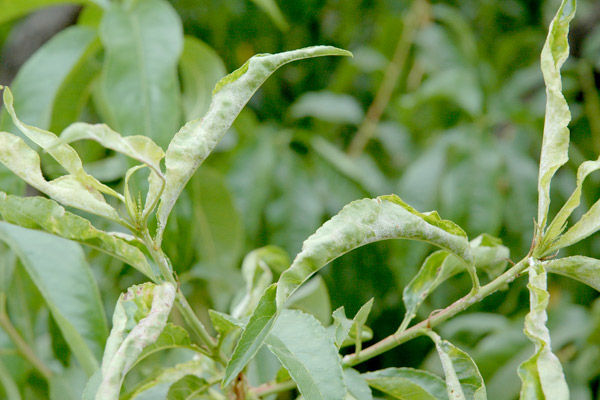
Powdery mildew on peach
Upon appearance of powdery mildew on apple and peach scions in nurseries, spray with a product with active base sulfur – Sulfur WG 600 g/da, Solfo 80 WG – 750 g/da or one of the products - Sistan 20 EW – 0 %, Luna Experience – 50-75 ml/ da, Flint Max 75 WG – 0.02 %.
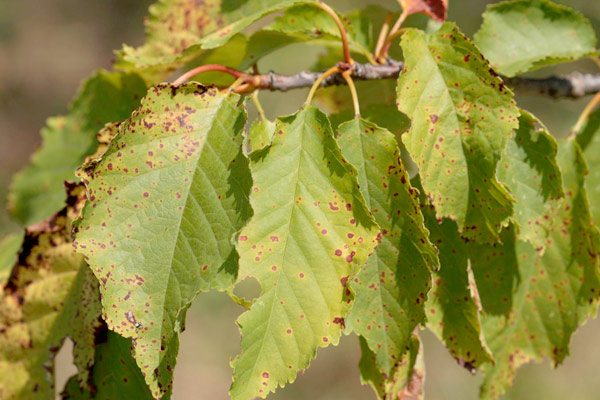
Cylindrosporiosis (white rust) causes significant damage to cherry production, as it causes premature defoliation of trees, which not only reduces the quantity and quality of the yield but also leads to freezing of trees during winters with low temperatures. The damage from cylindrosporiosis is mainly on the leaves and only on some varieties also on the fruit stalks.
Upon appearance of first signs of cylindrosporiosis on the leaves of sour cherry and sweet cherry scions in nurseries and sweet cherry and mahaleb rootstocks in the seedbed, spray with Silit 544 SC – 125 ml/da. If pest density exceeds the economic threshold (ET), add an insecticide with active base deltamethrin – Deca EC – 30-50 ml/da, Decis 100 EC - 7.5 -12.5 ml/da, Delmur – 50 ml/da, Meteor – 0.06 -0.09% or another broad-spectrum pyrethroid like cypermethrin, lambda-cyhalothrin, tau-fluvalinate, esfenvalerate against leaf-eating insects, aphids, sloe sawfly, weevils to the solution.
In fruit orchards
Shoots infected with powdery mildew, missed during winter pruning of apple trees, are cut out. Buds infected late in the previous year are also discovered, which in appearance are almost indistinguishable from healthy ones and remained unnoticed during winter pruning.
Apple trees, marked in the previous year, whose fruits suffer from cork spot, are fertilized with borax (soil – 2 - 3 kg/da or foliar - 0.25 - 0.5 %) or another fertilizer rich in boron.
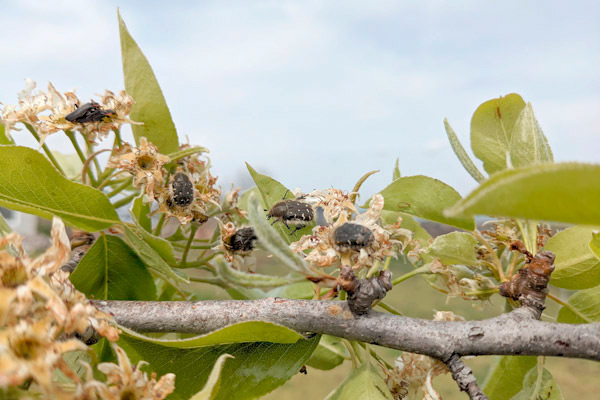
The hairy beetle is widespread throughout the country. It is a very dangerous pest of a large number of plants. The main host plants are from the family Rosaceae
For control against hairy and stink beetle during flowering, blue sticky pheromone traps are placed, blue tubes cut at the top with water and vinegar, placed on the branches and blue trays with water and vinegar in the inter-rows.
Hairy and stink beetles attack the entire flowers of fruit trees
To avoid harming bees you can use a product based on azadirachtin, such as Nim Azal – 300 ml/da. Nim Azal is used against all chewing, sucking and plant-feeding pests. The insecticide does not have a direct effect on the nervous system. It acts only orally, through the digestive system. Satisfactory action is shown by the product Mavrik 2F – 60 ml/da, which is not dangerous to bees.
When sprayed, the beetles enter a state of catalepsy - temporary paralysis and fall to the ground, which allows successful mechanical collection onto cloth and destruction of the adult insects. The measure is applicable for smaller trees and not very large areas.
It is possible to create provocative strips of early-flowering species that the pest prefers, for example phacelia, which are sown around the fruit gardens and when the beetles concentrate on them they are collected manually or with an entomological net.
For control against bark beetles, the stems of the thick branches of fruit plants are treated with a contact broad-spectrum pyrethroid insecticide with longer residual action – Decis 100 EC - 7.5 – 12.5 ml/da, Karate Zeon 5 CS - 15 ml/da, Sumi Alpha 5 EC - 0.02% and others. Chemical control can only be conducted against the adult females emerging from the stem. Two treatments are performed against each generation. Usually the second generation is during harvest, therefore the measures are primarily focused on the first generation – especially for the small fruit tree borer.
Against adult black vine weevil, treat with broad-spectrum contact insecticides, at their highest registered doses, such as Deca EC – 30 - 50 ml/da, Mavrik 2F – 60 ml/da, also spraying the tree trunks, but the period they are on the trees in the gardens is quite long, and the beetles themselves are extremely resistant and the result is not very good.
Among bioproducts against adult black vine weevil, only products based on pyrethrins – for example Abanto (75 ml/da) and spinosad - Sineis 480EC (20 ml/da) show decent results upon direct hit on the beetles.
Overwintered larvae of the black vine weevil begin to feed relatively late, only at the beginning – end of May, at a soil temperature of 20 0C.
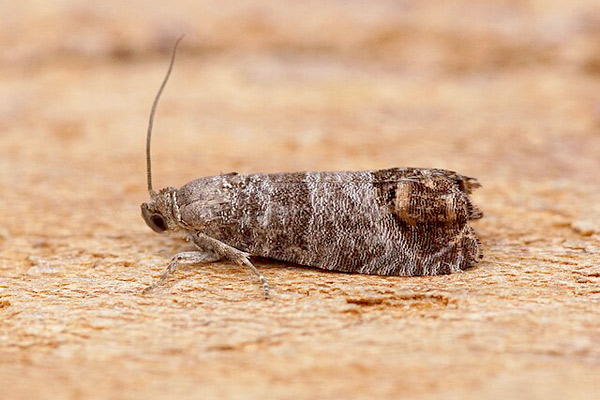
Adult codling moth
Around the second ten-day period of the month, specific pheromone traps for each species are placed, at a distance of 120-160 m from each other, to determine the beginning, mass flight and end of flight of the codling moth, plum fruit moth and oriental fruit moth.

Shot hole on apricot
The first post-bloom spray on apricots is performed immediately after flowering with a fungicide based on captan - Captan 80 WG – 150 - 180 g/da, Merpan 80 WG - 225 g/da, Scab 80 WG - 180-210 g/da against shot hole, brown rot and with an insecticide with active base deltamethrin – Deca EC – 30-50 ml/da, Decis 100 EC - 7.5 -12.5 ml/da, Delmur – 50 ml/da, Meteor – 0.06 - 0.09 % or another broad-spectrum pyrethroid like cypermethrin, lambda-cyhalothrin, tau-fluvalinate, esfenvalerate against fruit weevils, peach twig borer (anarsia), leaf-eating caterpillars. Against early brown rot you can treat with one of the products - Score 250 EC - 0.02 - 0.03 %, Sistan 20 EW - 0.025-0.03 %, Difcor 250 EC - 20 ml/da, Horus 50 WG - 45-50 ml/da. Among biological fungicides you can use Serenade ASO SC – 400 - 800 ml/da. Against peach twig borer and leaf-eating caterpillars, among bioproducts, Dipel DF – 0.1 %, Sineis 480EC – 20 ml/da can be used, and against aphids - Flipper – 1 – 2 l/da, Ovitex – 2000 ml/da, Niimik Ten – 260 – 390 ml/da.
The second post-bloom spray on apricots is done 10-12 days after the first with the same chemical products against the same diseases and pests.
The third post-bloom spray on apricot trees is done 10-12 days after the second with a fungicide based on captan - Captan 80 WG – 150 - 180 g/da, Merpan 80 WG - 225 g/da, Scab 80 WG - 180-210 g/da against shot hole, brown rot, gnomonia and with an insecticide with active base deltamethrin – Deca EC – 30-50 ml/da, Decis 100 EC - 7.5 -12.5 ml/da, Delmur – 50 ml/da, Meteor – 0.06 - 0.09 % or another broad-spectrum pyrethroid like cypermethrin, lambda-cyhalothrin, tau-fluvalinate, esfenvalerate against anarsia, oriental fruit moth, aphids, fruit weevils and leaf-eating caterpillars and with one of the acaricides - Nissorun 10 WP – 75 g/da (against eggs and young larvae), Apache EW, Vamec, Bermectin, Laota – 100 ml/da, Flipper – 1-2 l/da, Nim Azal T/C – 300 ml/da and Naturalis – 100-150 ml/da (against nymphs and adults), with the last three being biological, against red fruit mite and brown fruit mite. The last product works well only in increased humid environment, as it is of fungal nature. Against peach twig borer, oriental fruit moth and leaf-eating caterpillars, among bioproducts, can be used - Dipel DF – 0.1 % (gives unsatisfactory results against the oriental fruit moth), Sineis 480EC – 20 ml/da.

Oriental fruit moth
Against the oriental fruit moth, viral, contact products Carpovirusin – 100 ml/da and Madex Twin - 10 ml/da are also used. They are applied without a wetting agent. After drying (2 hours) they are not washed off by rain. They degrade from strong sunlight and their action lasts 8 - 10 sunny days. If some of