

![MultipartFile resource [file_data]](/assets/img/articles/фитоплазма-бабх.jpg)
The Bulgarian Food Safety Agency (BFSA) has placed 20.66 hectares in a vineyard area in the Veliko Tarnovo region under quarantine. A buffer zone of approximately 140 hectares has been established around them for a period of one year. The measure was taken due to the dangerous phytoplasma disease (Grapevine flavescence dorée) - the causative agent of grapevine flavescence dorée. The presence of the pathogen was confirmed through molecular testing at the Central Plant Quarantine Laboratory of the BFSA following a report from a research institute and the plantation owner.
The disease spreads through infected planting material and via a vector (carrier) – the American grapevine leafhopper (Scaphoideus titanus), which feeds on grapevine sap and can transmit the pathogen from infected to healthy plants.
An organization has been established to eradicate the identified outbreak.
Over the next year, complete surveys of the vineyard plantations in the area will be carried out, samples will be taken, laboratory analyses will be performed, and monitoring for the presence of the disease vector will be conducted. The goal of the measures is to timely limit the disease and protect the viticulture sector in the country.
The disease is considered one of the most dangerous for grapevines in Europe. It can lead to a reduction in yields by up to 50 percent and the gradual desiccation of grapevine plants. Due to the high risk of infection, the phytoplasma is classified as a quarantine pest in the European Union and is subject to strict phytosanitary control.
The National Program of Measures for Preventing the Spread and Control of Pests in Grapevines (genus Vitis) pays special attention to "vectors" - organisms that transmit and spread plant disease pathogens (viral, phytoplasmal), such as the American grapevine leafhopper (Scaphoideus titanus), a vector of the Flavescence dorée phytoplasma-PHYP64, the causative agent of Grapevine flavescence dorée. The phytoplasma is included in Annex II to Implementing Regulation (EU) 2019/2072, in the "List of Union quarantine pests and their respective codes"; Part B – "Pests known to occur in the Union territory". The American grapevine leafhopper, the vector of the phytoplasma, has been established in the territory of Bulgaria. Some European countries (France) already implement programs for mandatory insecticide treatment or sanitary uprooting of vines, aiming to limit the spread of grapevine flavescence dorée (Flavescence dorée phytoplasma).
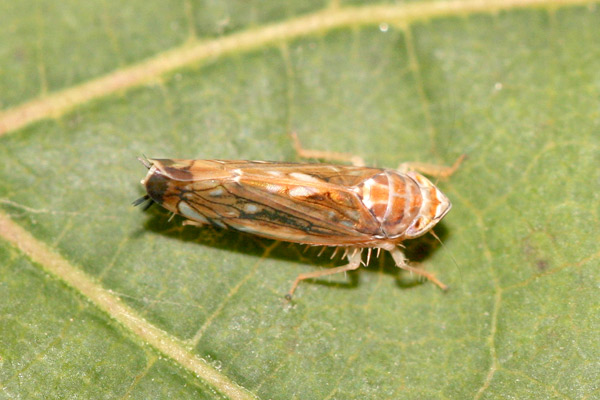
American grapevine leafhopper (Scaphoideus titanus) – adult
The nymphs and adult individuals of the American grapevine leafhopper (Scaphoideus titanus) acquire the Flavescence dorée phytoplasma while feeding on the leaves of infected plants. The latent period after acquisition is 4-5 weeks, after which the leafhopper transmits Flavescence dorée for the rest of its life. The species develops one generation per year and overwinters as an egg in the canes. Nymphs hatch in April. They feed (suck sap) from the leaves and young green shoot tips of the canes.
Adults appear in July. Copulation occurs in August, and egg-laying in the canes takes place in September.
From the beginning of May until the end of June (depending on meteorological conditions), inspections of vineyard plantations are conducted to search for larvae of Scaphoideus titanus. They are wingless and jumping. Cast larval skins can be found on the underside of leaves. A magnifying glass is used during the inspection.
Period for placing yellow sticky traps – from the beginning of July until the end of September. The traps are set and checked on a bi-weekly basis, i.e., over three months there are six rounds of setting and checking.
Featured photo and information: BFSA
More on the topic: