

![MultipartFile resource [file_data]](/assets/img/articles/заглавна-златка-прз.jpg)
Abstract
The Black Flatheaded Rootborer is widespread throughout the country and causes serious damage to stone fruit and some pome fruit species. In recent years, an increase in the pest's population density has been observed, which requires the implementation of urgent measures to limit its density and the damage caused by it.
The Black Flatheaded Rootborer (Capnodis tenebrionis) is one of the most dangerous pests of stone fruit species. The species is widespread in many European countries and causes serious damage annually. In the Mediterranean region, it primarily attacks cultivated and wild tree and shrub species of the Rosaceae family (Marannino and de Lillo, 2007).
In Bulgaria, between 1951 and 1955, the pest was responsible for the death of 40,000 trees in just one district. This necessitated an urgent study of its biology and control possibilities to limit the pest's spread and damage. In our country, the species develops one generation over two years and overwinters as larvae of various ages at the site of damage, as a pupa in a pupal chamber at the end of the tunnels in damaged roots, and as an adult in the soil (Kaitazov, 1958; Ben-Yehuda et al., 2000). Damage is caused by both adults and larvae, but the most economically significant damage is that caused by the larvae. Adults gnaw on the buds of young shoots and leaf petioles, leading to leaf drop (Figs. 1 and 2).
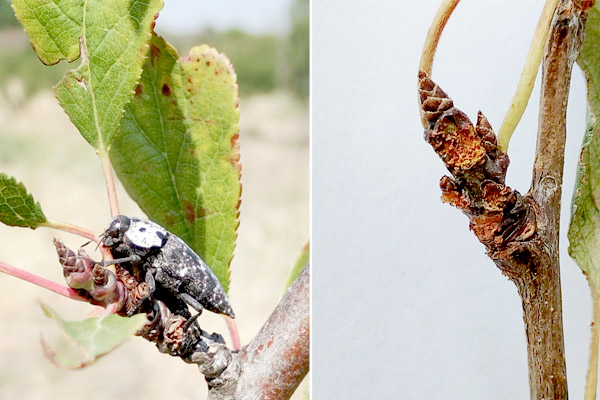
Figures 1 and 2. Adult Black Flatheaded Rootborer (left) and damage (right)
The larvae attack the roots, gnawing tunnels and galleries and destroying the cambial layer of the wood (Figs. 3 and 4). Attacked trees show signs of drought stress and moisture deficiency, and later dry out (Özyurt Koçakoğlu et al., 2020).
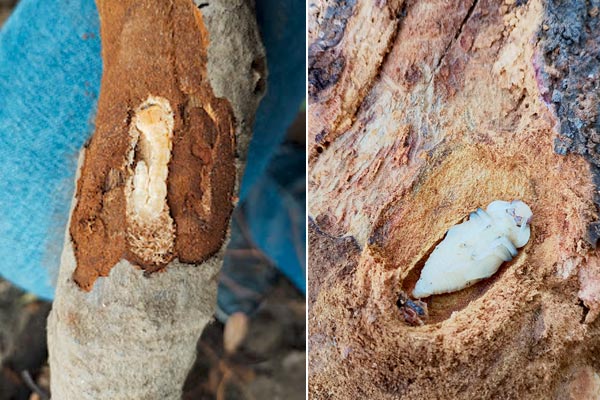
Figures 3 and 4. Larva and root damage (left) and pupa at the base of the root (right)
During the period 2024-2025, numerous observations were conducted in the Plovdiv region regarding the pest's emergence, population density, as well as testing of some control measures.
In 2025, under field conditions in plum orchards in the Plovdiv area, several chemical active substances were tested for the control of adult Black Flatheaded Rootborers. During the summer months, the biological efficacy of several plant protection chemical products (deltamethrin, acetamiprid, chlorantraniliprole, lambda-cyhalothrin, esfenvalerate, and tau-fluvalinate) was studied. All products were tested at the respective concentrations recommended by the manufacturing companies. After treating the adult insects, results were recorded at 24h, and on the 3rd, 5th, 7th, and 9th day after treatment.
The tested products showed weak biological efficacy against adult Black Flatheaded Rootborers, as the highest mortality rate of individuals reached only 30% (chlorantraniliprole and lambda-cyhalothrin). For two other active substances, a mortality of 20% was recorded (tau-fluvalinate and acetamiprid), and for the rest, it was below 20%.
The low toxicity of the tested active substances can be explained by the fact that these products are among the most commonly used in fruit growing for controlling a number of pests in fruit crops. Their widespread use leads to the development of pest resistance, including in the Black Flatheaded Rootborer.
As a recommendation, in orchards where the first adults have been spotted or the density is very low, treatment with chlorantraniliprole and lambda-cyhalothrin can be applied. However, in plantations with a high pest density, the efficacy of applying these active substances separately for adult control will be unsatisfactory.
References
- Marannino, P., & de Lillo, E. (2007, January). Capnodis tenebrionis (L. 1758)(Coleoptera: Buprestidae): morphology and behaviour of the neonate larvae, and soil humidity effects on the egg eclosion. In Annales de la Société entomologique de France (Vol. 43, No. 2, pp. 145-154). Taylor & Francis Group.
- Kaitazov, A. (1958). Capnodis tenebrionis L. Bionomics and measure for control.
- Özyurt Koçakoğlu, N., Candan, S., & Çağlar, Ü. (2020). Histomorphology of the adult digestive tract of Capnodis tenebrionis (L. 1758)(Coleoptera, Buprestidae). Microscopy and Microanalysis, 26(6), 1245-1254.
- Ben-Yehuda, S., Assael, F., & Mendel, Z. (2000). Improved chemical control of Capnodis tenebrionis and C. carbonaria in stone-fruit plantations in Israel. Phytoparasitica, 28(1), 27-41.
* This article is part of the seminar: "Science and Practice in Plant Protection", held on 19.02.2026 at the International Agricultural Exhibition AGRA 2026