

![MultipartFile resource [file_data]](/assets/img/articles/заглавна-мрежести-петна-ечемик.jpg)
Net blotch (Pyrenophora teres) is not just another disease in the crop – it is one of the serious economic factors in barley cultivation. Unlike wheat, barley has a shorter growing season and more delicate foliage, which allows the pathogen to spread quickly. Expert analyses show that if protection does not start on time, yield losses can reach up to 40%, and the quality of grain for brewing purposes can drastically deteriorate.
Knowing the pathogen and the exact time for reaction ensures profitable production and reduction of economic losses.
Host specificity: Why is barley vulnerable?
According to specialized studies, barley reacts much more acutely to stress and diseases in the early stages. Its leaves are thinner and physiologically more active in the lower layers than in other cereal crops. This means that net blotch, which traditionally starts from the lower leaves, directly „steals“ energy for the formation of the future ear right at the very beginning of tillering.
Symptoms and Biology
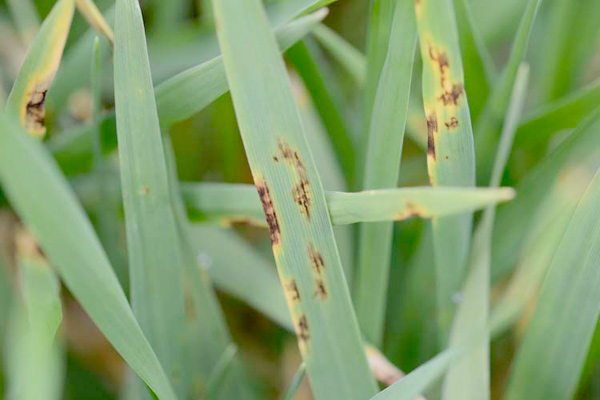
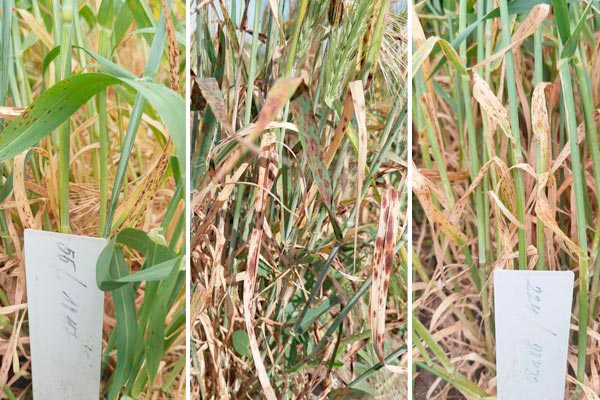
The pathogen manifests in two main forms, which often confuse inexperienced agronomists. The typical net form (f. teres) creates characteristic reticulated structures on the leaves, while the spot form (f. maculata) is limited to oval necroses with a chlorotic halo, resembling other leaf spots.
The life cycle of the fungus is closely related to plant residues. It survives on stubble, which makes minimal tillage technologies (No-Till and Strip-Till) riskier in terms of primary infection. Volunteer plants and infected seed material are the other two main pathways for the disease to enter the new crop.
The Climatic Factor: When Does the Risk Become Real?
Net blotch is highly sensitive to moisture. The critical period for infection requires relative air humidity above 90% and temperatures between 15°C and 25°C. It is important to note that even at lower temperatures (around 5-8°C), the pathogen does not stop its development but only slows it down. Prolonged leaf wetness for more than 10 hours is a sure sign for agronomists that they should prepare their sprayers.
How to protect the harvest?
The key to successful control of net blotch in barley requires a comprehensive approach – from selecting a resistant variety and quality seed treatment, to precise field monitoring and using the right molecules at the right time. In agriculture, information and prevention are as important as the technology itself.
Integrated Pest Management (IPM) is a strategy that combines various control tools to minimize economic damage at the lowest cost and minimal environmental risk. The strategy consists of the following points:
1. Prevention:
• Crop rotation: Adherence to a two-year crop rotation.
• Resistant varieties: Selection of genetically tolerant hybrids.
• Residue management: Deep plowing to destroy residues.
2. Monitoring and forecasting:
• Regular field surveys (the already discussed checklist).
• Use of meteorological stations to calculate risk periods (prolonged leaf wetness).
3. Mechanical and agrotechnical control:
• Optimal sowing times (avoiding too early sowing in winter barley, which extends the time for autumn infection).
• Balanced nutrition (avoiding excess nitrogen).
4. Biological control:
• Use of antagonistic microorganisms.
5. Chemical control:
• Application only when the Economic Injury Level (EIL) is exceeded.
Biological control of net blotch
Biological control relies on living organisms or their metabolites to suppress the pathogen. In modern agriculture, it is becoming increasingly relevant due to ecological and sustainability requirements in the sector, as well as the increasing resistance of fungi to chemical substances.
Key biological agents:
• Bacillus subtilis (Bacterial preparations):
Mechanism: This bacterium colonizes the leaf surface and creates a protective biofilm. It produces lipopeptides that directly destroy the cell walls of Pyrenophora teres spores.
Application: Used for spraying in early stages or as an additive to fungicides to reduce the chemical dose.
• Trichoderma spp. (Soil fungi):
Mechanism: The Trichoderma fungus is a hyperparasite. It literally feeds on the mycelium of pathogenic fungi in the soil and plant residues.
Application: Treatment of stubble after harvest to accelerate its decomposition and destroy overwintering infection.
• Strengthening the plant immune system:
Examples: Seaweed extracts, chitosan, or amino acids.
Action: They do not kill the fungus directly, but „trigger“ the barley's immune system, preparing it to react faster to an attack.
Advantages and challenges of biocontrol
|
Advantages |
Challenges |
|
No withholding period (safe for humans). |
Dependent on weather conditions (moisture is needed for bacteria). |
|
Prevents the development of resistance. |
Typically has a shorter period of action than systemic chemistry. |
|
Improves overall soil and plant health. |
Requires more precise application time (preventive). |
Practical scheme for integrated control in 3 steps:
- After harvest: Treat the stubble with a Trichoderma-based preparation to reduce the source of infection for the following year.
- Seed treatment: Use a biological or combined (bio + chemical) seed treatment for a strong start and root protection.
- Vegetation: For low to moderate pressure in T1 (tillering), include a biofungicide based on Bacillus subtilis. Reserve serious chemistry (SDHI) only for T2 (flag leaf), when the infection pressure is strongest.
The integrated approach not only protects the environment but is also often more profitable in the long term, as it preserves soil fertility and the effectiveness of fungicides for critical moments.
Preventive vs. Curative
Analyses of experimental fields confirm that preventive spraying is always cheaper than curative. When net blotch becomes visible to the naked eye on the sub-flag leaf, part of the plant's potential is already irrevocably lost. The use of modern fungicides with prolonged action (up to 4-6 weeks) allows the farmer to „stay ahead of events“, providing protection even during prolonged rainy periods when entering the fields is impossible.
The Foundation of Chemical Protection: Early Treatment during Tillering
In barley, unlike wheat, the protection of the lower leaf layers is of critical importance.
1. T1 treatment (beginning of tillering): Its role is to „clear“ the infection coming from the soil and residues. Skipping T1 in barley after barley is often a fatal mistake.
2. T2 treatment (flag leaf emergence): Here the fate of the yield is decided. Protecting the flag leaf and ear is a priority, using the most powerful fungicidal combinations.
The „Xpro“ Revolution in Fungicide Protection
For the second treatment (T2), science offers technologies that work on several levels:
1. Triple barrier: Mixing different mechanisms of action (triazole + two different SDHI molecules) ensures that the pathogen will not develop resistance.
2. „Green effect“ and physiological stimulation: Xpro technology enhances photosynthesis and optimizes the plant's water balance. This allows barley to remain green longer, which is directly related to higher hectoliter weight and larger grains.
3. Resilience to climatic stress: A better developed root system and strengthened stems make the crop resistant to droughts, which often occur in late spring.
Successful management of net blotch requires a precise selection of molecules. The old practice of spraying with „whatever is at hand“ is no longer profitable. The combination of early infection stoppage (T1) and powerful physiological support in T2 (Xpro technology) is the only sure way to maximum results in barley.
Key tip: Barley does not forgive delays. Plan your T1 treatment as early as the appearance of the first node (BBCH 31) to ensure peace of mind until harvest.
Professional Mistakes: Why does the fungicide „not work“?
Often, low effectiveness is not due to the product, but to the method and timing of application:
• Low working solution volume: For dense barley, 15 l/da is not enough. At least 20-25 l/da are needed for good penetration.
• Compromising the dose: Reduced doses are the fastest way to pathogen resistance.
• Delayed spraying: Spraying after blotches have covered 50% of the leaves is „fighting the consequences“, not protection.
More on the topic: