

![MultipartFile resource [file_data]](/assets/img/articles/заглавна-системи-почва.jpg)
Summary
The application of a complex of agrotechnical approaches for maintaining the soil surface in fruit plantations based on the selection of a suitable system according to the specific soil-climatic growing conditions and the biological characteristics of the scion-rootstock combinations are an important element for the success of fruit production and increasing its economic efficiency.
The application of high agrotechnology is a key factor for increasing yields and improving the economic efficiency of fruit production. From the entire complex of agricultural practices for growing fruit crops, the choice of a suitable system for maintaining the soil surface and the control of weed vegetation as a primary limiting factor for the unproductive use of vegetation factors (moisture, fertilizers, light) is essential for their successful cultivation.
For the conditions in Bulgaria, over 300 wild, semi-cultivated herbaceous plants have been identified in the weed category, and about 100 species are defined as economically important weeds. (Kolev I.1963, Fetvadzhieva N.1973, Lyubenov Ya et al. 1988., Tonev T.2000).
Weed vegetation is one of the main limiting factors for the growth and development of fruit plants. Weeds compete with trees for water, light, and nutrients. The depressing effect of weed infestation is most pronounced in young apricot trees, until they begin initial fruiting, when their root system is shallow and competition for vegetation factors is most strongly manifested. The indirect harm from weed infestation – the spread of economically important diseases and pests with the participation of weed flora – has no less harmful consequences. It has been established that weed species, present in typical weed associations in the row strips of plantations in the country, participate in the epidemiology of the most economically important viral disease – "sharka" (Plum pox) in stone fruit species, including apricots, by favoring the spread of the disease (Milusheva Sn., Z. Rankova, 2002; Milusheva Sn., Z. Rankova 2006).
In the country's fruit plantations, two main types of weed associations are differentiated – tilled and meadow type (Tonev T., 2000; Rankova Z et al., 2011). In young plantations and gardens where regular soil cultivation is carried out, a tilled-type weed association is found. Main species in it are representatives of late spring weeds – White goosefoot (Chenopodium album (L.)), Common amaranth (Amaranthus retroflexus (L.)), Cocklebur (Xanthium strumarium (L.)), Common knotgrass (Polygonum aviculare (L.)), Common purslane (Portulaca oleracea (L.)), Black nightshade (Solanum nigrum (L.)), Canadian fleabane (Erigeron canadensis (L.)), Jimsonweed (Datura stramonium (L.)) and others. Species from the group of early spring and winter-spring weeds are also found, as well as from the group of ephemerals – Common chickweed (Stellaria media (L.)), Shepherd's purse (Capsella bursa-pastoris (L.) Medic), Common groundsel (Senecio vulgaris (L.)), Ivy-leaved speedwell (Veronica hederifolia (L.)), Field speedwell (Veronica agrestis (L.)), Red dead-nettle (Lamium purpureum (L.)), and Henbit dead-nettle (Lamium amplexicaule (L.)), and others.
Perennial rhizomatous and root suckering weeds are found as accompanying species.
In plantations grown with low agrotechnology, where no annual soil cultivation is performed and no herbicides are applied, the weed association is of the meadow type. Main representatives in this type of association are the persistent perennial rhizomatous and root suckering species – Johnson grass (Sorghum halepense (L.) Pers.), Bermuda grass (Cynodon dactylon (L.) Pers.), Field thistle (Cirsium arvense (L.) Scop.), Field bindweed (Convolvulus arvensis (L.)), Dwarf elder (Sambucus ebulus (L.)), and others. Fighting them is difficult, and improper execution can lead to an increase in weed infestation with these species.
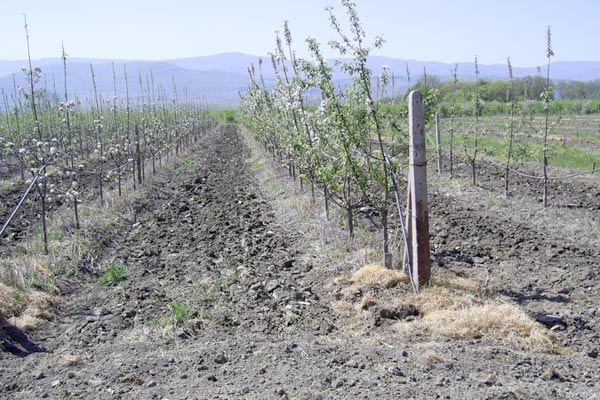
Young apple plantation maintained in black fallow
Black fallow is the main system for maintaining the soil surface in orchards in Bulgaria. It is recommended as a system for maintaining young plantations established under relatively dry conditions in the country, without irrigation possibilities. This system requires periodic shallow spring-summer cultivations (to a depth of 7-10 cm) and autumn plowing in the inter-row spaces to a depth of 14-16 cm once every three years. The main advantages of black fallow are effective mechanical weed control, soil cultivation breaking the soil crust, which leads to improved water and air regimes of the soil, and allows for the incorporation of organic and mineral fertilizers. (Stamatov et al., 1982; Iliev and team, 1981, Rankova Z and team, 2011).
However, it has been established that, along with its advantages, black fallow has a number of significant disadvantages, namely: frequent passes of agricultural machinery lead to soil compaction, formation of ruts where water collects during heavy rainfall or irrigation; high costs for fuel and lubricants; the use of disc harrows causes fragmentation of perennial weed rhizomes, which favors their reproduction; frequent passes of machinery lead to pulverization of the surface soil layer, which degrades soil structure; the soil becomes depleted of organic matter (Stamatov, 1982, Karov et al., 2007).
Following Bulgaria's accession to the EU and the implementation of the Union's Common Agricultural Policy, Bulgarian fruit production focuses on applying the principles of bringing production in line with the requirements of ecologically oriented fruit production, preserving biodiversity and environmental components.
In the context of these requirements, grassed systems for maintaining the soil surface are defined as an ecologically sound approach that preserves biodiversity and soil structure. (Zhivondov, Rankova, 2009)
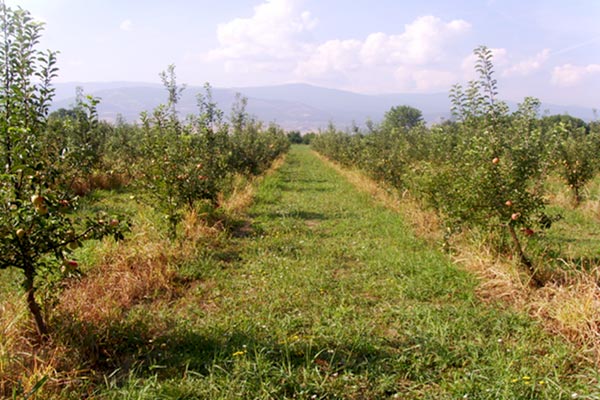
Sod-mulch system in the inter-rows, row strip treated with herbicides
Grassed systems for growing fruit plants (natural grassing, cultivated grassing - sod-mulch system) are a suitable system for application in humid regions and areas with ensured irrigation. A permanent grass sod is created in the inter-rows, and the periodically mowed grass mass is left in place to serve as mulch and for organic fertilization. Most often, the grass sod is created in the inter-rows, while the row strips are kept free of weeds through mechanized soil cultivation (rotary tillers with deviating sections) or treated with herbicides. For grassing the inter-rows, grass mixtures are recommended – Ryegrass (Lolium perenne (L.)), Meadow fescue (Festuca pratensis Huds.), Kentucky bluegrass (Poa pratensis (L.)), Timothy grass (Phleum platens (L.)), alone or mixed with White clover (Trifolium repens (L.)) or Red clover (Trifolium pratense (L.)).
The following grass mixtures are recommended for inter-row grassing: ryegrass (alone 4-5kg/da; 3-4 kg/da ryegrass + 0.2kg/da white clover; 2-3 kg/da meadow fescue + 0.2 kg/da white clover; 2-2.5 kg/da meadow fescue + 0.2 kg/da white clover (Stamatov, 1982; Karov et al. 2007). The seeds of the grass mixtures are sown in spring (April) in the first or subsequent years of the plantation's establishment. If irrigation is provided, grassing can be done in the year of tree planting. Otherwise, to limit competition for moisture between grasses and trees, it is advisable to carry out grassing in the second or third year after the plantation's establishment, when the trees have a deeper root system. Grasses are mowed periodically at a height of 10-12 cm, with the mowed mass left as mulch, and an additional amount of organic matter is incorporated into the soil.
The main advantages of the sod-mulch system are manifested in the improvement of soil structure, water, air, and nutrient regimes. It provides the possibility for year-round passes of agricultural machinery without forming ruts. Grass mixtures suppress weed development, including persistent perennial rhizomatous and root suckering species – Johnson grass, Bermuda grass, field bindweed, field thistle (Stamatov I et al., 1982; Mitov P, Zhelev I et al. 1981).

Natural grassing in a fruiting cherry plantation, row strip maintained with herbicides
In recent years, as an alternative to applying herbicides in the row strip of plantations, mulching with various materials – polyethylene sheets, straw, plant residues, wood chips, etc. – has been carried out. A main requirement for mulching is that the row strip must be cleared of weed plants, especially persistent perennial species.
The mulching layer suppresses the development of weed vegetation, limits moisture evaporation, and when using mulching materials of plant origin, nutrient elements are also introduced.
Conclusion
The integrated approach between agrotechnical means and ecologically oriented application of herbicides ensures the maintenance of plantations in good agrotechnical and ecological condition.
References
1. Zhivondov A., Z. Rankova (2009). Integrated fruit production - an ecologically sound approach for obtaining clean fruit products. Collection of papers from the Third International Symposium "Ecological approaches in the production of safe foods", 2009, 15-22
2. Karov S., L. Ivanova, A. Trifonov. 2007. Organic apricot production
3. Kolev I. 1963. Weeds in Bulgaria, ed. BAS
4. Lyubenov Ya et al. Integrated weed control systems, volume II, Zemizdat, Sofia, 1988
5. Milusheva Sn., Z. Rankova. 2006. Serological identification of Plum pox potyvirus in some economically important weeds, Agricultural Science, 4, 38-41
6. Mitov P., I. Zhelev, G. Pepelyankov, R. Panova. 1981. Intensive fruit plantations. ed. "Hr. Zh. Danov", Plovdiv
7. Stamatov I., V. Todorov, K. Gogova, Z. Makariev. 1982. Systems for soil maintenance in fruit plantations, ed. Hr. G. Danov, Plovdiv
8. Fetvadzhieva, N. A., 1973. Weed control, ed. Zemizdat,
9. Milusheva Sn., Z. Rankova (2002). Plum pox poty virus Detection in Weed Species under Field Conditions. Proc. 7 th International Symposium on Plum and Prune Genetics, Breeding and Pomology , Acta Horticulturae, 577 : 283 – 287.
10. Rankova Z, M. Tityanov, T. Tonev. 2011. Agrotechnical approaches for maintenance of the soil surface in orchards in a good agrotechnical and ecological condition. Proceedings of EWRS - 9 th Workshop- Physical and cultural weed control, 28-29 March 2011, Samsun, Turkey
11. Rankova Z., 2006. Ecological approaches for weed control in fruit orchards. Proceedings of First International Symposium “Ecological approaches towards the production of safety food” 19-20 October 2006, Plovdiv, 211-216.
12. Tonev T., 2000. Handbook of integrated weed control and farming culture, Higher Institute of Agriculture – Plovdiv, Book 2.