

![MultipartFile resource [file_data]](/assets/img/articles/заглавна-памук-растение.jpg)
Cotton (Gossypium spp.) is the most significant fiber crop globally. The standard fiber obtained from it is a main raw material for the textile industry due to its unique qualities – high hygroscopicity, electrical neutrality, resistance to friction and heating.
Cotton is attacked by a number of pests (around 1326) throughout the entire growing season, which damage all parts of the plant and are capable of reducing yield and deteriorating fiber quality (Leigh et al., 1996; Hanchinal et al., 2009; Kulkarni et al.,2024). Their species composition varies across different phenophases of the crop and in geographical regions worldwide (Rajendran et al., 2018).
In Australia, over forty species of insects and seven species of mites have been described on cotton, among them the most economically important are: cotton bollworm (Helicoverpa armigera Hub.), tobacco whitefly Bemisia tabaci (Grennadius), cotton aphid (Aphis gossypii Glover), tobacco thrips (Thrips tabaci L.), western flower thrips (Frankliniella occidentalis) (Pergande) and common spider mite (Tetranychus urticae Koch.) (Wilson et al., 2018).
In Pakistan, 38 species of insects from 9 orders and 25 families have been identified on cotton. Among them, those of economic importance are: Erias insulana Boisd., pink bollworm (Pectinphora gossypiella Saund.), tobacco thrips (Thrips tabaci L.), cotton aphid (Aphis gossypii Glover), tobacco whitefly (Bemisia tabaci Grenn.) and mites of the genus Tetranychus spp. (Taqi et al., 2019).
In the tropical and subtropical regions of India, several authors Puri et al. (1998), Hanchinal et al. (2009), Navi et al. (2021), report: Bemisia tabaci Gennadi and Scirtothrips dorsalis Hood as important cotton pests that transmit viruses.
In the USA, the following pests have been reported on cotton: thrips of the genus Frankliniella spp. (Thysanoptera:Thripidae), black cutworm (Agrotis ipsilon Hufnagel) (Lepidoptera:Noctuidae), cotton aphid (Aphis gossypii Glover) (Hemiptera:Aphididae), bugs from the family Miridae and wireworms from the familyElateridae (Allen еt al., 2018).
Leigh and Goodell (1996) point out that wireworms cause the greatest damage to cotton in the first phenophases, destroying germinating seeds and young plants.
According to Williams, (2008, 2015, 2016, 2017) in the period 2007-2016, thrips attack between 70-95% of cotton areas in the USA.
Stoetzel et al., (1996) report eight species of aphids on cotton in the USA: Aphis craccivora Koch; Aphis fabae Scopoli; Aphis gossypii Glover, Anuraphis maidiradicis Forbes, Macrosiphum euphorbiae Thomas, Myzus persicae Sulzer, Rhopalosiphum rufiadominale Sasaki and Smynthurodes betae Westwood. Of these, the cotton aphid is constantly present in the cotton agrocenosis (Leigh et al., 1996).
Bugs from the family Miridae: Lygus lineolaris (Palisot de Beauvois), Lygus hesperus Knight, Pseudatomoscelis seriatus (Reuter) and Neurocolpus nubilis (Say), are cited as economically important cotton species (Leigh et al., 1996; Layton, 2000) and attack 38-61% of areas in the USA (Williams, 2008, 2015, 2016, 2017).
Before cotton sowing in Chirpan, species from the family Elateridae were identified: common click beetle (Agriotes sputator L.) and dark click beetle (Agriotes obscurus L.). They were recorded at a low density 0.5 - 1.5 larvae/m² (Table 1). Wireworms cause serious damage from sowing until the 1-2 true leaf stage. They gnaw at seeds, sprouts, and create tunnels in young plants. These damages are significant with early sowing and a cool spring, which prolongs the crop's vegetation. Alongside them during this period, the common darkling beetle (Opatrum sabulosum L.) was found, which was recorded at a density of 0.4-1 individuals/m2.
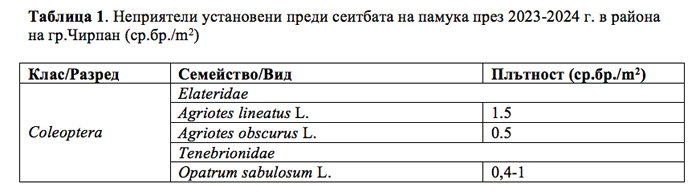
Immediately after cotton emergence until the 4-5-th leaf stage, the following were found: turnip moth (Agrotis segetum Schiff.), cotton bollworm (Helicoverpa armigera Hb.), cotton aphid (Aphis gossypii Glover), tobacco thrips (Thrips tabaci Lind.) and common spider mite (Tetranychus urticae Koch.) (Table 2).
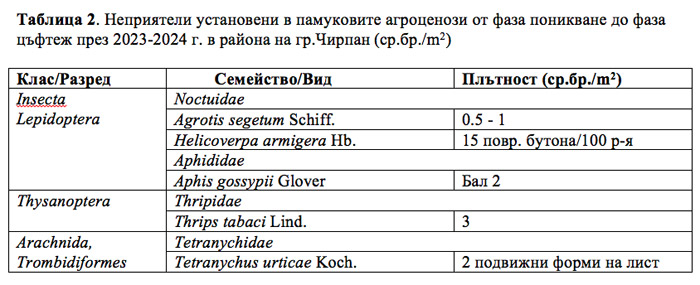
During the period from emergence to the 1-2 true leaf stage, cotton damage is caused by the caterpillars of the turnip moth, which gnaw at sprouts and young stems near the soil surface. During the reporting period, its density was low, 0.5 - 1 individuals/m2
After cotton emergence, the tobacco thrips migrates from weed vegetation. It was recorded at a low density of 3 individuals/m2. Mass reproduction of the pest is observed in warm and dry weather. The species attacks the youngest leaves and the growing tip of the plants, as a result of which the leaves become deformed and the plants branch out.
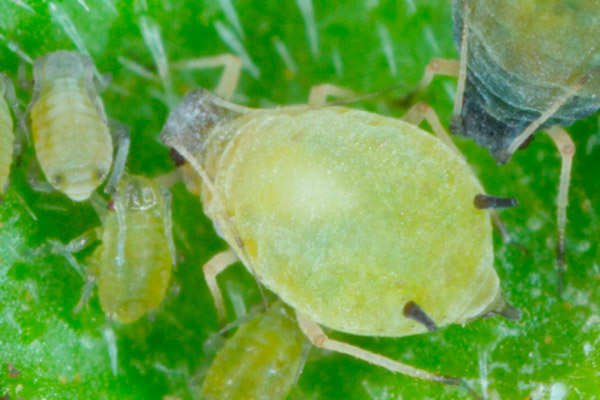
Cotton aphid
The cotton aphid causes the most economically significant damage during this period. It sucks sap from the underside of leaves and plant stems, secreting honeydew. The damages are in patches and the degree of infestation was high - 2 points.
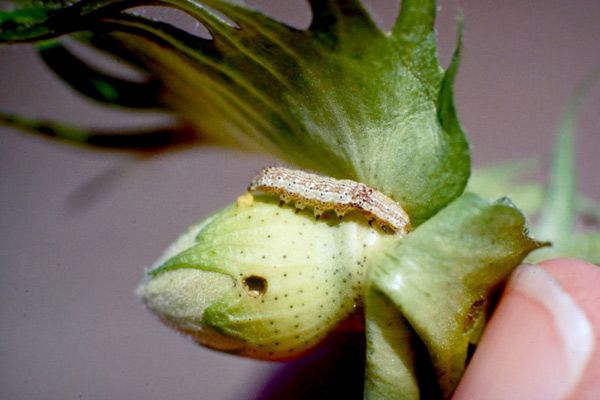
Cotton bollworm caterpillar
During the budding-early flowering period, damages from cotton bollworm caterpillars were observed. They damage the buds, which later fall off. 15 damaged buds per 100 plants were recorded.
From the beginning of flowering until ripening, cotton is damaged by the common spider mite, which develops on the underside of leaves, sucks sap, as a result of which the leaves yellow and dry out. In case of mass reproduction of the species, leaves, stems, and the growing tip are covered with silk threads. During the reporting period, mite density reached 2 mobile forms per leaf.
In May-June, among the polyphagous pests in the cotton agrocenosis, the great green bush-cricket (Tettigonia viridisima L.) was found. The species was recorded in low numbers, 1 individual/m2. Larvae, nymphs, and adults gnawed on leaves and were found along the periphery of the crop.
In the flowering to ripening stage, the harmful activity of the cotton bollworm, cotton aphid, horned leafhopper, and common spider mite continues. All these pests were recorded at low densities. This period covers the months of July and August, which are characterized by maximum high temperatures and low relative humidity (Table 3).
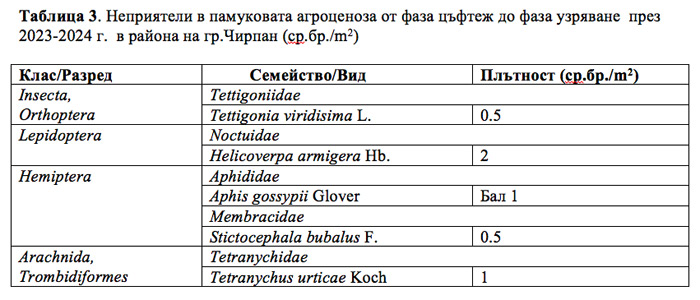
The cotton agrocenosis has less entomofaunal biodiversity due to the presence of gossypol in cotton plants – a compound with toxic effects on animal organisms. Additional influence is exerted by the ecological conditions under which the crop is grown – the southernmost regions of the country, characterized by extremely high temperatures during the summer season.
The agricultural practices carried out in cotton cultivation, including inter-row cultivation, limit the availability of host plants for insects inhabiting cotton fields.
The beneficial entomofauna in the cotton agrocenosis includes representatives of the order Coleoptera, family Coccinellidae: seven-spot ladybird (Coccinella septempunctata L.), five-spot ladybird (Coccinella quinquepunctata L.), variable ladybird (Adonia variegata Gz.), fourteen-spotted ladybird (Propylaea quatuordecimpunctata L.) and punctate ladybird (Stethorus punctillum Ws.); from the order Heteroptera, family Nabidae - Himacerus apterus F. and Nabis ferus L.; from the order Neuroptera, family Chrysopidae - common green lacewing (Chrysopa carnea Steph.), seven-spotted green lacewing (Chrysopa septempunctata Wesm.) and beautiful green lacewing (Chrysopa formosa Br.); from the order Diptera, family Syrphidae - Scaeva pyrastri L. and parasites from the order Hymenoptera, family Aphidiidae - Diaeretiella rapae M. Int., Lysiphlebus fabarum March. and Aphidius matricariae Hal.
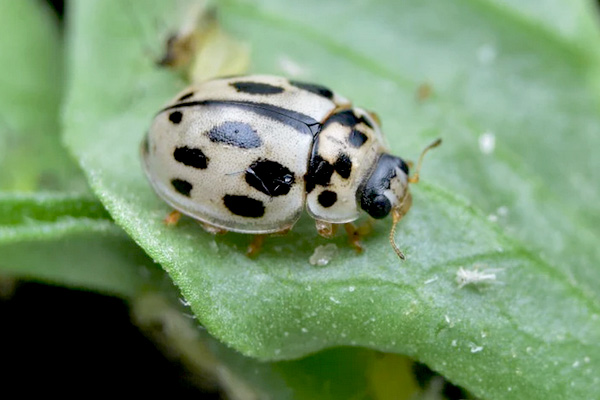
Fourteen-spotted ladybird (Propylea quatuordecimpunctata)
The development of beneficial species on cotton is closely related to the presence of the main pest — the cotton aphid. Its appearance leads to an increase in the number of several beneficial insects acting as natural regulators. Among them, important ones are: seven-spot ladybird (Coccinella septempunctata), five-spot ladybird (Coccinella quinquepunctata), variable ladybird (Hippodamia variegata), fourteen-spotted ladybird (Propylea quatuordecimpunctata) and representatives of the family Nabidae: Himacerus apterus (F.) and Nabis ferus (L.).
These species limit the aphid population and contribute to the stability of the agrocenosis.
References
- Allen, C.,, Randall G. Luttrell, Thomas W. Sappington, Louis S. Hesler, and Sharon K. Papiernik, (2018). Frequency and Abundance of Selected Early-Season Insect Pests of Cotton, Journal of Integrated Pest Management, 9(1), 20, 1-11.
- Hanchinal, S. G., B. V. Patil, M. Bheemanna and A. C. Hosamani, (2009). Incidence of mealy bug on cotton in Tungbhadra project area In: Proc. Dr. Leslie C. Coleman Memorial Nation. Ssymp. Pl. Prot., 2009, 4-6, 2008, Univ. of Agric. Sci. GKVK, Bangalore.
- Kulkarni D. R., P. S. Joshi, S. G. Chhaba, (2024). A PRELIMINARY SURVEY ON INSECT PESTS IN COTTON ECOSYSTEM OF WASHIM DISTRICT OF MAHARASHTRA (INDIA), Vidyabharati International Interdisciplinary Research Journal 19(1) Sept 2024 – Nov 2024 ISSN 2319-4979.
- Layton, M. B. (2000). Biology and damage of the tarnished plant bug, Lygus lineolaris, in cotton. Southwest. Entomol. Suppl., 23, 7-20.
- Leigh, T. F., S. H. Roach, and T. F. Watson. (1996). Biology and ecology of important insect and mite pests of cotton, pp. 17-86. In E. King, J. Phillips and R. Coleman (eds.), Cotton insect and mites: characterization and management. The Cotton Foundation, Memphis, TN.
- Leigh, T. and P. Goodell. (1996). Insect management. In S. J. Hake, T. A. Kirby and K. D. Hake (eds.), Cotton production manual. UC DANR Publication 3352. Univ. of California Division of Agriculture and Natural Resources, Oakland, CA.
- Navi, Sh.,, C. Shashikumar, G. Somu, N. Meena, R. Krishna Kishore and B. Rajendra, (2021). Effect of Pyriproxifen 10% EW against sucking insect pest population in cotton, International Journal of Chemical Studies, 9(1), 1313-1316.
- Puri, S. N., O. P. Sharma, K. S.Murthy and Sheo Raj., (1998). Hand Book on Diagnosis and Integrated Management of Cotton Pests, , 1-5.
- Rajendran, T. P., A. Birah and P. S. Burange. (2018). Insect Pests of Cotton. In: Omkar (eds) Pests and Their Management. Springer, Singapore. https://doi.org/10.1007/978-981-10-8687-8-11.
- Stoetzel, M. B., G. L. Miller, P. J. O’Brien, and J. B. Graves. (1996). Aphids (Homoptera: Aphididae) colonizing cotton in the United States. Fl. Entomol., 79, 193-205.
- Taqi Raza, Rehman Talha, Nawaz Ahmad, Javed Muhammad Uamr and Ullah Sami, (2019). Diversity and abundance of insects in cotton crop land of Punjab, Pakistan, GSC Biological and Pharmaceutical Sciences, 09(02), 117-125.
- Williams, M. R., (2008). Cotton insect losses—2007, pp. 927-979. In Proc. Beltwide Cotton Conf., 8–11 January 2008, National Cotton Council, Memphis, TN.
- Williams, M. R., (2015). Cotton insect loss estimates—2014, pp. 494-506. In Proc. Beltwide Cotton Conf., 5–7 January 2015, National Cotton Council, Memphis, TN.
- Williams, M. R., (2016). Cotton insect loss estimates—2015, pp. 507-525. In Proc. Beltwide Cotton Conf., 5–7 January 2016, National Cotton Council, Memphis, TN.
15. Williams, M. R., (2017). Cotton insect losses—2016, compiled for cotton foundation, National Cotton Council, Memphis, TN.
16. Wilson Lewis, J., Mary E. A. Whitehouse and Grant A. Herron, (2018). The Management of Insect Pests in Australian Cotton: An Evolving Story, Annu. Rev. Entomol. 63:215-37.
More on the topic
The Cotton Bollworm – A Dangerous Pest of Agricultural Crops