

![MultipartFile resource [file_data]](/assets/img/articles/заглавна-аспержи-болести.jpg)
Summary
Asparagus is valued by many for its delicate taste and health benefits. Like any crop, it is susceptible to various diseases and pests that affect its growth, yield, and overall quality. Understanding these diseases and pests, the reasons for their appearance, and methods for prevention and management is crucial for asparagus growers. This article includes major diseases affecting asparagus, the pests that attack them, and the damage they cause. Key strategies for minimizing their impact are also discussed.
Asparagus Asparagus officinalis, is a perennial herbaceous plant belonging to the Asparagaceae family. It is cultivated for its young shoots or spears, which are consumed as a vegetable. The plant can be eaten raw or cooked. It is low in calories and sodium. It is a good source of vitamin B6, calcium, magnesium, zinc, vitamin A, vitamin C, vitamin E, vitamin K, thiamine, riboflavin, rutin, niacin, folic acid, iron, phosphorus, potassium, copper, manganese, selenium, chromium, dietary fiber, and protein. It prefers well-drained soils with an optimal pH between 6.5 and 7.0. It requires 90–150 days of cold weather to break its dormancy. The areas where it is cultivated should be well-leveled and sun-exposed.
ASPARAGUS DISEASES
1. Purple Spot (Stemphylium vesicarium).
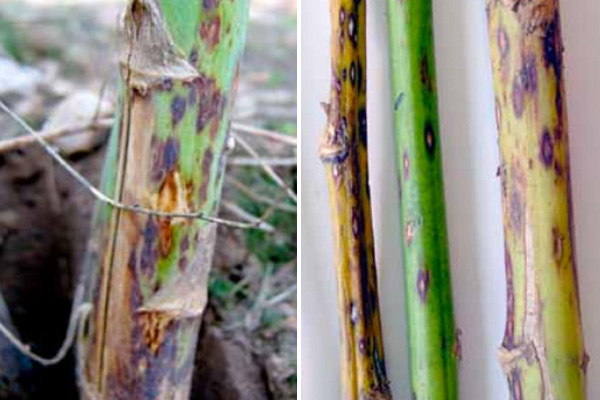
Purple Spot (Stemphylium vesicarium)
The first symptoms are sunken, purple, oval spots that appear on the spears. In severe infestations, up to 60-90% of them can be affected. Yellow-brown to brown spots are also observed on the leaves, including needle-like deformations. Later, the spots grow, merge, and the plants may defoliate. The disease is caused by the asexual stage of the pathogen, which produces numerous spores (conidia) throughout the growing season. Spores enter plant tissues through wounds and stomata. Premature defoliation of plants limits their photosynthetic capabilities, reducing their carbohydrate reserves. This affects the harvest in the following year, yields are lower, and plants become more susceptible to other pathogens. The lifespan of the plantation is reduced. The pathogen only attacks asparagus. It prefers cool and rainy weather. It does not affect taste and texture and disappears during cooking, but the market appearance of the produce is impaired.
Control: Regular inspection of areas for early detection of disease infestation; Removal of diseased plants in the plantation; Systemic control of the pathogen improves plant vitality and can enhance the fight against soil-borne pathogens; Adherence to good agricultural practices; Plowing in plant residues at the end of autumn and during winter over large areas is difficult to implement.
2. Rust (Puccinia asparagi)
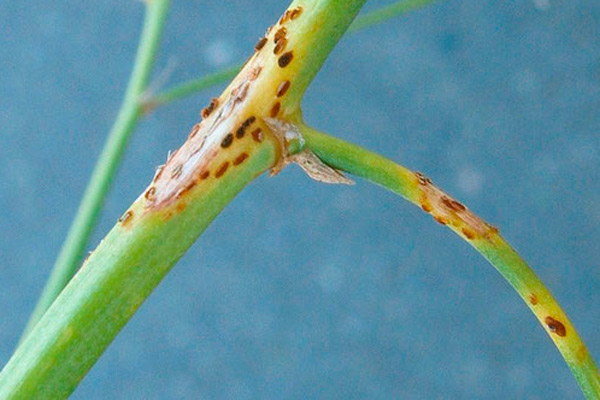
Rust (Puccinia asparagi)
Rust is one of the most common diseases affecting asparagus. It exhibits several symptoms depending on the season. Initially, it appears in early spring or early summer as small, raised spots, which are usually light green. Subsequently, they turn white or orange and become deeper. As the disease progresses, new spots appear around the base of the stems. Then, the rust itself develops. This happens when the weather warms up later in the summer. The first lesions burst, scattering spores into the air. This way, they infect other plants. The problem does not disappear when the weather cools down, as black spores are produced, which overwinter and can attack the stems the following spring. This can lead to the death of the plant. One way to reduce rust is to cut off the aerial parts as they die during winter. Infected parts are removed. Although crop rotation is impossible since the plant is perennial, it is advisable not to establish new plantations next to old ones. If necessary, treatments with plant protection products (PPPs) can be carried out to destroy existing spores. Spores usually infect plants when they are wet from rain or dew. Planting in a sunny and well-ventilated location will help the plants dry faster and be less vulnerable.
3. Cercospora blight (Cercospora asparagi)
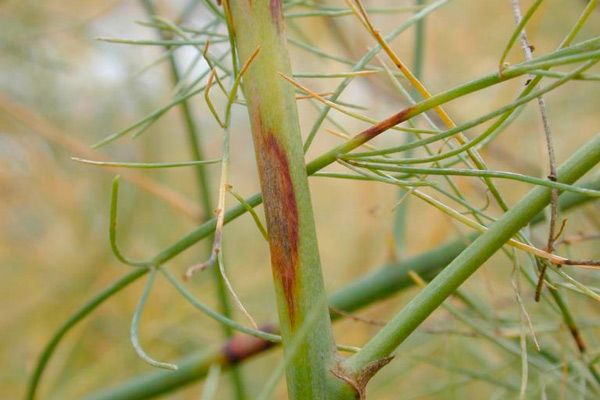
Cercospora blight (Cercospora asparagi)
The fungus causes leaf spots on asparagus. The first signs are the appearance of small, oval spots with a grey or brown color and reddish-brown margins on the needles and small branches. Symptoms progress from the lower parts to the top of the plant. The pathogen prefers high humidity. Spores from the spots are spread by rain and wind. Therefore, its appearance can be expected during wet periods. Infestation worsens the condition of the plants and reduces the yield of spears. Severe infestation can also reduce the cultivation duration of the plantation.
Control: Planting plants at optimal distances from each other to increase air circulation between them; To prevent the development of the disease, watering should be done in the morning without wetting the leaves; Removal and burning of infected plant material; If necessary, treatment with registered plant protection products.
4. Fusarium Root Rot (Fusarium oxysporum f. sp. asparagi, Fusarium proliferatum and Fusarium moniliform). It is caused by one of three microscopic fungi. The pathogen causes yellowing, dry rot, wilting, and ultimately the death of the plant. It is a soil-borne fungus that quickly kills plants after infecting them. It causes root rot, and plants die very quickly. Controlling this disease is difficult. It persists in the soil for a long period, spreading through infected soil and seeds. Plants under stress conditions are more susceptible to infection.
Control: It is necessary to observe good agricultural practices to minimize stress; The plot should be leveled and well-drained to prevent crop flooding; Cultivation of resistant varieties, if available; Sowing disinfected seeds; Keeping the area around the plantation free of weeds – some of them can be hosts; Asparagus should not be harvested continuously throughout the season. The crop should rest periodically; Optimal irrigation and balanced fertilization are also important; Stop harvesting asparagus when the yield falls below 70%.
5. Phytophthora Root and Crown Rot (Phytophthora asparagi)
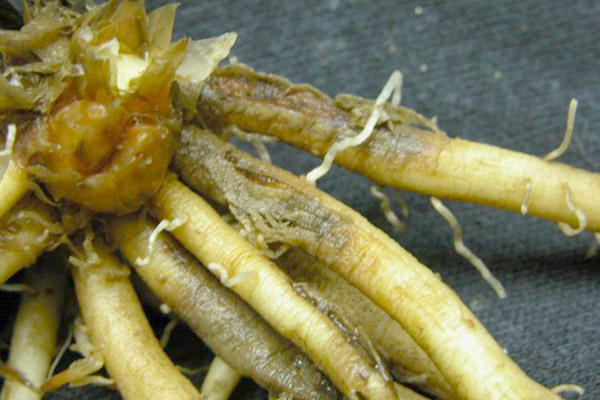
Phytophthora Root and Crown Rot (Phytophthora asparagi)
The disease is caused by an oomycete fungus. It is most commonly found in waterlogged soils. It begins with soft, watery areas that appear just above the soil surface. Infected plants turn yellow, and the crown rots. If immediate measures are not taken, the pathogen can drastically shorten the lifespan of the plantation.
Control: Establishing a new plantation in well-drained areas; Planting healthy seedlings in pathogen-free areas; Optimal irrigation, without waterlogging; If necessary, the soil should be treated with registered plant protection products.
6. Gray Mold (Botrytis cinerea). The causal fungus has many hosts from different families. Upon infestation, watery spots covered with a grayish coating of mycelium and fungal spores are observed. It is most common in wet areas. Spores are preserved in stagnant water, and the pathogen persists in the soil for a long time. It is observed in denser crops, excessively fertilized with nitrogen fertilizers. To avoid waterlogging, plantations should be located in well-ventilated areas. Regular pruning and targeted removal of plant parts can help prevent this disease.
Control: Establishing plantations in well-ventilated, well-drained areas with optimal density; Balanced fertilization; Watering should be done in the morning; Regular harvesting of finished products with removal of unnecessary growths; If necessary, treatment with registered plant protection products.
7. Asparagus Mosaic. Nine viruses have been identified on asparagus so far. Of these, three, named Asparagus Virus 1 (AV1), Asparagus Virus 2 (AV2), and Asparagus Virus 3 (AV3), attack only asparagus. Other viruses like TSV, CMV, TMV, and three nepoviruses have also been isolated from asparagus with varying frequency and economic importance. The most important viruses for this crop are AV1 and AV2. Asparagus mosaic virus often goes unnoticed with few visible symptoms. However, it can drastically reduce yields and make plants more susceptible to other diseases. It can cause mottling - light and dark green spots on the plant. Removal of infected plants is important, as is relocating the crop to a new site. The virus can be transmitted through seeds, so certified, disinfected seeds should be used for new plantings. Some insect pests, such as flower aphids, can also spread it. Control of these pests is necessary. The virus overwinters, so at the end of the growing season, all plant residues and weeds should be cleared.
ASPARAGUS PESTS
Asparagus is attacked by several types of pests, specific only to this crop and which do not harm other vegetable crops grown in the country.
Leaf Beetles
Asparagus is attacked by 2 species of beetles Crioceris asparagi L. and Crioceris duodecimpunctata L. (Coleoptera:Chrysomelidae). More commonly found in crops is the twelve-spotted asparagus beetle (C. duodecimpunctata).
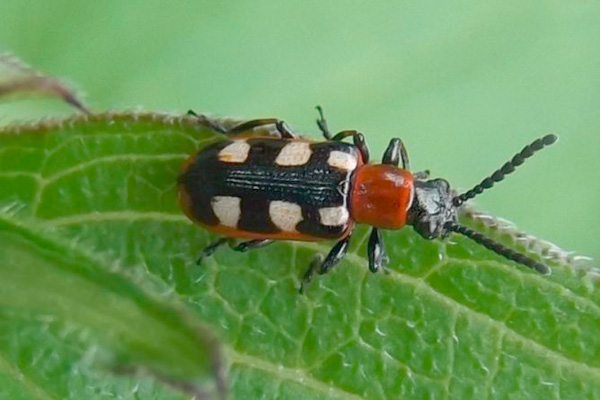
Adult of asparagus beetle (C. duodecimpunctata)
The adults of the pest are 5-6 mm, have an oval body shape and long antennae. The pronotum and elytra of the beetle are orange-brown to reddish-brown, with 12 black spots. The antennae, scutellum, abdomen, and leg tarsi are black. The head is strongly constricted behind the eyes. Adults should not be confused with beneficial ladybugs. The larva is yellowish to orange, with a visible head and legs. The twelve-spotted asparagus beetle has 2 generations per year. It overwinters as an adult insect under tree bark, in the surface soil layer, in hollow old asparagus stems, or in piles of stems collected after pruning at the end of the growing season. Beetles usually appear on asparagus in mid-May. Adults feed on the tender spears.

Female individuals lay eggs singly, attached to the upper part of the leaves.
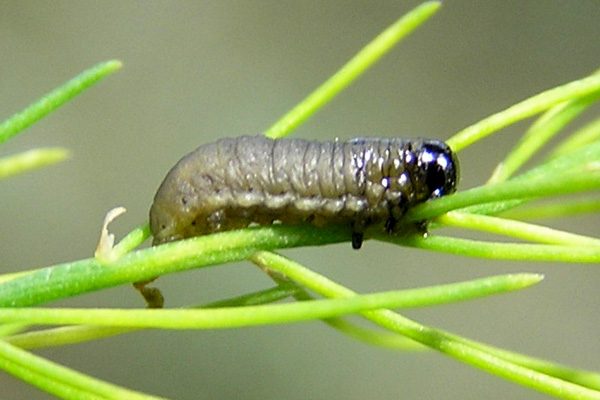
Larva of twelve-spotted asparagus beetle (C. duodecimpunctata)
The larva hatches after 7-12 days. It gnaws on the leaves, damages the fruits, enters inside, and feeds on the seeds, potentially attacking 3 or 4 fruits before they ripen. When fully grown, it falls to the ground by a silken thread and pupates beneath the soil surface. Beetles of the new generation appear during the second ten-day period of August and, as temperatures drop, go to overwintering sites. Feeding on the spears, the twelve-spotted asparagus beetle creates gnaw marks (scars) that can turn brown and lead to the distortion of the spears. Damage to the tips of the “spears” degrades the market appearance of asparagus.
Asparagus Aphid (Brachycorynella asparagi Mordvilko) is blue-green to gray-green in color, often covered with a powdery waxy coating.
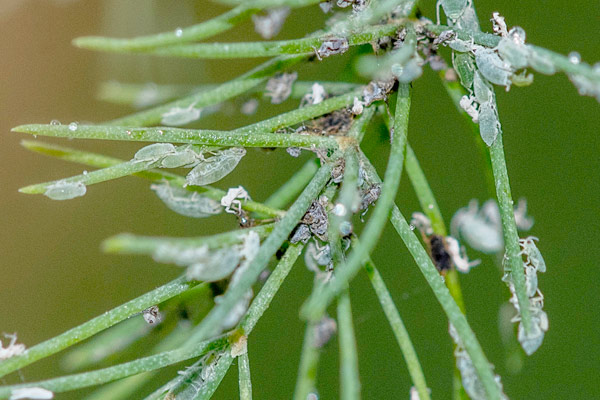
Asparagus Aphid (Brachycorynella asparagi Mordvilko)
Unlike most aphids, it is almost invisible due to its small size and coloration, which blends with the color of the bushes. It is difficult to spot even with careful inspection. The best way to determine if a crop has aphids is by shaking a shoot over a sheet of white paper. Wingless forms of aphids feed on shoots, often forming dense colonies. Young plantations are most vulnerable. Winged forms are often present in high numbers and can be observed as a large cloud. The asparagus aphid overwinters as an egg on the old rhizome or in the soil. Damaged plants have shortened internodes, are deformed, lag in growth, and can dry out under severe infestation.
Control: Establishing a new plantation in well-drained areas; Planting healthy seedlings; Optimal irrigation and fertilization; If necessary, treatment with plant protection products approved for use in this crop.
To prevent diseases and pest damage in asparagus, regular inspection of the crop, identification of pests, and adequate control measures are necessary. Proper irrigation and sufficient air circulation are important to prevent the appearance of diseases. Appropriate preventive measures are needed to preserve the plantation for a sufficiently long time.
References
- Elmer, W., 2024. Diseases of Asparagus. Handbook of Plant Disease Management. Springer, Cham. https://doi.org/10.1007/978-3-030-35512-8_37-1
- Morrison, W., 2015. Disease and Insect Pests of Asparagus, Michigan State University, Bulletin E3219.
- Tomassoli, L., A. Tiberini, H. Vetten, 2012. Viruses of Asparagus, 345-365, In Advances in Virus Research, Elsevier.