

![MultipartFile resource [file_data]](/assets/img/articles/заглавна-агро-дейности-ноември-2025.jpg)
Agrometeorological conditions in November will be determined by temperatures close to and above climatic norms and precipitation around and below the monthly norm. Above-normal average daily temperatures are forecast for most days in November.
In early November, the Arctic cold will remain far from Europe, thanks to a strongly concentrated polar vortex over the North Pole. In Bulgaria, this will result in milder than usual weather – daytime temperatures between 14 and 18°C, and in southern regions even up to 20°C. Overall, no serious precipitation is forecast until the end of the first ten days. Short-lived atmospheric disturbances are possible, but of short duration. The probability of temperature inversions increases, with minimum temperatures in many areas being around and below zero, with conditions for frost.
Around the middle of the month, cooler air from the northeast will reach the Balkans. In Bulgaria, this will be felt with a drop in temperatures, which will approach seasonal norms – daytime temperatures between 8 and 13°C, and minimums between 1 and 6°C. Morning fogs and inversions will become more frequent in the lowlands. Towards the end of November, rain and snow are expected, especially in the mountains. Towards the end of the month, cold air masses from the northeast are expected to descend towards the Balkans after November 25. A noticeable cooling is then expected, especially in Northern and Western Bulgaria. Snow is possible in the mountains and foothills, and rain and wet snow in the lowlands. In clear weather, mornings will be cold, with frequent frosts and negative temperatures.
During the month, more suitable conditions for planting fruit trees and carrying out phytosanitary activities on fruit crops will be created during the second ten-day period.
In fruit tree nurseries
Mother plants are unearthed in the stool beds. All – rooted and unrooted suckers – are cut with scissors or a sharp knife, as low as possible. If the mother bushes are weak, 1-2 suckers are left to strengthen them. After cutting the suckers, the mother plants are covered with soil to protect them from winter frosts.
Rootstocks are removed from the seedbeds after the plants' vegetation period is complete.
If the leaves have not fallen, they are removed by hand or by spraying with defoliants – 0.1-0.2% calcium chloride, 0.4% manganese chloride, and others. The rootstocks are sorted according to BDS, separating the weak, underdeveloped, and overgrown ones.
In the first-year nursery, rootstocks are planted. The soil must be well-prepared in advance. Planting distances depend on the fruit species, usually 80 x 20 cm, and for walnuts – 100 x 30 cm. Seedling rootstocks are planted 1-2 cm deeper than the root collar, and vegetative ones – at a depth of 20 cm, regardless of the length of the root-covered part. After planting, the rootstocks are watered and mounded to a height of 10 cm to retain moisture and ensure more successful budding.
The remaining rootstocks, not planted in the nursery, are stored until spring in a sheltered, wind-protected place, away from farm buildings. The roots are buried with loose, moist soil and watered thoroughly.
New stool beds are planted. Light, moisture-retentive, deeply cultivated soil, fertilized with 4-6 tons of farmyard manure, 100-150 kg of superphosphate, and 50-60 kg of potassium sulfate per decare, is preferred. Plants are planted at a distance of 1.8 – 2 m between rows and 35-60 cm within rows, and a depth of 25-30 cm. After planting, the aerial part is cut to about 20 cm above the soil surface.
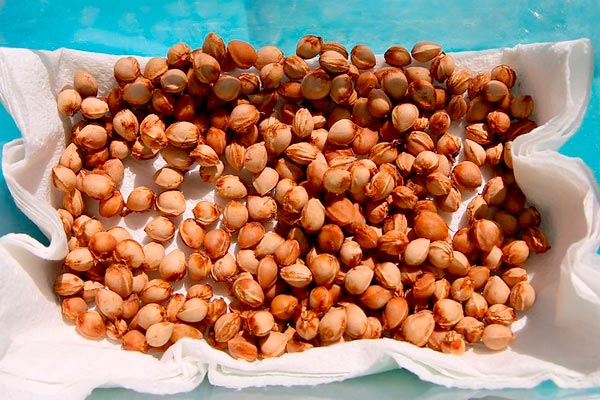
Cherry seeds for sowing
Seeds are sown in the seedbeds. The soil is pre-fertilized with 4-5 tons of farmyard manure per decare and brought to garden condition – plowed to 30-35 cm and leveled. Apple and pear seeds are not pre-stratified, while small stone fruit seeds are stratified in moist sand for two months to induce post-harvest ripening processes.
Fruit trees are dug up, sorted, and stored. Digging is performed with a tractor plow, hydraulic mounted equipment, or a special clamp. Sorting is carried out according to BDS requirements, tying them into bundles – 25 pieces each, with a label indicating the variety name and rootstock type. The trees are stored in a level, well-drained, wind-protected place, away from farm buildings and haylofts, and watered so that the soil adheres well to the roots.
Cuttings for scions are collected for spring grafting. Usually, cuttings are taken from the southern part of the tree crowns. They are tied into bundles of 25 and stored in moist sand in a shaded place in cool cellars or cold storage rooms.
Care is taken for the stratified seeds. Towards the end of the month, preparations for bench grafting begin.
In fruit orchards
In young fruit orchards, the number of failed trees is recorded, and a plan is prepared to fill the empty spots by species and varieties. Wire structures are repaired, and new ones are built, and the transport and spreading of farmyard manure continues. In case of drought, a water-retaining irrigation is carried out with 60-80 m3 of water per decare.
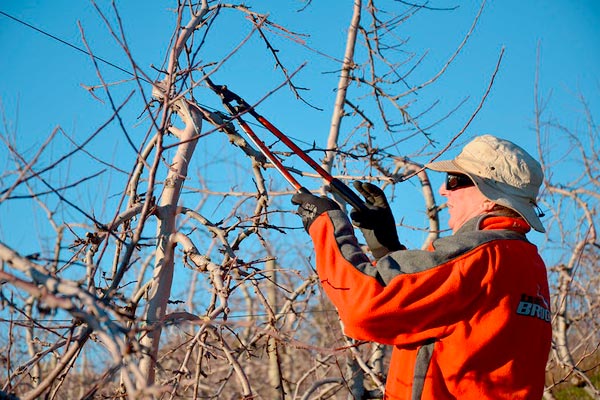
Winter pruning of apple orchards
Winter pruning for production begins for pome fruit species.
Fruit trees are planted in new orchards. When creating dense plantations, planting in furrows is recommended instead of in planting pits.
In strawberry plantations
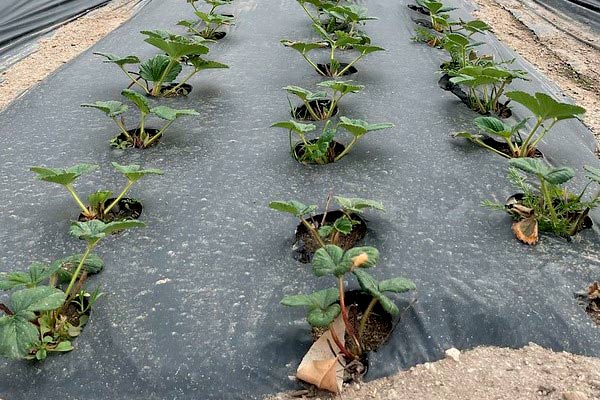
The removal, preparation, and storage of strawberry seedlings in refrigerators for spring-summer planting continues.
In case of drought, plantations established in September or October are watered, and if weeds are present, the area is cleared. At the end of the month, water-retaining irrigation is carried out for old plantations.
Plants are planted in heated greenhouses for early strawberry production.
In raspberry plantations
Planting material is dug up, sorted, and stored. From the production plantation, suckers are removed manually with a straight shovel. From second-year mother plantations, all suckers suitable for planting material – except those for approval – are removed manually. In the third year from mother plantations, suckers are removed with a plow or clamp. Suckers intended for spring planting are stored in furrows, covered with a soil layer 15-20 cm above the root collar. The soil is tamped down and thoroughly watered.
New raspberry plantations are established.
In blackcurrant plantations
Mature cuttings are collected. One-year-old shoots from young production or mother plantations are used. The shoots are cut into cuttings. Each cutting should have a length of 20 to 25 cm and a thickness of over 5-6 mm. At the base, the cutting is cut 2-3 mm below a bud, and at the top – up to 1 cm above a bud.
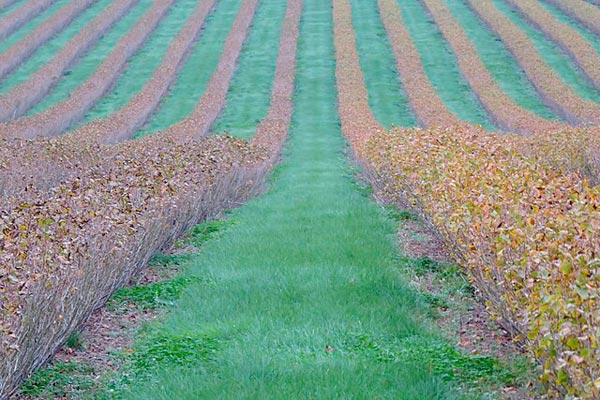
The cuttings are rooted. In the row, the cuttings are placed 15-20 cm apart, inclined, close to a 45° angle, in the soil. When soils are light, they are dibbled in, and in heavy soils, they are planted with a planting tool. The topmost bud is left below the soil surface. After planting, the soil around the cuttings is tamped down.
The planting material is dug up, sorted, and stored. Rooted plants are removed manually or mechanically at the beginning of the month, but not at temperatures lower than 0 oC. Plants designated for spring planting are stored in furrows or trenches, 45-50 cm deep. Their roots are covered, the soil is tamped down, and thoroughly watered. Measures are taken to protect against mice.
New blackcurrant plantations are established, and the bushes are pruned for fruiting.
In plantations with other crops
Fig cuttings are collected for rooting. One-year-old branches with a thickness of 1-1.8 cm, with short internodes, are used for rooting. Cuttings are formed with a length of 25-26 cm. The bottom cut is made directly below the node, and the top – 1 cm above a well-developed lateral bud. The cuttings are tied into bundles of 50, labeled, and buried in sand in cool rooms or outdoors, in shallow trenches – up to 25 cm deep.
Pomegranate cuttings are collected for rooting. They should be from one- or two-year-old branches. The length of the cuttings is 20-25 cm, and the thickness at the base – from 0.5 to 1.2 cm. After cutting, the branches are cleaned of thorns and side shoots, and cuttings 20-25 cm long are formed. They are tied into bundles and labeled. They are stored in a cool place in moist sand or in outdoor trenches. Measures are taken to prevent drying out.
Sea buckthorn cuttings are collected for rooting. In the same way as for pomegranate.
Bay laurel seeds are collected. The seeds are cleaned of the pericarp. They are stored in slightly moist sand in cool cellars or outdoors. In warmer regions, the seeds are sown outdoors immediately after cleaning. They are sown in the seedbed at a depth of 4-5 cm, at a distance of 20 cm – between rows and 5 cm – within the row. The seeds are covered with sand or other mulching materials.
Caucasian persimmon seeds are collected, cleaned, dried in a shaded place, and stored in cool rooms, mixed with moist sand or zeolite.
The collection of hackberry (kukuch) seeds, which will be used for the production of pistachio rootstocks, continues.
If a warm room is available, lemon seeds and trifoliate orange (Poncirus trifoliata) seeds are sown in boxes, crates, etc. The soil mixture consists of one part soil, two parts sand, and one part well-rotted farmyard manure. It is regularly moistened.
Pomegranate, fig, persimmon, bay laurel, and sea buckthorn are planted, with the areas first marked. They are planted at the following distances – fig – 5x5 m, pomegranate – 4x4 m, persimmon – 5x5 m, bay laurel – 3x0.8 m, sea buckthorn – 4x2.5 m.
Rooted cuttings of pomegranate, fig, sea buckthorn, and one-year-old grafted persimmon trees are dug up outdoors.
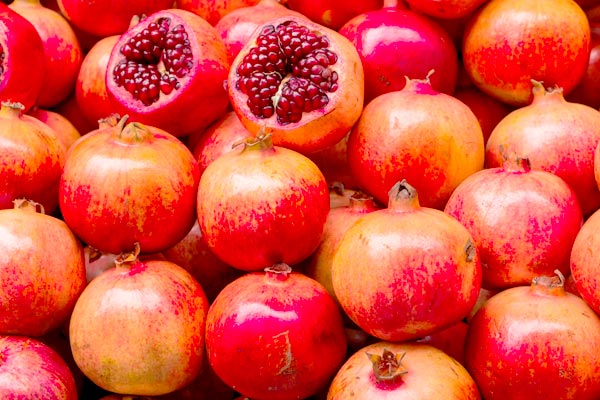
Persimmon fruits are harvested, pomegranate harvesting concludes, and pruning for fruiting of persimmon and fig begins.
The collection of dried bay laurel leaves from pruned shoots begins.
Winter pruning of actinidia (kiwi) is carried out. Crowding shoots are removed, exhausted cordons are replaced, and old fruiting wood is removed. The harvesting and storage of actinidia fruits are completed. Rooted actinidia cuttings are set for further cultivation.