

![MultipartFile resource [file_data]](/assets/img/articles/заглавна-земна-ябълка.jpg)
Food, feed and bioethanol in one – with low cultivation requirements and attention to invasiveness
• Jerusalem artichoke is a perennial crop – unpretentious and adaptable to any conditions: it tolerates cold, heat and poor soils.
• The agricultural crop is known by various names in our country: Jerusalem artichoke, gulia and topinambur. It also has a number of useful applications: for food and feed, for biomass and for bioenergy (bioethanol, biogas).
• A key advantage of Jerusalem artichoke is the high content of the polysaccharide inulin in its tuber – useful and rich in many vitamins (B1, B2, B6, C, PP), amino acids and minerals.
• Jerusalem artichoke is suitable for cultivation in all regions of Bulgaria, but this potential has not yet been developed.
• It also yields stable harvests on poor, eroded and dry soils with minimal fertilization and often without irrigation. We are talking about the ideal crop for the new climatic conditions in most Bulgarian regions.
Jerusalem artichoke is a traditionally cultivated crop, largely forgotten today. In climatic times, it has a new role: it thrives in drought and poor soils, is useful in the kitchen and as fodder, and its tubers are a raw material for bioethanol. Why does this species have great potential for cultivation in our country and how can we use it responsibly?
Perennial crop with multiple applications
Jerusalem artichoke (Helianthus tuberosus) is known by several names: Jerusalem artichoke, gulia and topinambur. In our country, it has been cultivated since the late 19th century. Originating from North America, it has now spread to Europe and can be invasive in some places, including Northern Bulgaria. This perennial crop is unpretentious and adaptable to all conditions, tolerating cold, heat and poor soils. It is used for food and feed, for biomass and for bioenergy (bioethanol, biogas).
The name topinambur comes from the indigenous American tribe in Chile, who cultivated the plant since ancient times.
One of the most important advantages of Jerusalem artichoke is the content of the polysaccharide inulin in its root vegetables. It is beneficial because it aids digestion, can help reduce the risk of cardiovascular diseases, support bone density, and lower blood sugar levels.
Jerusalem artichoke closely resembles potatoes in appearance, as well as in cultivation and use – the root vegetables are eaten. This perennial herbaceous plant is a "relative" of the sunflower: with its upright stem, about 1.5–5 m high. In late summer, yellow "sun-like" flower heads appear at the top. It primarily blooms from late August to September.

Photo 1: Flowering Jerusalem artichoke, source Wikipedia

The plantations are also used as green belts around industrial zones with the aim of absorbing carbon dioxide (CO2).
The dense foliage shades the soil and suppresses weeds, which significantly facilitates its cultivation. The plant is less often attacked by aphids, further reducing the need for treatments.
Useful and easy to prepare: a natural source of fiber and vitamins.
Jerusalem artichoke is a crispy root vegetable with a slightly sweet taste (reminiscent of cabbage and artichoke). Its tubers contain valuable inulin fiber, along with many vitamins (B1, B2, B6, C, PP), amino acids, and minerals. Inulin is a prebiotic – it supports "good" bacteria in the gut and can favorably influence digestion and blood sugar levels. It is not a medicine, but it is a good food for a varied and balanced diet.
How to consume it: Raw, it is suitable grated in salads or as a potato substitute in soups and main dishes (larger quantities can cause gas – normal for foods rich in inulin).
For feed: a nutritious crop for cows, poultry and pigs
Jerusalem artichoke is an excellent fodder – often much more nutritious than potatoes and corn. If used as part of animal rations, it can increase milk yield in cows, the number and quality of eggs in chickens, and the fat content in fattening pigs.
Jerusalem artichoke in the energy mix: from the fields to the tank
Over the last decade, bioenergy markets have grown rapidly – in volume, but also geographically. Today, there is a global trade in wood pellets and especially in bioethanol. In the EU's total final energy consumption (electricity, heating/cooling and transport – bioenergy is the leading renewable source: nearly 60% of all RES in 2021, which amounts to approximately 12–13% of total final consumption. The trend remains similar in recent years. It is important to note that in electricity generation, things are different: wind and solar are leading, with bioenergy following them.
The advantage of biomass is that it is versatile and easy to store and distribute. It can replace fossil fuels or complement variable RES (solar and wind) in electricity generation and heat supply, transport and some industrial processes. This increases the resilience and security of the energy system.
Sustainable bioenergy can:
• improve energy independence and access to clean energy;
• support rural regions through income and jobs;
• increase agricultural productivity and farmers' incomes;
• support climate change mitigation measures.
From Jerusalem artichoke to bioethanol
For farmers in Bulgaria, bioenergy crops are a way to stabilize incomes while also preserving biodiversity and reducing pressure on the climate and local biodiversity.
Jerusalem artichoke is a good opportunity for exactly this: its tubers contain 8–13% inulin. After storage, inulin breaks down into fructose, which is easily fermented into ethanol.
It was established as early as the middle of the last century that, under good conditions, 1 hectare of plantation can yield up to about 11 tons of ethyl alcohol.
Policies and sustainability
The EU promotes the production of biofuels derived from waste, residues, or crops cultivated on abandoned or so-called marginal lands – these are territories with low agricultural value, eroded, saline, or dry terrains. These crops require minimal use of water, fertilizers, and pesticides. Thus, the risk of displacing food production and further plowing new territories (the so-called ILUC) is lower. By these criteria, Jerusalem artichoke is the type of crop that deserves special attention and fits the objectives of the Renewable Energy Directive (RED II).
It meets exactly these conditions: it yields stable harvests on poor, eroded and dry soils with minimal fertilization and often without irrigation, which reduces "chain" emissions. As a perennial crop with deep roots, it limits cultivation, holds the soil, and aids carbon accumulation. It provides high and diverse biomass — tubers rich in inulin, suitable for fermentation (bioethanol/biochemicals), and above-ground mass for biogas or second-generation fuels. It can also be included as an intermediate crop in rotation, without competing with main food crops.
In Bulgaria: great potential, but undeveloped
Jerusalem artichoke is suitable for cultivation in all regions of Bulgaria, either independently or together with other crops (e.g., cucurbits). Judging by its adaptability, it is particularly suitable for drier regions – Dobrich, the Northeast region, and the Thracian Plain, as well as for poor, eroded, and weak soils, abandoned fields, and peripheries around industrial zones. It is advisable to avoid river terraces and humid corridors where there is an invasive risk.
For now, however, this crop with great potential is not cultivated industrially anywhere in our country, but only by small farmers and in family gardens. The main reason for this is the lack of interest from large farmers, who control over 90% of the arable land in our country. In the middle of the last century, over 60 different plant crops were grown in the country, which today are reduced to just three species: wheat, sunflower, and corn.
This trend is unlikely to change in the foreseeable future without active policies stimulating small and medium family farming and the cultivation of alternative crops.
The transition from a "petroleum-based" to a bio-economy aims to reduce dependence on fossil fuels and pollution, without disrupting the food and feed chain. Therefore, it is important to choose species suitable for the local climate that yield harvests with lower needs for water, land, and fertilizers. Such is the Jerusalem artichoke in the Bulgarian context.
The risk of invasion is real
So far, in Bulgaria, we have no examples of species invasion or cases where it competes with other species. However, the risk exists, judging by foreign experience and practices. It is not limited only to "marginal" lands, although it is precisely there that the species becomes aggressive, as competition from other plants is absent. Jerusalem artichoke often thrives in disturbed and wet habitats (river terraces, floodplains), where it forms dense patches and displaces native vegetation. This has been documented in Central and Western Europe, including Belgium and along the river floodplains of the Carpathian Basin.
Therefore, strict prevention and control should be planned: spatial isolation from natural habitats and water corridors, regular mowing before seeding, careful biomass management, strict hygiene of machinery and transported soil, because fragments of rhizomes/tubers are easily spread (including by floodwaters), as well as multi-year monitoring of the periphery. Mechanical control is effective but requires repeated interventions and discipline.
In Bulgaria, where, unlike Western Europe, the species manages to complete its cycle and produce fertile seeds, the danger of invasion can be facilitated by the dispersal of these seeds by wind and birds to new territories.
Besides being a danger to biodiversity, wild invasive forms of the species can be a source for the selection of new, highly productive varieties adapted to local conditions and agricultural practices.
A bit of history
In the 19th century, in France, the tubers were used for beer and spirits, and later – for sake in Japan. Studies show that after the First World War, the yield of fermentable carbohydrates per hectare was comparable to that of sugar beet and higher than that of potatoes.
Lessons from other regions
We can already point to proven successful examples such as ethanol from sugarcane in Brazil and biodiesel from non-edible oils in South Asia, but these cannot be automatically transferred to Europe due to the different environment and conditions. For our conditions, crops like Jerusalem artichoke are the more practical choice.
Jerusalem artichoke combines sustainability, nutritional value, and economic potential — a crop for climatic times. If we cultivate and use it wisely, people, farms, and nature all benefit.
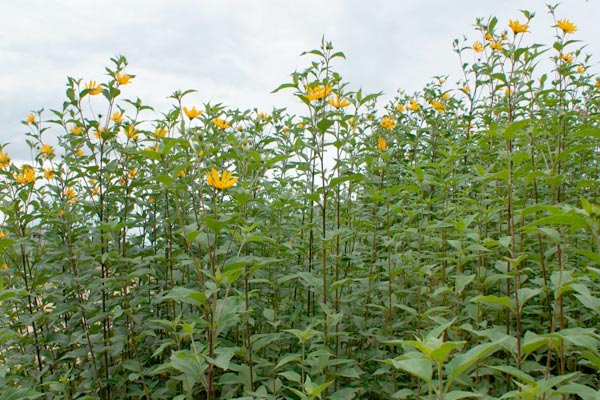
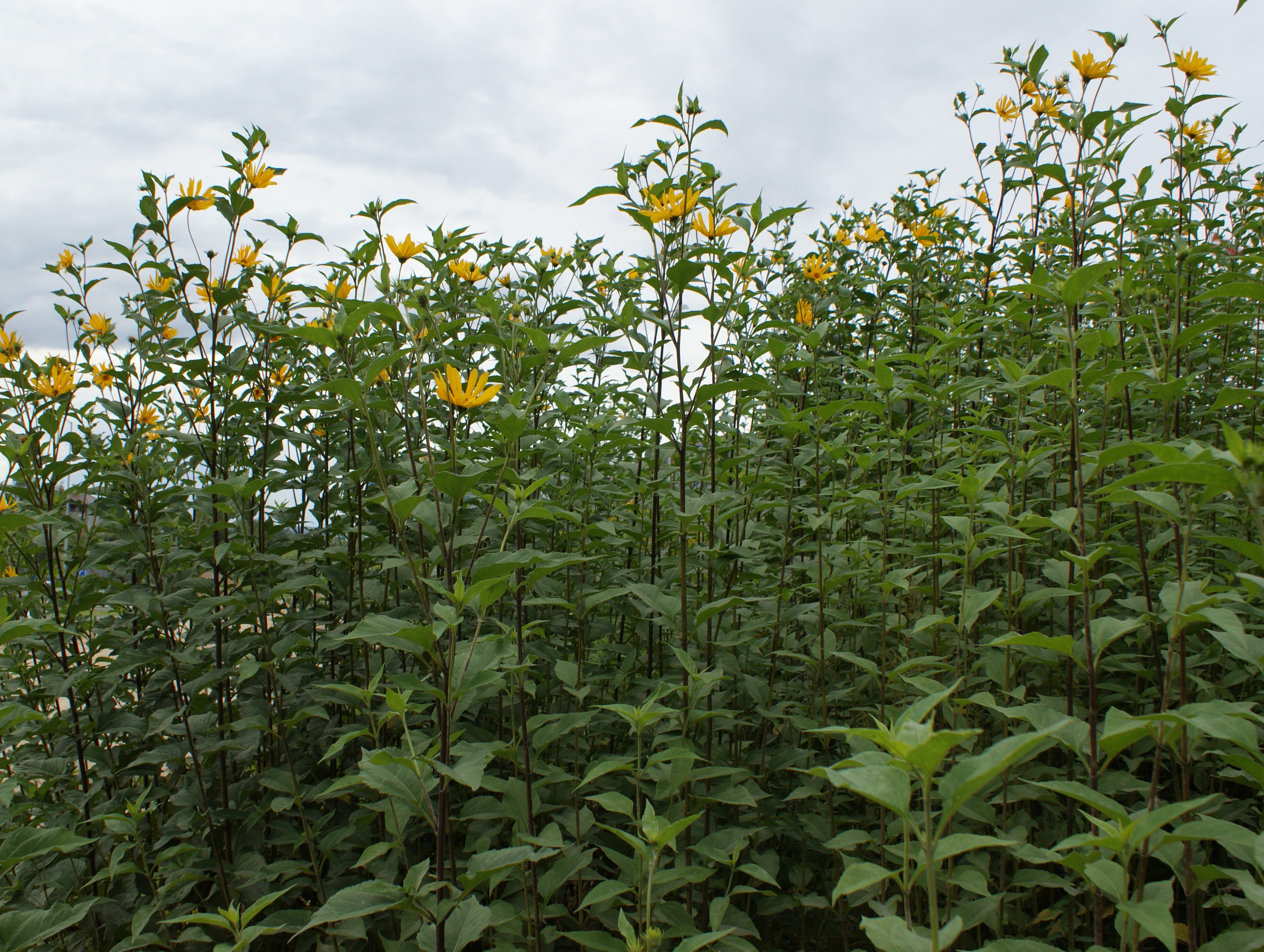
Photo 2: Jerusalem Artichoke Plantation / Source: Wikipedia
Brief cultivation instructions
Plant from tubers – in autumn (a few weeks before persistent cold) or in spring (after the soil warms up). Arrange in furrows about 60–80 cm between rows and ~40 cm in the row, water and keep the soil loose. The plant is unpretentious and suppresses weeds with its dense foliage.
Storage
Can also be grown in large containers (minimum ~40 cm diameter and depth). The tubers have a delicate skin – store in the refrigerator, in a paper bag, for up to about 30 days; peeled/chopped – for up to 3 days.
Source: Climateka
The publication used materials from:
- Chen F, Long X, Yu M, Liu Z, Liu L, Shao H. Phenolics and antifungal activities analysis in industrial crop jerusalem artichoke (Helianthus tuberosus L.) leaves. Ind. Crop. Prod. 2013; 47, 339–345.
- Chen F.J, Long X.H, Li EZ. Evaluation of antifungal phenolics from Helianthus tuberosus L. leaves against Phytophthora capsici leonian by chemometric analysis. Molecules. 2019; 24(23), 4300.
- Rossini F, Provenzano ME, Kuzmanović L, Ruggeri R. Jerusalem artichoke (Helianthus tuberosus L.): A versatile and sustainable crop for renewable energy production in Europe. Agronomy,2019; 9(9), 528.
- Vasiliki Liava, Anestis Karkanis, Nicholaos Danalatos and Nikolaos Tsiropoulos , Cultivation Practices, Adaptability and Phytochemical Composition of Jerusalem Artichoke (Helianthus tuberosus L.): A Weed with Economic Value, Agronomy 2021
- Ruf, T.; Audu, V.; Holzhauser, K.; Emmerling, C. Bioenergy from Periodically Waterlogged Cropland in Europe: A First Assessment of the Potential of Five Perennial Energy Crops to Provide Biomass and Their Interactions with Soil. Agronomy 2019
- Растениевъдство, Ат. Попов, К. Пвлов, П. Попов, Земиздат 1957 г.
- Bioenergy report outlines progress being made across the EU – Energy
- CountryReport2024_EU27_final_v2.pdf
- Invasive Alien Species in Belgium: Helianthus tuberosus