

![MultipartFile resource [file_data]](/assets/img/articles/защита-септември-2025.jpg)
Towards the end of the growing season, the development of diseases subsides but does not completely cease. The forecasted rainfall in the third ten-day period will increase the risk of fungal pathogen development on ripening fruit crops - late brown rot, late scab on the fruits of late varieties of fruit trees. The density of pests significantly decreases. Many of them have transitioned into inactive stages – pupae, eggs.
In fruit orchards
The disinfection of fruit storage facilities is carried out by a specialist!
To determine the winter stock of the gypsy moth, egg clusters are counted on the trunks and thick branches of 40-60 trees, and for the lackey moth – egg rings on 20 three- and four-year-old twigs.
Approximately two weeks before harvesting, apple and pear orchards, whose fruits are intended for storage, are treated with Captan 80 WG (150-180 g/dka) to protect them from late scab and other diseases that develop in fruit storage facilities.
The causal agent of apple scab – the ascomycete fungus Venturia inaequalis (Cooke) Winter, with its conidial stage Fusicladium dendriticum (Wallr. & Fuckel) is the most economically damaging disease of apple. It is preserved in its saprophytic form in damaged fallen leaves, overwintering on the soil surface, where after overwintering, pseudothecia with ascospores are formed, carrying out primary infections in spring. They do not mature simultaneously, but over 7-9 weeks, most often during the flowering period. The maturation and discharge of ascospores occur only after wetting. Ascospore germination is possible only in the presence of a free water droplet on the plant surface, but the duration of the incubation process depends on temperature – at 7-8 oC it is 17 days, and at 20 oC – only 8 hours.
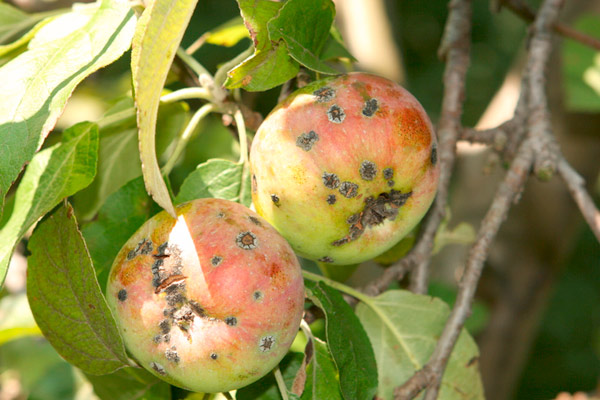
In case of late infection on fruits that have already started to ripen, the symptoms of the disease appear in the form of relatively small brownish-black, sharply defined spots, which continue to develop and grow under storage conditions. These damages are very often the primary cause for the intense development of pathogens typical for the storage period – grey rot, soft rot, Alternaria rot, trichothecium rot, and others.
The ascomycete fungus, Venturia pyrina (Bref.) Aderhold, with its conidial stage Fusicladium pyrinum (Libert) Fuckel, the causal agent of pear scab, has a high damaging potential and under favorable conditions for its development can cause very significant economic damage. The pathogen overwinters not only on fallen leaves, where asci with ascospores develop, but also in cankers on shoots. The development of the disease is favored during periods of frequent rainfall, prolonged retention of water droplets on plant tissues, and moderately high temperatures.
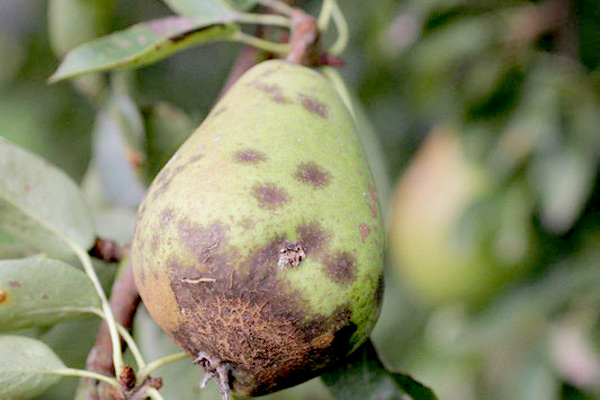
The symptoms of the disease initially appear as rounded spots, covered with a radially developing dark green fungal coating. Later, these spots necrotize, forming wide scorched areas and premature defoliation. Unlike apple damage, these spots appear on the underside of the leaves and are more noticeable.
To determine the density of the pear bud weevil at the end of the month, 10 trees per 500 decares, scattered throughout the plantation, are shaken – initially every other day, and after the first insects are discovered, every day.
The pear bud weevil (Anthonomus pyri Kollar) primarily attacks pear, occasionally damaging apple, apricot, and plum. It is found throughout the country. The weevil develops one generation annually. It overwinters as an egg in pear buds and a small portion as adult insects.
The beetles are sluggish. In September, they feed by gnawing on leaf and flower buds to mature sexually, after which they lay their eggs. They can destroy more than 40 buds. Females gnaw a channel into mixed buds and lay a single egg at the bottom. The egg-laying period lasts 1.5-2 months. Average fecundity is 15-20 eggs. The eggs overwinter and hatch the following year. Some of the beetles remain to overwinter and continue laying eggs in the spring.
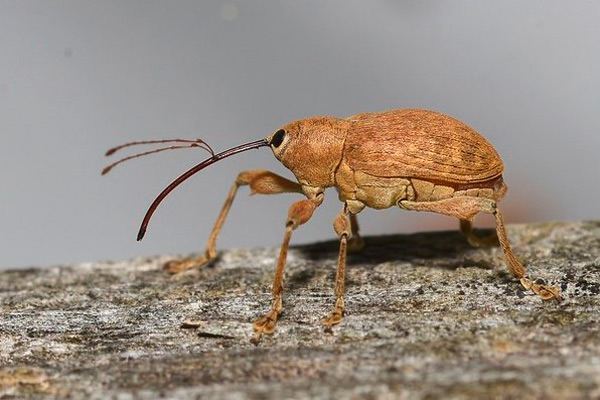
Chestnut trees are sprayed at the beginning of the month, before egg-laying, with Coragen 20 SC (18-30 ml/dka) or another contact insecticide to combat the chestnut weevil. The spraying is repeated two more times every 7-10 days.
In strawberry plantations
Before transplanting, for weed-free crops, strawberry plantations are treated with Roundup Energy (300-500 ml/dka for annual and biennial weeds and 500-800 ml/dka for perennial weeds).
Strawberry plantations are irrigated with one of the insecticides - Decis 100 EC (17.5 ml/dka) or another deltamethrin-based product, Mospilan 20 SP (30 g/dka), Naturalis (300 ml/dka) until the soil is moistened to a depth of 15 cm against the larvae of root weevils.
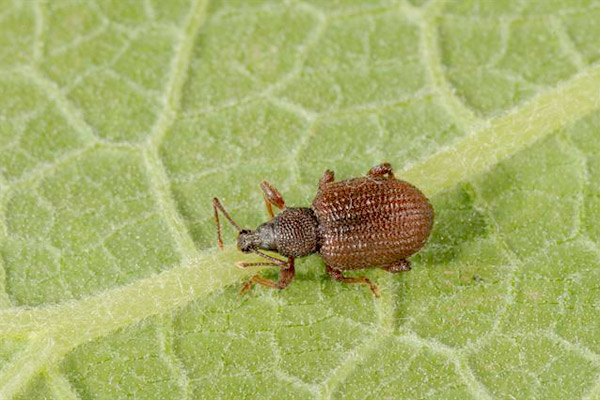
During this period, the strawberry root weevil (Otiorhynchus rugosostriatus), Turkish vine weevil (Otiorhynchus turca), small vine weevil (Otiorhynchus sulcatus) and alfalfa root weevil (Otiorhynchus ligustici). The larvae of these weevils feed on the roots of strawberry plants.
Strawberry planting material is checked for diseases and pests that are transmitted with it – white and violet-brown leaf spots, root weevils, strawberry nematode, strawberry mite, viral diseases, etc.
Strawberry seedlings are disinfected, if attacked by strawberry mites or strawberry nematodes, by immersing them for 13-15 minutes in water with a temperature of 45-50 oC.