

![MultipartFile resource [file_data]](/assets/img/articles/заглавна-зеленчукови.jpg)
Summary
Diseases and pests attack vegetable crops throughout the entire growing season and cause losses to producers. There is a group of diseases and pests that damage only already ripe vegetables ready for harvest. The article examines non-infectious diseases – blossom end rot, sunscald, fruit cracking, cat-facing, and others, which worsen the appearance of the produce and make it unsuitable for the market. More important infectious diseases and pests are discussed, which cause damage both in the field and during the storage of already harvested produce. Of these, the causative agents of anthracnose rot, Alternaria rot, as well as some viral fruit deformities, are of great economic importance. Possibilities for control and protection of the produce are indicated.
NON-INFECTIOUS DISEASES
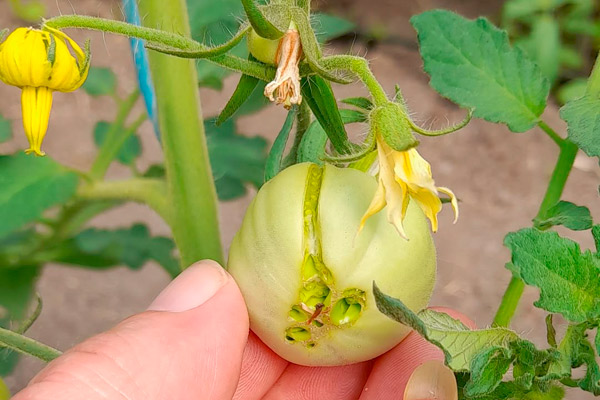
Cat-facing in Tomatoes
The cause of brown necrosis on tomato fruits is not well understood, but researchers believe it can occur when there are low temperatures during flowering or significant fluctuations in daily maximum and minimum temperatures. Thrips, high nitrogen content, and especially the variety can also play a role.
Growth cracks in tomatoes can appear both horizontally and vertically on the fruits. They occur with over-watering. Cracks can be large or small, horizontal or vertical. Small cracks on tomato fruits can appear with fluctuations in soil moisture. It occurs most often when there is an excess of moisture after a dry period. Larger cracks create openings for secondary pathogens and saprophytes to enter, even insects can penetrate the fruit, while smaller, finer cracks may not affect commercial value. The variety is due to the fact that different cultivars have different elasticity of the fruit skin.
Green (or yellow) shoulder in tomatoes appears when the top part of the tomato fruit around the stem scar remains green (yellow) and hard. When the fruit is cut in half, these areas may be white, and the affected part never ripens. It is assumed that the green shoulder is due to very hot weather, potassium deficiency, or direct sunlight on the fruits. The variety also matters. Green shoulder is also observed when plants are attacked by pathogens that cause stem dieback, as dead stem tissue cannot effectively transport nutrients. If many fruits with green shoulder are found in the crop, the plants should be checked for signs of leaf, stem, and root diseases.
Blossom End Rot
It is observed in tomatoes, peppers, eggplants, melons, watermelons, etc. It develops massively under conditions unfavorable for plant growth both in the open field and in cultivation facilities. It appears in the initial stages of plant development. Initially, a small watery spot appears at the apex of the fruits, which subsequently grows. The tissue beneath it sinks, and its surface turns brown or greyish-brown. Later, the spot grows up to 3-4 cm and blackens. If the disease appears in earlier stages, the spot can cover half of the fruit. Such fruits turn red, ripen prematurely, and may drop. With a later appearance, the fruits may be preserved and ripen, but they have no commercial value and are unfit for consumption. Saprophytic or parasitic microorganisms settle on the necrotic tissue, which cause the black discoloration. The fungus Stemphylium botryosum is most commonly observed. It has been established that when plants are grown in conditions of normal and constant soil moisture in their early stages of development, they do not overgrow, and blossom end rot does not appear on their fruits. Conversely, when plants are grown under conditions of increased soil moisture and unilateral nitrogen fertilization, they form juicier tissues, and blossom end rot is more frequently observed on their fruits during drought. This is linked to changes in the composition of macronutrients in the fruits. Most often, it is due to a deficiency or inability to absorb calcium.
Control: Proper site selection. Do not sow crops on light, sandy soils that dry out quickly; Balanced fertilization; Maintenance of constant optimal soil moisture; Removal of affected fruits; Treatment with 0.5% calcium nitrate. If necessary, repeat the treatment; Use fertilizers with low nitrogen content and increased phosphorus content for fertilization; Watering on a constant schedule.
Sunscald
Ripe and green fruits exposed to direct sunlight often suffer from sunscald. Bleached areas appear on the sun-exposed spots, becoming visible upon ripening. The surface in these areas slightly sinks and becomes parchment-like.
Control: Maintenance of healthy foliage to cover the fruits and protect them from sunscald; Control of foliar pathogens and mite infestation can prevent premature leaf drop; Plants grown in cultivation facilities suffer less from sunscald compared to those grown in the field. Shading greenhouses can be beneficial when direct sunlight exposure to fruits is expected.
DISEASES CAUSED BY PATHOGENS
Fruit deformities caused by viruses. Viruses cause strange deformities – spots, lumps, mottling on the fruits. They can vary in color and appearance depending on the virus - from hard, dark-colored spots to perfectly round dots, or streaks. Insect pests (aphids, thrips, whiteflies) spread these pathogens, which can happen even with small populations. If there is a virus infestation, check for insect vectors during seedling production - it is easy for an infected insect to contaminate entire trays of seedlings in the greenhouse.
Anthracnose rot (Colletotrichum spp,).
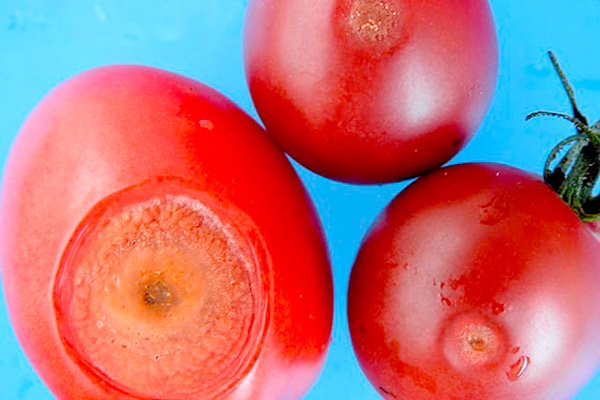
1. Tomatoes. Causative agent Colletotrichum phomoides. One of the most common diseases of tomato fruits is anthracnose rot. It is caused by a microscopic fungus. Ripe fruits are particularly susceptible, but the pathogen can also infect green ones, with symptoms not appearing until it begins to ripen. Spots on the fruits are initially small, round, and sunken. They can significantly enlarge over time and form concentric rings. Their center turns black from the stroma of the causative fungus, and in the presence of moisture, pink or orange sporulation appears. The latter are released when the weather is humid or rainy. Spores are spread by water droplets to other fruits. Later, the entire fruit rots, especially if there are several anthracnose spots or if putrefactive microorganisms enter the diseased tissue. Fruits closest to the ground are the first to be affected. This pathogen infects tomato fruits on plants whose leaves are completely healthy. It is most commonly observed when fruits are overripe. Harvesting at the pink fruit stage or at the beginning of ripening can help limit losses.
Control: Includes measures to limit sources of the disease; The pathogen is seed-borne, so seeds should not be harvested from diseased fruits; Introduction of a 3-4 year crop rotation without species from the family Solanaceae; Orienting rows parallel to the prevailing wind direction; Mulching areas with black polyethylene provides a barrier between the soil pathogen and the fruits; Growing on trellises improves air circulation and allows plants to dry faster; Drip or gravity irrigation instead of overhead irrigation; Minimizing its spread by creating unfavorable conditions for its development; Removal of diseased fruits before they fall to the ground; The pathogen is transmitted through seeds, so seeds should not be harvested from diseased fruits; Treatment with PPP.
2. Pepper. Causative agent Colletotrichum capsici. As with tomatoes, this is also a serious disease in peppers. It is caused by microscopic fungi that attack ripe fruits. Rotting lesions appear on them. They are black or brown, sunken, and moist. They quickly enlarge and become covered with pathogen spores, which spread to other fruits. Green fruits can also be infected, but symptoms do not appear until they ripen during harvest. This is a latent infection. Anthracnose can continue to spread after harvest in storage facilities and during transport. Therefore, any fruit showing these symptoms must be removed. The causative agent survives as sclerotia in the soil. High temperature and humidity (from rain or irrigation) are favorable for its development. The pathogen is seed-borne and has alternative hosts from the family Solanaceae (tomatoes, potatoes, eggplants), cucumbers, and other cultivated plants and weeds. It spreads with water splashes or rain. Wounds on the fruits are not essential for infection, but moisture is necessary for spore germination and infection.
Control: If the disease is detected in seed-producing crops, diseased fruits must be removed; Introduction of a 2-3 year crop rotation without hosts; Before sowing, seeds must be disinfected; In case of fruit infestation, crops are treated with PPP.
3. Eggplant. Causative agent Colletotrichum melongenae. Anthracnose fruit rot of eggplant initially affects the skin, but later progresses into the interior of the fruit. Certain weather conditions can promote its appearance. The disease is highly contagious, but if detected early enough, it can be prevented and controlled. Symptoms of anthracnose rot appear when leaves are wet for a long period, usually around 12 hours. The causative agent is a fungus that is most active during warm, humid periods, due to rain in spring or summer, or overhead irrigation. The first signs are the appearance of small spots on the fruit skin. They are typically about 1 cm in diameter and range from round to angular. The tissue around the spot is sunken, and the interior is filled with a yellowish-brown mass - spores of the pathogen. As the disease progresses, affected fruits may fall from the stem. The affected fruit becomes dry and black, but sometimes bacteria causing soft rot enter it, making it mushy and putrid. Spores spread quickly by splashes of rain or wind. The pathogen overwinters in plant debris. Spores need moisture to germinate. Therefore, the disease is most prevalent in fields where overhead irrigation is practiced, or where it is warm and rain is constant. Plants that retain moisture on fruits and leaves for a long time promote growth.
Control: Infected plants spread the disease; The pathogen survives on seeds, so it is important to harvest seeds from healthy fruits; Symptoms of the disease can appear on young fruits, but are more common on ripe eggplants; Besides careful seed selection, cleaning plant debris from the previous season is also important; Crop rotation can be beneficial, but plants from the family Solanaceae should not be included; Treatment with PPP early in the season can prevent the spread of the pathogen; Dipping fruits in fungicide or hot water after harvest is recommended; Fruits should be harvested before they overripen to prevent the spread of the pathogen; Good hygiene and seed disinfection are effective methods for anthracnose control.
4. Cucurbits. Caused by Colletotrichum lagenarium. It attacks all above-ground parts of the plants, but only ripe fruits. Watery, round, brown, sunken spots appear on them, reaching up to 1-2 cm in diameter. Typically, the spots have a concentric structure, from which a pink exudate is released. Later, the spots dry out and crack. Secondary pathogens or saprophytes can enter through the cracks and cause rot. In watermelons, damage appears on very young fruits. The spots on them are smaller, sunken, and often cause their decay. On ripe fruits, the damages are watery and round spots, initially protruding above the surrounding surface. Later, the spots sink and turn pink from the released spore mass. The pathogen persists in plant debris in the soil as sclerotia and pseudopycnidia. With increased temperature and humidity, the fungus spores spread to newly emerged plants and infect them. A droplet of water is necessary for their germination. Rains accompanied by wind contribute to the spread of the disease. The pathogen is seed-borne. Under the climatic conditions of the country, watermelons and melons are more severely attacked. The causative agent primarily attacks their fruits and stems. In some years, severe infestation is also observed on pumpkins. Cucumbers are usually not attacked by anthracnose.
Control: Do not harvest seeds from diseased fruits; Seed disinfection before sowing; Watermelons and melons should be sown on higher, well-ventilated areas that do not retain excess moisture; Upon appearance of first signs, treat with registered PPP.
Alternaria rot in tomatoes (Alternaria tenuis). It causes black spots on the fruits. They are common at the end of the growing season. The disease attacks only ripe tomato fruits. Spots appear near the stem scar and vary in size. Common are the concentric rings that are observed. The pathogen quickly penetrates the fleshy part of the fruit and causes rot. It survives as mycelium and spores on plant debris in the soil. In tomato fruits, it penetrates through wounds. The pathogen also infects seeds, but only superficially. Nevertheless, it impairs their sowing qualities, reducing germination and germination vigor. In years with more frequent and abundant rainfall, losses from this disease are greater.
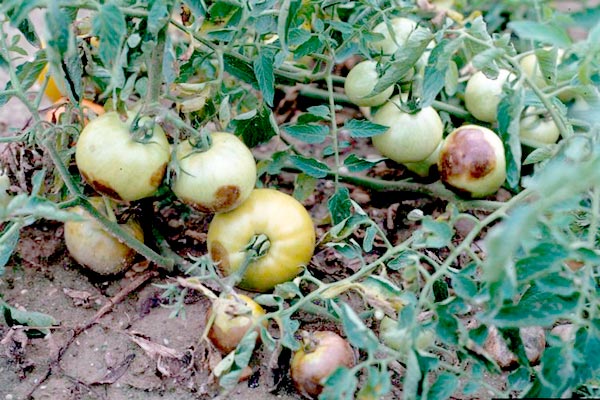
Phytophthora rot in tomatoes (Phytophthora nicotiane var. parasitca). It attacks all above-ground parts of tomato plants in all phases of their development. Large, grey, soft spots appear on fruits that are in contact with the soil surface. They are easily recognized by the dark concentric rings within them. Gradually, the rot encompasses entire fruits, and they drop. The pathogen easily transfers to healthy fruits at points of fruit contact. On newly infected fruits, no concentric rings are formed, but the entire fruit rots. From the lower clusters, the pathogen transfers to the upper ones, and under favorable conditions, all fruits can become infected. In hydroponic tomato cultivation, the pathogen attacks the root system of plants and can easily enter nutrient reservoirs, causing mass infections. The fungus persists in plant debris in the soil for 1-2 years. It develops well and infects plants under high substrate moisture. It has a wide range of hosts.
Control: Introduction of a 2-3 year crop rotation; Soil disinfection in greenhouses; For determinate tomato varieties, before plants sprawl, the soil is sprayed with 1-2% Bordeaux mixture or another copper-containing preparation to form a protective film; Treatment with PPP upon appearance of first diseased plants or fruits.
DAMAGE CAUSED BY PESTS
Tomato leafminer (Tuta absoluta)
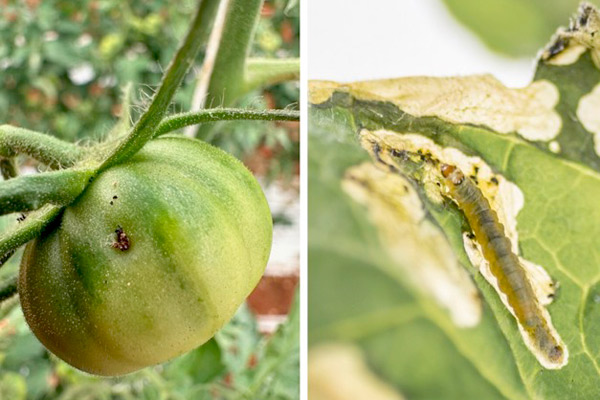
The tomato leafminer is a major pest of tomatoes grown in the field and in greenhouses. It is an oligophagous pest that primarily attacks members of the family Solanaceae. The main host is tomatoes, but it also attacks eggplant, pepper, and tobacco, as well as some weeds – datura, black nightshade, etc. The most characteristic symptoms of damage caused by it are the mines on the leaves. Sometimes the caterpillar itself can be seen inside them. It prefers leaves and stems, but also damages fruits. Fruits can be attacked as soon as they form, but caterpillars prefer unripe fruits. Initially, the mines on the fruits are superficial, sometimes going unnoticed, with only a small hole visible where the caterpillar penetrates, but subsequently, they widen and deepen.
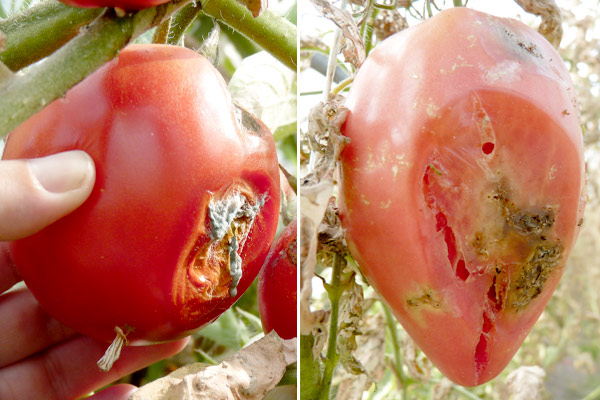
Damage to tomato fruits caused by tomato leafminer
Damage to fruits by the tomato leafminer provides an opportunity for the development of diseases that cause them to rot. Even after harvest, caterpillars develop in the infested fruits left for storage, so after a few days, they can surprise us with a drastic picture of damage.
Control of the leafminer is difficult due to the hidden lifestyle of the caterpillars and the rapid development of resistance in populations to commonly used plant protection products. Economic injury threshold: 10% of leaves with mines or 4% of fruits with damage. Treatment can be carried out during vegetation with some of the following plant protection products, which largely limits fruit damage as well: Azatin EC 100-150 ml/da; Altacor 35 WG 8-12 g/da; Ampligo 150 ZC 40 ml/da; Beltirul 50-100 g/da; Benevia 40-60 ml/da; Verimark™ 200 SC 37.5-50 ml/da; Voliam Targo 063 SC 80 ml/da; Delmur 50 ml/da; DiPel DF 75-100 g/da; Coragen 20 SC/Voliam/Shenzi 14-20 ml/da; Minecto Alpha 125 ml/da (Water L/da 25–100 L/da); Minecto Alpha 100 ml/da (Water L/da 1000–2000 L/da); Niimik Ten 390 ml/da; Neem Azal T/S 300 ml/da; Rapax 100-200 ml/da; Cyneis 480 SC 10-25 ml/da.
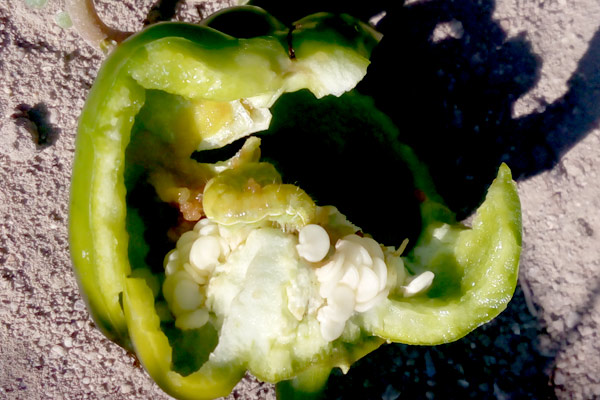
Cotton bollworm caterpillar
Cotton bollworm (Helicoverpa armigera). This pest is a polyphagous species. It damages a number of vegetable crops: tomatoes, peppers, beans, eggplants, peas, etc. The caterpillars skeletonize and partially eat the leaves, damage flowers, buds, and fruits.
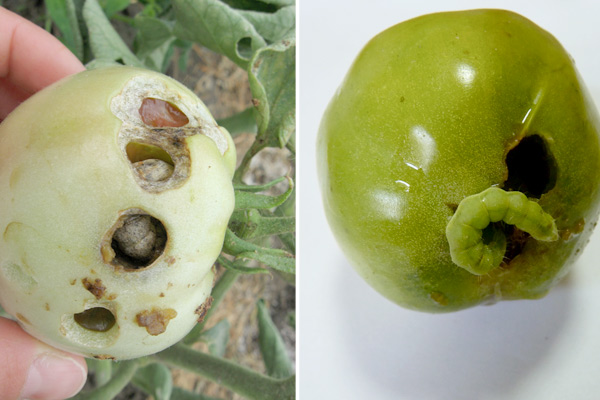
Damage from Cotton Bollworm (Helicoverpa armigera)
The most damaging are the second-generation caterpillars. They bore holes from the stem end, burrow into the fleshy part of the fruit, destroying the pericarp and seeds, contaminating the produce. Damaged fruits rot. Until its full development, one caterpillar damages 2 to 5 fruits.
Damage from Cotton Bollworm (Helicoverpa armigera)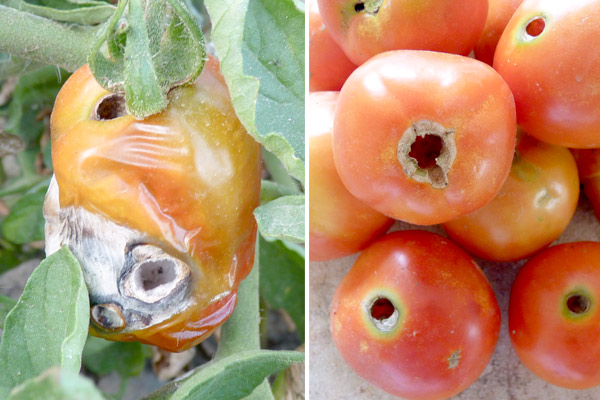
Damage from Cotton Bollworm (Helicoverpa armigera)
Control against this pest includes: agrotechnical measures – clearing weed vegetation, regular soil cultivation to destroy pupae; chemical treatments when 5% of fruits are infested. Authorized PPP: Ampligo 15 ZC 0.04 L/da; Altacor 35 WG 8-12 g/da; Affirm 095 SG 150 g/da; Benevia 60-112.5 ml/da; Verimark™ 200 SC 37.5-50 ml/da; Delmur 50 ml/da; Deltagri (Deltafar) 30-50 ml/da; Decis 100 EC 7.5-12.5 ml/da; Inphis 50 ml/da; Scato 30-50 ml/da; Coragen 20 SC/Voliam/Shenzi 14-20 ml/da; Minecto Alpha 125 ml/da (Water L/da 25–100 L/da); Minecto Alpha 100 ml/da (Water L/da 1000–2000 L/da); Rapax 100-200 ml/da; Oikos 150 ml/da; Niimik Ten 390 ml/da.
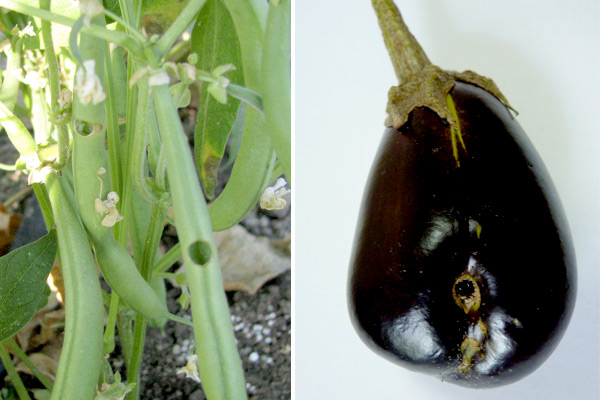
Silver Y Moth (Chrysodeixis chalcites). It occurs during the spring-summer period when growing cucumbers in cultivation facilities. The caterpillars cause damage. On cucumber fruits, the caterpillars make superficial gnawings. Damaged fruits have no commercial value.
Control against this pest can be carried out by treating with the product Benevia 60-112.5 ml/da.
Southern green stink bug (Nezara viridula). The pest is a polyphagous species. Adult bugs, nymphs, and larvae cause damage. They damage all parts of the plant, but prefer growing fruits. When sucking sap from fruits, numerous spots are formed, which are initially whitish, and later turn brown and merge. The fruit tissue beneath the damaged area has a hard consistency and is unfit for consumption. Young fruits, under severe infestation, become deformed, turn white, and often drop. Problems caused by these insects appear as discrete spots. Towards the end of the growing season, a mass multiplication is observed. Damage caused by their feeding ranges from pale (in green tomatoes) to yellow (in red tomatoes) spots on the fruit surface. When such fruits are cut, the areas around the spots are white. Discoloration and the presence of unripe areas around feeding spots are a result of damage caused by the bugs. Such fruits have impaired taste qualities.
Although less common, the brown marmorated stink bug (Halyomorpha halys) can also be observed in tomato and pepper crops. When feeding on fruits, it causes fruit drop, sunken areas, deformities, and corky spots.
Control: To control these pests, "trap crops" can be planted, such as beans in the summer or cruciferous crops early in spring and in autumn. The "trap crops" should be treated with insecticides before nymphs develop into adults. If necessary, treatment with PPP can be carried out: Decis 100 EC 4.5-7.5 ml/da.
Tomato russet mite (Vasates (Aculops) lycopersici). It primarily damages plants from the family Solanaceae, such as tomatoes, peppers, eggplants, potatoes, etc. Its harmful activity is significant in tomato cultivation in growing facilities, although it has also been found in the field during summer months. The tomato russet mite damages all above-ground parts of tomato plants by sucking sap from stems, petioles, the upper side of leaves (mainly along the veins), and fruits. The areas where the mite feeds turn brownish. A rusty-brown network of cracks forms on the fruits, and the skin hardens. Fruits remain small, hard, with impaired taste and commercial appearance, unfit for consumption.
Control: Among preventive measures for controlling the tomato russet mite, the most important is the use of healthy seedlings. Greenhouses must be thoroughly cleaned before transplanting. Regular surveys should be conducted for timely detection of the pest. Heavily infested plants should be destroyed. Maintaining higher soil and air humidity, especially in cultivation facilities. In our country, there are no registered plant protection products against the tomato russet mite. The use of some acaricides may limit the infestation.
Thrips cause fruit drop, silvery spots, and deformities on fruits. Other pests such as aphids and whiteflies can cause indirect damage by transmitting viruses or excrete "honeydew" during larval feeding, on which sooty mold saprophytic fungi develop, contaminating the fruits. The two-spotted spider mite lives and feeds on the lower leaf surface, but with severe infestation, it also moves onto the fruits. Damaged fruits are marbled with an impaired commercial appearance.
To reduce losses from diseases and pests on vegetable fruits, it is necessary to harvest them earlier to avoid the development of anthracnose, Alternaria, and other rots. For example, pink-stage tomatoes will quickly ripen off the plant. If ripe tomatoes are harvested, they will continue to ripen, becoming overripe, while in storage. Watering plays a role in both pathogen and physiological problems. Plants must receive sufficient moisture and the necessary amount of potassium during the fruiting stage. To limit infections, good agricultural practices must be followed: Crop rotation to avoid diseases and pests hidden in the soil; Cleaning plant debris – fallen leaves and fruits around the plants; Tying plants to support structures so that leaves do not touch the soil; Proper orientation of crops to ensure plants receive six hours of sunlight per day and sufficient light. This will minimize the possibility of the plant being in humid conditions for an extended period. Optimal plant spacing is necessary to ensure good air circulation and prevent increased humidity in the crop.
References
1. Bahariev D., B. Velev, S. Stefanov, Ek. Loginova, 1992. Diseases, Weeds and Pests of Vegetable Crops, Zemizdat.
2. Gordon A., 2002. 17 Eggplant Insect Pests and Diseases: Pest Management, In Luv 2 Garden.
3. Nilofar, P., K. Kannamwar, R. J. Sawant, 2024. Tomato Anthracnose Disease Caused by Colletotrichum Species, Int J Sci Res Sci & Technol. 11 (12):132-136.
4. Alexander S. A., K. Pernezny, 2003. Anthracnose. In: Pernezny KL, Roberts PD, Murphy JF, Goldberg NP (eds) Compendium of pepper diseases. APS Press, St. Paul, 9–10.
5. Bonnie Cox, Timothy Coolong, 2009. Management of Non-Pathogenic Fruit Disorders of Tomato in Organic Production Systems.