

![MultipartFile resource [file_data]](/assets/img/articles/заглавна-сливи-2025.jpg)
In September, agrometeorological conditions will be determined by temperatures above the climatic norms and precipitation around and below the monthly norm.
The highest temperatures will reach 33–35°C, while the minimum will drop to 6–8°C. In the western half of the country, precipitation will be around and above the norm – between 35–65 l/sq.m for the plains and 55–85 l/sq.m for the mountainous areas. In Eastern Bulgaria, the total precipitation will be between 45–55 l/sq.m, which will help alleviate possible dry periods. In most of the field areas, productive moisture will be absent in the 50 and 100 cm soil layer.
During the first ten-day period, precipitation is expected, mainly in the western and central regions, in places accompanied by thunderstorms. In the mountains, the rainfall will be more intense, especially in Central Bulgaria, during the expected front on 3–5 September. After that, temperatures will rise. The maximum will be between 27–34 °C, the minimum – 14–18 °C, with lower temperatures expected in the high plains of Western Bulgaria – 11–13 °C. Along the Black Sea coast, daytime temperatures will reach 24–27 °C, and nighttime – up to 17–20°C. The first week of September will bring a gradual change in the weather – summer heat will give way to more unstable atmospheric conditions, influenced by stratospheric anomalies in the polar vortex. Temperatures will decrease slightly, with a change in air circulation expected around 3–5 September, with potential for cooler incursions due to a weaker polar vortex in the stratosphere (anomalies from +3.5 °C to +5.7 °C above the norm at the 10 hPa level). During this period, the passage of a cold atmospheric front is also expected. After this front, a brief stabilization will occur with an inflow of warmer air, which will raise daytime temperatures to 28–33°C for a few days.
The first days of the second ten-day period will be predominantly sunny, with scattered clouds in the afternoon. Temperatures will rise to 24–28 °C. Around 9–12 September, warmer air will penetrate from the south and daytime values will reach 26–30 °C. A deterioration of the weather is expected around 13–16 September. Temperatures will stabilize around 15–24 °C. The weather will be determined by atmospheric disturbances, with an increased likelihood of precipitation and autumn-like conditions.
Climatic models forecast more frequent cyclones during the third ten-day period, influenced by a weaker polar vortex. At the beginning of the period, the weather will be cloudy and rainy due to a cyclone over the Balkans, with a decrease in temperatures expected. At altitudes above 1500–2000 m, snowfall is also possible. Towards the end of the third ten-day period, the air mass will stabilize, temperatures will rise and in some places maximum values will reach 14–20 °C, close to the norm for the end of September.
The leaf apparatus of the trees is actively photosynthesizing, providing assimilates for fruit nutrition, differentiation of fruit buds and accumulation of reserve nutrients. The more timely the fruits are harvested, the better the trees are supplied with nutrients, the more easily they withstand low winter temperatures and bear normally the following year.
In fruit tree nurseries
Care for the seedbeds continues – they are irrigated in case of drought and cultivated. Care is taken to prevent the rootstocks from sprouting.
The bindings used after budding are inspected and, if there is a risk of girdling, they are loosened.
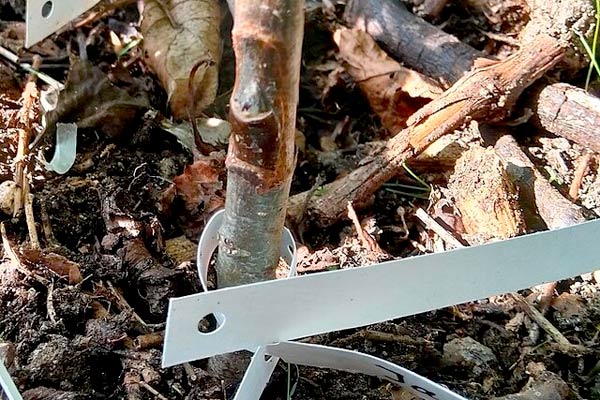
Budding on a rootstock
No later than mid-month, budding (grafting of a bud) of the rootstocks in first-year nursery blocks is completed. The soil in the nurseries, compacted by the grafters, is cultivated. The soil in second-year nursery blocks is also cultivated.
Cleaning of the mother plantations from off-types continues. Now is the most suitable time for identification of the rootstocks.
In fruit orchards
To ensure good hardening of the wood, care in young orchards is focused on timely cessation of growth. In the event of prolonged drought, however, especially in pome fruit species, moderate irrigation is recommended.
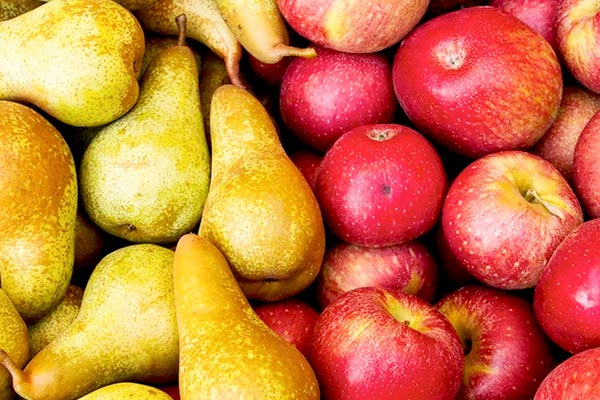
Harvesting of autumn-winter apple and pear cultivars begins. The harvested produce is transported and sorted. The moment of fruit harvest must be correctly determined. Picking maturity of the fruits can be determined by the following complex of indicators:
- Fruit retention strength. At picking maturity, the fruits separate easily from the bearing wood.
- Clearing of the colour of the skin and flesh.
- Firmness of the fruit flesh. A certain degree of maturity corresponds to a certain firmness of the fruit flesh. It is determined with a penetrometer.
- Age of the fruit. For each fruit species and cultivar, there is a genetically determined period from flowering to picking maturity. For late apple cultivars it is 130–146 days, and for late pear cultivars – about 120 days.
- By starch test. The method is based on the ability of starch to turn blue under the influence of iodine. At optimal picking maturity, 1/3 to ½ of the surface of the cut turns blue.
At the end of summer, fruits increase their weight by 1–2% per day, so very early harvesting leads to significant losses. In addition, fruits picked early do not have the cultivar’s typical organoleptic complex and do not acquire it during postharvest ripening. In fruits picked late, the percentage of damage from physiological breakdown of the fruit flesh increases, and a mealy consistency and glassiness occur.
Fruits are brought into storage facilities and the chambers are loaded. Proper storage of the fruits is monitored. The optimal storage temperature for fruits is about 0 oC, at a relative air humidity of 85–90%. The air in the cold chamber should be circulated. Air renewal during the first month of storage is carried out weekly, and later once or twice a month.
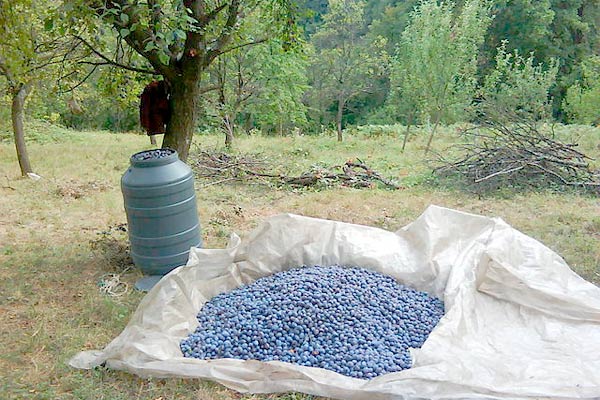
Harvesting of late plum cultivars is carried out – Strinava, Gabrovska, Angelino
Walnut fruits are harvested on a mass scale.
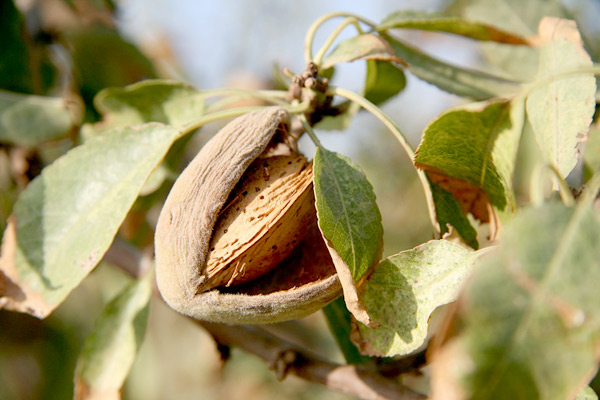
Around mid-month, harvesting of almond fruits begins
The most suitable moment is when the fleshy hull is fully open, but before it has dried and adhered to the shell.
In strawberry plantations
Strawberry plantations, both young and old, are irrigated as necessary.
Planting material for establishing new plantations is lifted and stored. Depending on the planting time, strawberry runners are lifted from the mother plantations from the end of August to the end of November. For autumn planting, they are lifted earlier, and for cold storage and summer planting – later, but at an air temperature not lower than 0 oC. From the plants intended for autumn planting, after lifting, those damaged by diseases and pests are removed. The remaining plants are cleaned of runners and dry leaves, tied into bundles of 25 or 50, placed in crates or other containers and stored until planting, ensuring that the roots do not dry out.
Plants that will be stored in a cold room are lifted and defoliated. The roots are cleaned of adhering soil by shaking or washing with water. The plants are thoroughly moistened and placed, 500 each, into polyethylene bags (35–40 x 45–50 cm). In each bag, a label is placed indicating the cultivar name, class and number of plants. The bags are hermetically sealed and stored at a temperature of -2 oC. Air humidity in the cold storage rooms is maintained above 90%.
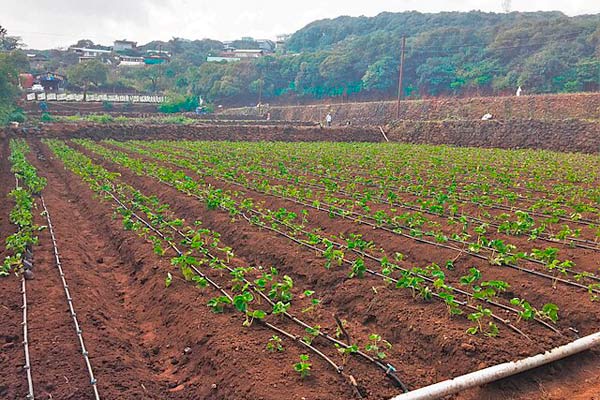
Autumn planting of runners in the new plantations is carried out
Immediately before planting, the roots of the plants are trimmed back to fresh, viable tissue, without excessive shortening. To reduce transpiration, old leaves are removed.
Planting is carried out at a depth equal to or slightly greater than that before lifting, taking care not to bend the roots and not to cover the crown with soil. The soil around the planting material is firmly compacted and irrigated. For early planting dates, a second irrigation is applied, and for later ones – after about 7 days. After about a week, plant establishment is checked and gaps from failed plants are filled. Until the end of autumn, irrigation is carried out a further 2–4 times.
In raspberry plantations
Mother plantations are kept free of weeds. Young and bearing plantations are cultivated regularly. Fruited canes are cut out, removed and burned (if this has not been done in August).
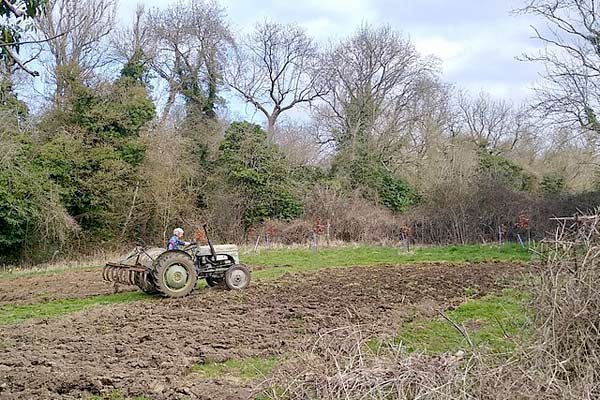
Preparation of areas for new plantations continues
In blackcurrant plantations
In dry conditions, irrigation has a very beneficial effect. Depending on needs, irrigation is carried out 1–2 times. The soil is cultivated regularly. Rooting beds are irrigated 1–2 times. The soil is cultivated and kept loose and free of weeds.
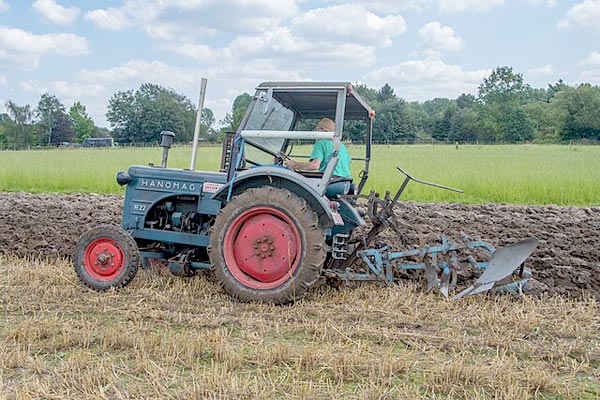
Areas for new plantations are prepared – fertilization is carried out (3–5 t of farmyard manure, 80–100 kg of superphosphate or the same amount of another phosphorous fertilizer, 25–30 kg of potassium sulfate or the same amount of another potassium fertilizer per decare), and deep ploughing.
In plantations with other crops
Summer budding of Caucasian persimmon with buds from Japanese persimmon is completed. Bud take is checked and, if necessary, the bindings are loosened.
After the lemon scion shoot grows to a height of 10–15 cm, the rootstock is cut off without a stub above the grafting point. Small stakes are driven in to straighten and tie the shoots.
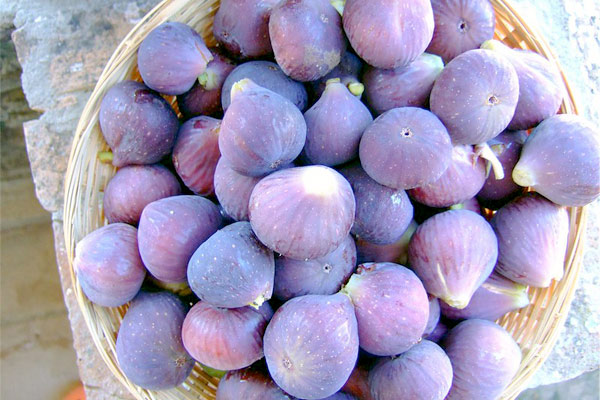
Fig harvesting continues
The soil in plantations, seedbeds and nurseries of southern crops is kept loose and free of weeds. Where necessary, it is irrigated regularly, especially for kiwifruit (Actinidia).
Care continues for green cuttings of kiwifruit, chokeberry, sea buckthorn and others, set for rooting at the beginning of July. The hardening process begins. The number and duration of misting are gradually reduced. Vegetation structures are gradually ventilated.