

![MultipartFile resource [file_data]](/assets/img/articles/пипер-заглавна-болести.jpg)
Summary
Pepper grown in protected structures and in the open field is attacked by many diseases and pests. Some of them are of greater economic importance for greenhouse production, and others for field production. Viral, fungal, bacterial and mycoplasma pathogens are harmful to pepper. They attack the roots, leaves, stems and fruits and can cause a significant reduction in yields. Among the pests, aphids, thrips, mites, leaf-mining flies, cutworms, leafhoppers, mole crickets, etc. are encountered. Some of them damage the plants directly, while others are vectors of viral diseases.
This article reviews the main diseases and pests of pepper, the damage they cause, as well as the control measures.
Pepper ranks fifth among vegetables in the world in terms of production and cultivated area, and in our country – second after tomato. Its importance for humans is due to the valuable nutritional and organoleptic qualities of its fruits, which are a source of vitamins, organic acids, sugars, essential and vegetable oils, and pigments. Pepper cultivars are divided into two groups – sweet and hot. In terms of vitamin C content, sweet peppers surpass all vegetables and contain more sugars and less capsaicin than hot peppers.
I. DISEASES
I.1. VIRAL DISEASES
Tobacco mosaic (Tobacco mosaic virus 1 Smith) is the most widely distributed disease of vegetable crops. It has a large number of hosts and is preserved for a long time in various forms. The apical leaves are mosaic mottled, blistered and boat-shaped curled. The plants are stunted, and black necrotic streaks appear on the stems and branches, which can cause desiccation of the vegetative apex. Necrosis spreads along the petioles and veins of the leaves, which drop. Under the skin of the fruits, dark necrotic streaks or spots, sunken and of various shapes, are formed. Symptoms are particularly severe in the cultivar ‘Cherna shipka’ grown in greenhouses. On pepper, tomato strains of the virus are encountered more frequently. Pepper is infected at any growth stage. The optimum temperature for symptom expression is 18-20°C. At higher temperatures, the symptoms are masked. The virus is inactivated at 93°C for 10 min. It is resistant to chemical plant protection products, but is sensitive to hydrochloric acid, trisodium phosphate and sodium hydroxide. It is preserved in the surface soil layer with residues from diseased plants, from where infection can easily occur. Another means of virus transmission is through seeds taken from diseased plants. The incubation period is 10-14 days, but with excessive nitrogen fertilization and vigorous growth, the period is shortened to 6-7 days. Lack of light, absence of potassium fertilization and low temperatures are favourable conditions for disease development.

Cucumber mosaic (Cucumber mosaic virus (Cucumis virus 1 Smith). It is transmitted by aphids, which is why it has the greatest economic importance for pepper grown in the open field. The first symptoms appear on the apical leaves, which are mosaic mottled, slightly to severely deformed – the midrib of the leaves acquires a zigzag shape. In cases of severe deformation they may become thread-like. The plants are stunted, the internodes are shortened, and they appear bushy. Such plants bear fewer fruits, because a large part of their flowers abort. Their fruits are severely deformed, mosaic mottled, sometimes with ring-shaped necroses. They have no marketable appearance and their organoleptic qualities are impaired. Sometimes the symptoms are similar to those of tobacco mosaic, and sometimes the infection may be mixed. Accurate diagnosis requires precise tests. Of greatest importance for the spread of the virus in pepper crops is the green peach aphid Myzus persicae Sulz. It is not transmitted by seeds, is not preserved in the soil and is not transmitted by contact. The virus is inactivated at 700C for 10 min. It is preserved until the next vegetation in some perennial weed hosts.
Control - Growing resistant cultivars; Destruction of weed vegetation in and around protected structures; Systematic control of vectors – aphids.
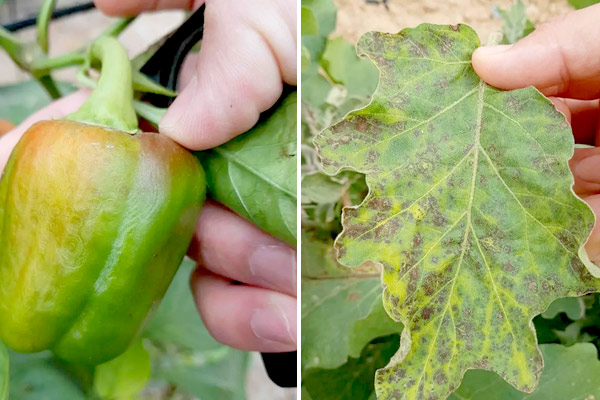
Tomato spotted wilt (Tomato spotted wilt virus (Lycopersicon virus 3 Smith).
The virus is widespread throughout the world. It is of great economic importance for vegetables, many ornamentals, tobacco, etc. Infected plants are stunted, and yellow chlorotic spots appear on the leaves. Yield is severely reduced. In plants infected later, small, round spots appear on the upper side of the apical leaves, where only the upper epidermis is damaged. The diseased leaves have a bronze tint. Later, necrotic streaks oriented towards the apex of the plant form on the stem. The spots on the fruits are small, necrotic, with a concentric structure. On ripe fruits, they become yellowish-orange, but do not penetrate into the pericarp. Their shape may vary, but they are always smooth and with a concentric structure. The virus is not transmitted by seeds and sap from diseased plants. It is not preserved in the soil. It is spread only by thrips that have fed on sap from diseased plants. It overwinters in the roots of weed vegetation, on houseplants, as well as in overwintered viruliferous thrips. It is transmitted by both adults and larvae. The duration of the incubation period depends on environmental conditions and varies from 7 to 14 days.
Control – Growing resistant cultivars; Removal of weed vegetation; Treatment with registered systemic insecticides for thrips control; Treatment of 10-metre-wide weed strips adjacent to protected structures with insecticides to reduce thrips populations; Removal of the first diseased plants to limit virus spread.
Stolbur (Mycoplasma). The disease occurs in a large number of vegetable crops, but is of economic importance for pepper, tomato, eggplant and potato. Diseased plants have a chlorotic appearance. The apical leaves are boat-shaped curled, erect, hard and brittle when squeezed. Later, chlorosis affects the entire plant. In pepper, root rot also appears, starting from the apical parts of the root and progressing towards the stem base. The bark of the rotted tissues easily peels off. The aerial parts of such plants wilt and dry out. In plants infected at a later growth stage, small, low-quality fruits are formed. The causal agent is transmitted by the leafhopper Hyalestes obsuletus. It has one generation per year. Infected insects transmit the phytoplasma throughout their life. It overwinters as a larva in the roots of bindweed and some perennial weeds. The flight of the insect is in June. The duration of the incubation period is about one month.
Control – Destruction of weed hosts of the leafhopper; Treatment against it with registered plant protection products three times at 7–10-day intervals when flight is detected.
I.2. FUNGAL DISEASES
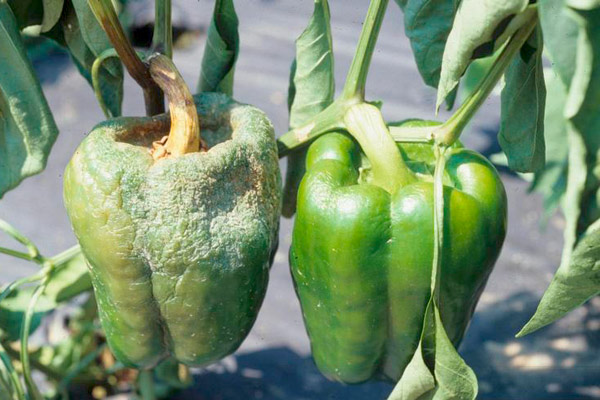
Phytophthora blight (Phytophthora capsici Leon). The economically most important disease of pepper. It attacks pepper plants at all growth stages. On seedlings, small water-soaked spots appear at the base of the hypocotyl, which later darken. The plants turn yellow, and their leaves fall easily when touched. Within 2–4 days they die. The roots of such plants are rotted. The disease can destroy the entire seedling crop if adequate measures are not taken.
On already transplanted plants, the second form of the disease appears, which is often mistaken for transplant failure. In the second half of July, when the weather becomes permanently warm, single plants or groups of plants begin to wilt and later die. The roots of such plants are rotted, and at the stem base there is a dark to black, sunken lesion. Usually the first diseased plants appear in low, waterlogged areas and then the infection is spread with irrigation water to other parts of the field. The disease develops in patches or along the rows.
In years with heavy rainfall in mid-summer another form of the disease is observed, which mainly affects the aerial parts of the plants. On the stems and branches of infected plants, elongated dark lesions appear, which completely girdle them. The parts above these lesions dry out. Usually no sporulation of the fungus is observed on these lesions. Dark, water-soaked spots appear on the leaves, which rapidly enlarge, also without sporulation. The lesions on the fruits are elongated, water-soaked and rapidly enlarging. They are covered with abundant, dense sporulation of the fungus. Most often they start from the fruit peduncle and cover the entire fruit. In subsequent dry weather, the rotted pericarp dries out and acquires a parchment-like appearance, which is one of the diagnostic features of the pathogen. The fungus develops in a temperature range of 9–350C, with an optimum of 25oC. It survives in the soil as mycelium and oospores under favourable conditions for 15–16 months. It develops down to a depth of 30 cm. It dies only at extremely low temperatures in snowless winters. The pathogen attacks the root system and the plant base. With irrigation water, the infection is spread to other parts of the field.
Control - Growing resistant cultivars; Leveling the fields to prevent waterlogged areas; Growing seedlings in sterile substrate and treatment with plant protection products before transplanting; Growing pepper on raised beds; Avoiding surface (gravity) irrigation; Pulling out the first diseased plants and their neighbouring apparently healthy plants and destroying them outside the crop. The patches are treated with a 2% solution of copper sulfate or ammonium nitrate; If necessary, the entire crop is treated with registered plant protection products: Infinito SC 120–160 ml/ha; Vitene triplo 400–450 g/ha.
Powdery mildew (Leveilula taurica (Lev.) Arnaud). It develops massively in the southern parts of the country and causes significant losses. On the upper leaf surface, small pale, yellowish spots of irregular shape appear, sometimes delimited by the veins. The lower surface is covered with a loose white fungal growth consisting of the sporulation of the fungus. Later the spots enlarge and merge. Sometimes sporulating growth may also appear on the upper side. The affected leaves drop. In cases of severe infection, plants may become completely defoliated. The fungus develops throughout the year, but can also be preserved as spores adhering to constructions or in plant residues in the soil. It is more harmful in dry and hot weather and at low relative air humidity. It develops mainly in the second half of summer and during dry and hot days in autumn.
Control - Growing resistant cultivars; Increasing air humidity in protected structures; Treatment with registered plant protection products when necessary: Vivando 30 ml/ha; Dagonis 100 ml/ha; Zoxis 250 SC 70–80 ml/ha; Carbicure 300 g/ha; Kozavet DF 500 g/ha; Custodia 50–100 ml/ha; Legado 80–100 ml/ha; Norios 250 SC 70–80 ml/ha; Orios 200 EW 125 ml/ha; Ortiva top SC 100 ml/ha; Prev-Gold 160–600 ml/ha; Sonata SC 500–1000 ml/ha; Score 250 EC 0.05%; Taegro 18.5–37.0 g/ha; Tazer 250 SC 80–100 ml/ha; Topaz 100 EC 35–50 ml/ha; Phytosev 200 ml/ha; Cidely top 100 ml/ha.
Brown leaf spots (Alternaria solani). It develops at high relative air humidity. It attacks pepper grown both in protected structures and in the open field. Initially, water-soaked, later brown spots with a concentric structure and irregular shape appear on the leaves. Similar spots form on the stem and on fruit and leaf petioles. The spots on the flower pedicels are particularly dangerous, as they may cause flower drop. Damage to the fruits is observed less frequently. In wet weather, a loose dark growth of fungal sporulation forms on the surface of the spots. The pathogen survives as mycelium on plant residues and seeds, which serve as sources of infection. It is also preserved on some weed hosts. Conidia are easily spread by wind and rain splashes. High relative air humidity and frequent showers favour abundant sporulation of the fungus. Older leaves are more susceptible to the disease.
Control – Treatment with plant protection products when high relative air humidity is present and at the appearance of the first spots. Registered plant protection products: Dagonis 100 ml/ha; Zoxis 250 SC 70–80 ml/ha; Norios 250 SC 70–80 ml/ha; Ortiva top SC 100 ml/ha; Score 250 EC 0.05%; Taegro 18.5–37.0 g/ha; Tazer 250 SC 80–100 ml/ha; Cidely top 100 ml/ha.
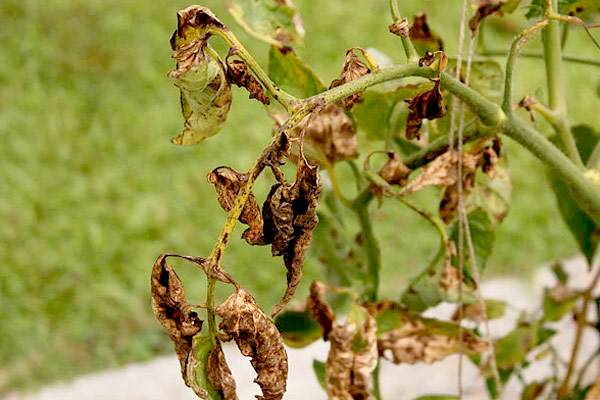
Verticillium wilt (Verticillium dahliae Kleb). The causal agent of Verticillium wilt is a soil-borne pathogen that has over 300 hosts. It is of greater economic importance for pepper, eggplant, cucumber, potato, mint, cotton, chrysanthemum, strawberry, raspberry, rose, alfalfa, some fruit species, etc. Favourable conditions for its development are a high content of organic matter in the soil, monoculture vegetable production in greenhouses and the impossibility of introducing crop rotation with the inclusion of non-host crops. When a significant amount of inoculum accumulates in the soil, the pathogen can compromise the crop. It attacks plants at all ages. The lowest leaves wilt, curl and dry. Later, the entire plant wilts. The vascular bundles of the stems and leaves of diseased plants are brown discoloured. A characteristic feature of all hosts of the fungus is that the roots always remain fresh and apparently healthy. The accumulation of inoculum in the soil is favoured by prolonged continuous cultivation of susceptible plant species. Light soils poor in organic matter also favour this process. If seedlings are grown in infested substrates, early infection of the plants and greater losses are observed. The reaction (pH) of the soil solution is of little importance, but increased salt concentration favours the infection process. The pathogen penetrates the host plant mainly through the roots and develops in the vascular system, destroying and blocking it. At the same time, it secretes toxins that disrupt normal biochemical and physiological processes. Damage to the roots caused by pests or tillage is also important. The fungus overwinters as mycelium in intermediate hosts and in plant residues. It can survive in the soil for more than 10 years in the form of microsclerotia. The pathogen is spread through infected seedlings, by tillage operations and with irrigation water. The root lesion nematode Pratylenchus penetrans also plays a role in this process. The number of resistant cultivars is limited.
Control – Preventive measures are important, such as collection and destruction of plant residues at the end of the vegetation period; Inclusion of pepper in a 4–5-year crop rotation involving cereals, beans, late cabbage and maize, which are not attacked by the pathogen; Production of healthy seedlings on disinfected soil; Carrying out regular irrigations to maintain soil moisture at 70–80%, i.e. avoiding both drought and prolonged waterlogging of the soil.
I.3. BACTERIAL DISEASES
Bacterial leaf spot (Pseudomonas syringae pv. syringae). It attacks pepper at any growth stage. On the apical leaves, water-soaked spots delimited by the veins are formed. Later they become dark, almost black, greasy, of various shapes and sizes; the tissue in them scorches and falls out. Sometimes the spots enlarge and merge and as a result the entire leaf turns yellow and drops. Similar, but larger, spots also form on the stem. Sometimes they coalesce and the apex breaks. The bacterium also damages flower pedicels, and flowers and fruits drop. It is transmitted by seeds and preserved with plant residues in the soil for up to two years. Seed infection is superficial. It develops during short, intense and heavy rains in late spring and early summer at temperatures of 16–240C. It is spread by water splashes that penetrate the plants through stomata or wounds. The incubation period is 3–6 days.
Control - Spraying with copper-containing plant protection products at first appearance; The spots on leaves and fruits will not disappear, but further spread will be limited. The bacterium is spread by raindrops. Therefore, after each more intense rainfall, spraying must be carried out immediately, because the infection is already present in the crop. Registered plant protection products: Serenade Aso SC 400–800 ml/ha; Funguran OH 50 WP 0.15%.
II. PESTS
Mole cricket (Gryllotalpa gryllotalpa L.). It has an underground way of life. It has one generation per year. It overwinters as a larva, nymph or adult in the soil. Early in spring, with the warming of the weather, it comes close to the soil surface. It prefers loose, moist, humus-rich soils. In the field, adults appear towards the end of May. The mole cricket makes underground tunnels, undermining and lifting the plants. Both larvae and adults feed on the underground parts of the plants, gnawing the root system and the stem near the soil surface, eating young shoots. Damaged plants dry out.
Control – Treatment with: Belem 0.8 MG/Colombo 0.8 MG 1.2 kg/ha. It is incorporated into the soil immediately before transplanting.
Aphids. They are harmful throughout the entire vegetation period of pepper, both during seedling production and in the field. They prefer younger and more tender plant tissues from which they suck sap. They concentrate on the leaves, shoot tips and branches, on leaf and flower buds. High temperatures and low relative air humidity in July and August cause depression in development and a strong reduction in numbers, and even temporary clearing of plants from these pests. Infested plants are stunted in growth and development. During feeding, aphids excrete a sticky secretion, the so-called “honeydew”, on which black saprophytic fungi develop.
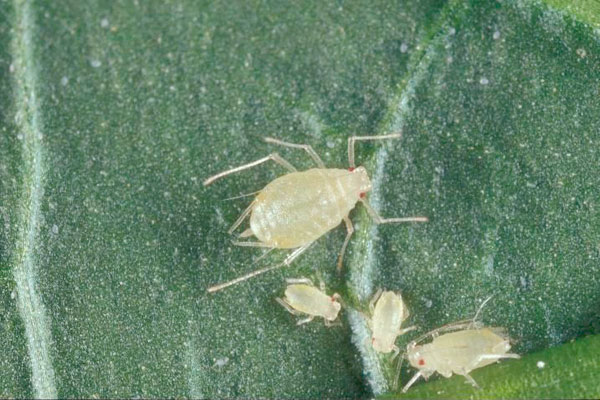
Green peach aphid (Myzus persicae Sulz.)
Aphids are vectors of some viral diseases. Several species are harmful to pepper: green peach aphid (Myzus persicae Sulz.), pepper aphid (Aphis nasturtii Kalt.) and potato aphid (Macrosiphum euphorbiae Thomas).
Control – Treatment with plant protection products at the appearance of the first individuals. Registered plant protection products: Verimark 200 SC 37.5–50.0 ml/ha; Deca EC/Dena EC/Desha EC/Deltin/Decis/Polesi 50 ml/ha; Decis 100 EC 10.5–17.5 ml/ha; Closer 120 SC 20 ml/ha; Lamdex Extra 28–60 ml/ha; Meteor 80–90 ml/100 l water; Mospilan 20 SG 25 g/ha; Neemik Ten 260–390 ml/ha; Oikos 100–150 ml/ha; Pyrekrys 70–120 ml/ha; Sivanto Prime 45 ml/ha; Flipper 1–2 l/ha.
Thrips. Two species are most harmful to pepper. Western flower thrips (Frankliniella occidentalis Perg.) – larvae and adults are harmful as they feed on epidermal cells of leaves, buds and flowers. Mass attacks can destroy the seedlings. Symptoms of direct damage are light mottling and silvering of leaves, malformation and discoloration of buds and flowers. A significant problem caused by thrips is also fruit deformation. Onion thrips (Thrips tabaci Lindeman) is found mainly on leaves, rarely attacks flowers, and the symptoms of damage are mottling and silvering of leaves. Indirect damage – caused by transmission of tomato spotted wilt virus.
Control – Treatment with plant protection products at first appearance. Registered plant protection products: Deca EC/Dena EC/Desha EC/Deltin/Decis/Polesi 30 ml/ha; Lamdex Extra 42–80 g/ha; Meteor 0.06–0.07%; Minecto Alfa 100 ml/ha; Naturalis 100–1150 ml/ha; Neemik Ten 260–390 ml/ha; Oikos 100–150 ml/ha; Requiem Prime 500–1000 ml/ha; Sineis 480 SC 25 ml/ha; Flipper 1–2 l/ha.
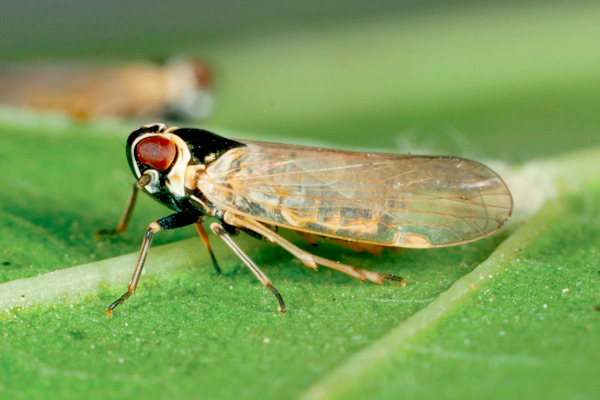
Leafhopper (Hyalesthes obsoletus Signoret). Development of the pest: beginning of adult emergence on weed vegetation at the beginning of June. It overwinters on the rhizomes of bindweed and, less frequently, in the rhizomes of other perennial weed hosts. The increase in leafhopper numbers is cyclical and is strongly influenced by meteorological conditions – temperature and moisture during the period. The pest is a vector (carrier) of the mycoplasma disease stolbur in vegetable crops.
Leafhoppers suck sap from the leaves of attacked plants. At the feeding sites, light spots can be seen, which often remain unnoticed. The direct damage caused by the pest is of no substantial importance for the crop. The dangerous aspect is the transmission of the mycoplasma disease stolbur. When it has fed on sap from diseased plants, the leafhopper can spread the disease throughout its life. The duration of the incubation period is 30–35 days.
Control – Three treatments at 7–10-day intervals with plant protection products when the first specimens are detected. Registered plant protection products: Meteor 0.08–0.09%.
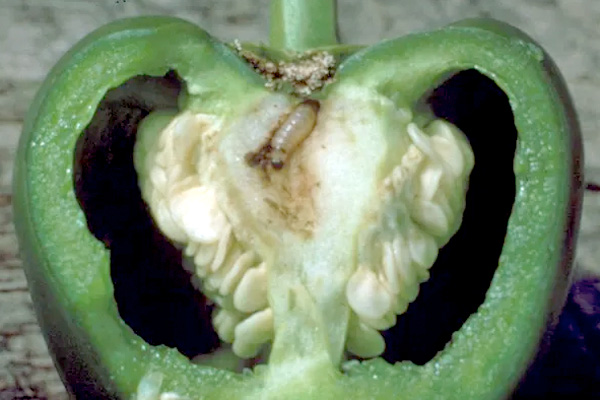
Cotton bollworm (Helicoverpa armigera Hubn.). The species develops three generations per year and overwinters as a pupa in the soil. Moths of the first generation begin to fly in May and are active at night. Moths of the second generation fly in June, and of the third – in September. The third generation is the most numerous, but the greatest damage is caused by larvae of the second generation. Embryonic development lasts from 3 to 10 days. The larvae are harmful, gnawing leaves, buds and flowers, and later attacking the fruits, boring into them and feeding on their contents. In damaged fruits, rot develops, resulting in soft, water-soaked decay. Usually the larva does not completely destroy the fruit but leaves it and moves to another one. Thus, one larva can damage two to five fruits before completing its development.
Control – Registered plant protection products: Verimark 200 SC 37.5–50.0 ml/ha; Voliam Targo 063 SC 80 ml/ha; Decis 100 EC 7.5–7.5 ml/ha; Dipel DF 50–100 ml/ha; Exalt 200–240 ml/ha; Litovir 10–20 ml/ha; Minecto Alfa 100 ml/ha; Rapax 100–200 ml/ha.
European corn borer (Ostrinia nubilalis Hb.). The pest develops two generations per year. It overwinters as an adult larva in the stems of cultivated and many weed plants. It lays its eggs in spring, at the beginning of May. In pepper, the larvae feed on the seeds of the pods. They bore near the fruit peduncle. Pepper is most often attacked when it is grown together with maize or in its vicinity.
Control – Registered plant protection products: Deca EC/Dena EC/Desha EC/Deltin/Decis/Polesi 30–50 ml/ha; Meteor 80–90 ml/ha.
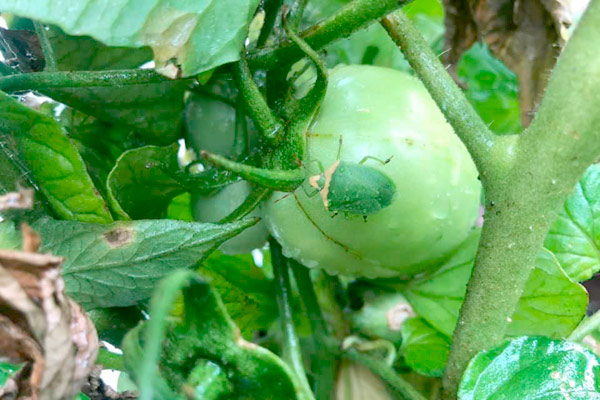
Southern green stink bug (Nezara viridula L.). The pest develops from three to five generations per year depending on meteorological conditions. It overwinters as an adult under plant residues, in soil cracks, under tree bark and in buildings. Adults, nymphs and larvae are harmful. They damage all parts of the plant, but prefer developing fruits, flower buds and young shoots. When they suck sap from fruits, numerous spots are formed, initially whitish, later turning brown and merging. In cases of severe infestation, young fruits are deformed, become whitish and often drop.
Control – Treatment with plant protection products at first appearance. Registered plant protection products: Decis 100 EC 10.5–17.5 ml/ha.
Two-spotted spider mite (Tetranychus urticae Koch). This non-insect pest is highly damaging, especially after the second half of summer (July–August). During this period, temperatures are high and air humidity is low. Therefore, conditions are favourable for its development; a large part of the weed vegetation dries up and it moves onto cultivated plants, where it develops several generations and causes damage to leaves and fruits. The pest sucks sap, together with which chlorophyll grains are also taken up. At the feeding sites, small pale pinpoint spots appear. Their number rapidly increases and the leaf acquires a mottled (mosaic) appearance. Severely damaged leaves turn yellow and subsequently dry and fall. At high population densities, mites form colonies and spin webs over all parts of the plant, which can very quickly die.
Control – Treatment with plant protection products at first appearance. Registered plant protection products: Vertimec 018 EC 60 ml/ha; Voliam Targo 063 SC 80 ml/ha; Naturalis 100–200 ml/ha; Nissorun 10 WP 75 g/ha; Requiem Prime 500–1000 ml/ha; Safran 50–100 ml/ha; Shirudo 25 g/ha.
To protect pepper during the vegetation period, a complex of plant protection measures must be applied. These include compliance with phytosanitary standards; Proper and precise management of agrocenoses, because the occurrence of pests is influenced by agrotechnical conditions; Use of healthy seedlings free from diseases and pests; Use of only registered plant protection products for crop treatments; Observance of the pre-harvest intervals specified on the label; Implementation of rotational treatments with pesticides having different modes of action to prevent the development of resistance in pest populations; Carrying out localized treatments, as well as the use of broader-spectrum products, with a view to reducing the number of sprayings and preserving bioagents; Application of plant protection products via drip irrigation systems, which limits direct contact of workers with the product and preserves beneficial species; The integrated use of biological and conventional means must take into account the side effects of chemical plant protection products on beneficial species and the requirements for their conservation.
To increase the effectiveness of applied plant protection measures, it is necessary to:
- Regularly monitor crops for early detection of pests;
- Accurately determine the species composition of both pests and beneficial species in agrocenoses;
- Determine the pest:bioagent ratio;
- Carry out treatments in accordance with economic injury levels.
- Install protective nets on ventilation openings in greenhouse production
- Place a disinfection solution near the doors.
References
- Baharieva, D., B. Velev, S. Stefanov, E. Loginova, 1992. Diseases, Weeds and Pests of Vegetable Crops, Zemizdat.
- Roberts, P.D., Adkins, S., Pernezny, K., Jones, J.B. (2004). Diseases of Pepper and their Management. In: Naqvi, S.A.M.H. (eds) Diseases of Fruits and Vegetables: Volume II. Springer, Dordrecht. https://doi.org/10.1007/1-4020-2607-2_10.
- Kenyon L, Kumar S, Tsai WS, Hughes Jd. Virus diseases of peppers (Capsicum spp.) and their control. Adv Virus Res. 2014;90:297-354. doi: 10.1016/B978-0-12-801246-8.00006-8. PMID: 25410105.
- Grozea I., S. Ramona, 2020. Pests and pathogens that affect the quality of pepper plants and their control, Chapter 2, In Capsicum, ISBN 978-1-53618-821-9, Nova Science Publishers.