

![MultipartFile resource [file_data]](/assets/img/articles/бурчак-заглавна.jpg)
Bitter vetch, or the so-called “bitter vetchling” (Vicia ervilia L.) Willd belongs to the family Leguminosae (Fabaceae). It belongs to the genus Vicia (vetch), which consists of about 160 annual and perennial species. Vicia ervilia is an ancient grain legume crop from the Mediterranean region. This crop was highly valued by farmers in the Old World for improving the nutritional value of fodder. At present, seeds of Vicia ervilia are of interest not only as feed, but also as a potential component in functional foods and food supplements.
In 2025, various bitter vetch accessions were studied in the experimental field of the IPGR – Sadovo. The different genotypes were evaluated according to various agromorphological traits, as well as for the development and spread of different airborne and soil-borne phytopathogens. During the observations at flowering and at the beginning of pod formation, isolated plants with slight chlorosis starting from the lower leaves were recorded. Gradually, the chlorosis also affected the leaves of the upper layers, and at a later stage the death of whole plants was observed (Fig. 1, 2). •
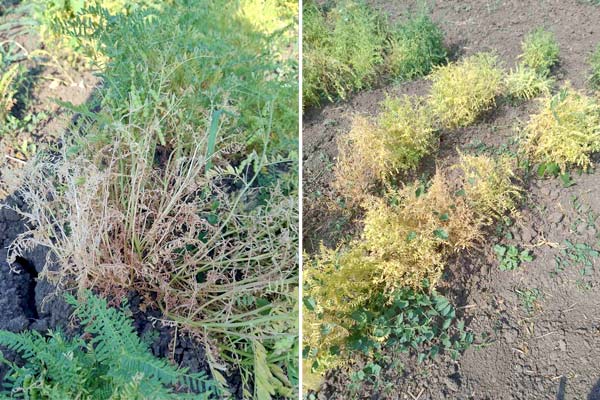
Symptoms of root rot in bitter vetch
During the inspections, infected plant samples were collected and analysed in the “Phytopathology” laboratory of the Institute. The diseased plant samples were washed and placed on a nutrient medium (potato-dextrose agar) and incubated in a thermostat at 24°C for 14 days. The dynamics of mycelial growth were determined every 3 days. Initially, we recorded rapid mycelial development with a creeping substrate mycelium. The colour of the aerial mycelium changed from whitish to light brown. After 14 days, a microscopic analysis and digital imaging of the pathogen structures were carried out. We found that the hyphae were septate and very often branched at right angles. The sclerotia were small, irregular in shape, located on the periphery and predominantly brown in colour (Fig. 3, 4).

Mycelium of Rhizoctonia solani
Following the laboratory analyses, the species Rhizoctonia solani was identified. The symptoms observed under field conditions and natural infectious background were also confirmed through artificial inoculation of the plants under controlled laboratory conditions.
This is the first report of the occurrence of root rot on bitter vetch (Vicia ervilia) in Bulgaria.
The soil-borne fungus Rhizoctonia solani is a dangerous soil phytopathogen. It mainly infects the roots and stems of various cultivated plants, including many legume crops in different parts of the world. Root rot caused by this fungus can significantly reduce the yield and quality of the production obtained from grain legume crops. The same pathogen has been reported as the causal agent of rhizoctoniosis in common bean in Bulgaria.
References:
1. Bobev, S. 2009. Handbook of Diseases of Cultivated Plants.
2. Zohary, D., Hopf, M. 2000. Domestication of plants in the Old World, Annals of Botany, 88 (4), 666.
3. Maxted, N., 1995. An Ecogeographical Study of Vicia subgenus Vicia. Systematic and Ecogeographic Studies on Crop Genepools 8. International Plant Genetic Resources Institute, Rome, Italy.
4. Salt, G. A. 1982. Factors affecting resistance to root rot and wilt diseases. Pages 259-267 in G.C. Hawtin and C. Webb, eds., Faba Bean Improvement. Martinus Nijhoff Publishers, The Netherlands.