

![MultipartFile resource [file_data]](/assets/img/articles/Papilio-machaon-2025.jpg)
Summary
Vegetable crops are hosts to a large number of species from the order Lepidoptera. Damage caused by the caterpillars often leads to major yield losses. Various butterfly species can prove to be as dangerous as they are beautiful. Timely detection of these pests in the crops enables limitation of the infestation and successful control.
Butterflies (Lepidoptera) represent an order rich in families and species. The science of butterflies, which is a branch of entomology, is called lepidopterology, from the name of the order derived from the Greek words lepis – scale and pteron – wing, i.e. insects whose wings are covered with small scales. The oldest butterfly imprints have been found in layers of the Mesozoic era, namely in middle Jurassic strata. Rich deposits have been discovered in England, Spain, Germany and Eastern Siberia. The glacial period had a strong influence on the distribution of butterflies in the Northern Hemisphere. The tropical regions of the Earth are now the richest in butterfly species. Various butterfly species can prove to be as dangerous as they are beautiful. In some species the larval form – the caterpillar – is the harmful stage for many agricultural crops. One of the traditional classifications of butterflies divides them into diurnal and nocturnal. The first group includes mainly large butterflies active during the day, usually brightly coloured, whereas the second group includes mainly butterflies active at night, coloured in dark shades. Vegetable crops are attractive hosts for butterflies and they often become the target of their attacks.
Fam. Noctuidae
Above-ground cutworms
Cotton bollworm (Helicoverpa armigera Hubn.)
The caterpillars are typical polyphagous pests. They damage tomato, pepper, bean, eggplant, pea and other vegetable crops. The species develops three generations per year and overwinters as a pupa in the soil. In some years there is also a fourth generation, which does not manage to complete its development. The flight of the butterflies of the first generation begins in May.
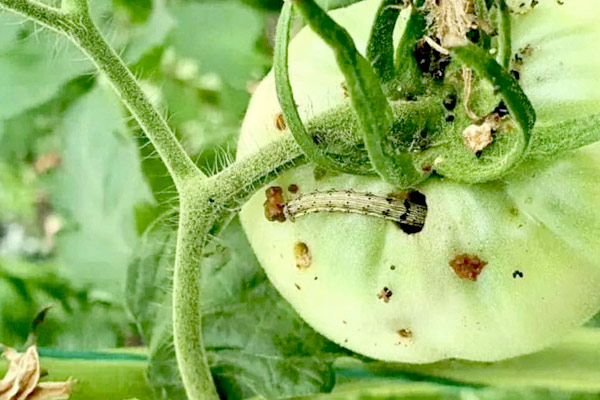
Damage caused by cotton bollworm (Helicoverpa armigera Hubn.)
The harmful stage is the caterpillar, which gnaws the leaves, buds and flowers and later attacks the fruits, boring into them and feeding on their contents. The caterpillars often bore in from the side of the fruit stalk (tomato, pepper), making round holes resembling perforations. Rotting processes start in the damaged fruits, resulting in soft, watery rot. Usually the caterpillar does not completely destroy the fruit, but leaves it and moves to another one. Thus, a single caterpillar can damage from two to five fruits before completing its development. The caterpillars of the second generation are the most harmful.
Cabbage moth (Mamestra brassicae L.)
It occurs throughout the country. It damages cabbage, broccoli, lettuce, cucumber, pepper, carrot, zucchini and others. It develops two to three generations per year. It overwinters as a pupa in the soil. The butterflies of the first generation fly at the end of April – beginning of May. The butterflies of the second generation fly during the second half of June until the end of July, and of the third – during the second half of August and the first half of September.
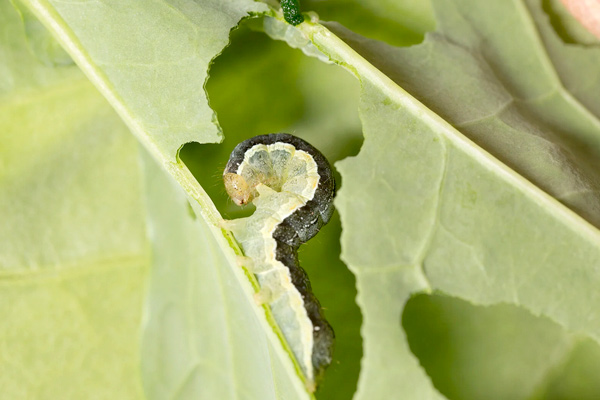
Caterpillar of cabbage moth (Mamestra brassicae L.)
The caterpillars cause feeding damage to the leaves and cabbage heads. After hatching they live on the underside of the leaves, later they eat the leaves leaving only the thick veins and then penetrate into the cabbage head. The damaged heads have an unpleasant odour.
Garden armyworm (Mamestra oleraceae L.)
It prefers cruciferous vegetable crops. It damages radish, small radish, pepper, tomato and others. It develops two generations per year. It overwinters as a pupa in the soil. The flight of the butterflies of the first generation begins at the end of April – beginning of May. The butterflies of the second generation fly in July–August.
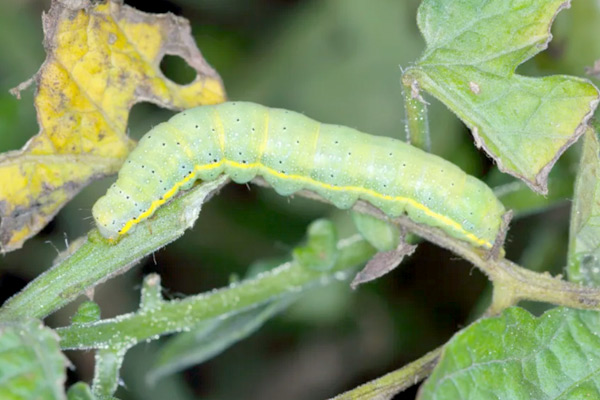
Caterpillar of garden armyworm (Mamestra oleraceae L.)
The harmful stage is the caterpillar. Initially they window-pane the leaves, later they eat the leaf blade completely without affecting the thick veins. Unlike the cabbage moth, the caterpillars of the garden armyworm do not penetrate into the cabbage head.
Variegated cutworm (Peridroma saucia Hubner)
It damages pepper, cucumber and others. It develops three to four generations and overwinters as a pupa. The caterpillars are very voracious, they feed on the margins of the leaves, perforate them or destroy them completely. They bore holes in the fruits, enter them, contaminate them and render them unfit for consumption. Such fruits usually rot.
Silver Y moth (Plusia chalcites Esper)
The pest has been observed on pepper, pea, dill and others. Under greenhouse conditions and in the presence of food, it develops continuously, without diapause.
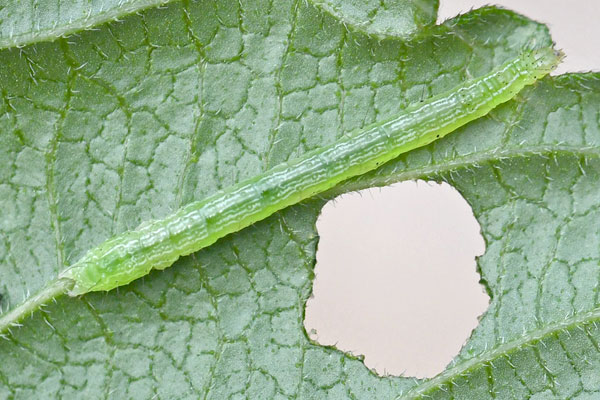
Caterpillar of silver Y moth (Plusia chalcites Esper)
Young caterpillars skeletonise the leaves by feeding on the lower epidermis and parenchyma, and later they also feed on the upper epidermis. As a result of the damage, numerous irregular holes are observed on the leaves. Later the caterpillars eat entirely or partially the leaf venation. On tomato fruits the caterpillars initially make superficial feeding damage, which can cover the entire fruit. Then they penetrate into the fruits and feed on their interior. One caterpillar damages 4–5 fruits. On cucumbers the caterpillars feed superficially on the fruits, and on pepper they make holes. The damaged fruits have no marketable appearance.
Soil cutworms (Grey worms)
These include the turnip moth (Agrotis segetum Schiff.) and the ipsilon cutworm (Agrotis ypsilon Rott). Soil cutworms are polyphagous and can be found on numerous vegetable crops as well as on weed vegetation. The turnip moth has two generations per year and overwinters as a fully grown caterpillar in the soil.
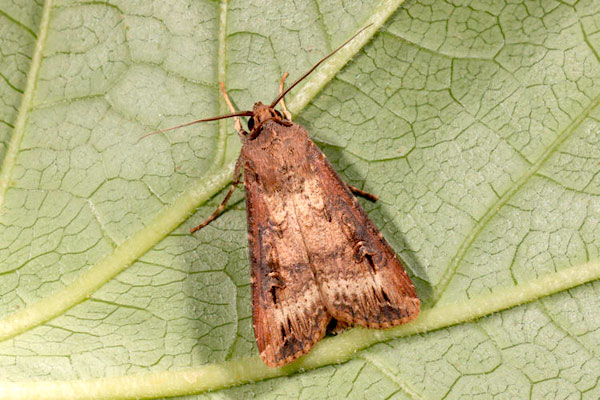
Adult of ipsilon cutworm (Agrotis ypsilon Rott)
The ipsilon cutworm has three full generations per year and a partial fourth one, and overwinters as a pupa and a fully grown caterpillar in the soil. Young caterpillars feed by gnawing the leaves from below without affecting the upper epidermis. Older caterpillars hide during the day below the soil surface, under soil clods, and at night they feed on the leaves, eating holes and later the entire leaf except for the thickest veins. Fully grown caterpillars almost do not emerge from the soil; they gnaw the stems below the soil surface. The caterpillars are earth-grey to black, smooth, shiny, with a greasy lustre, and can often be found near the plants, curled up in a “ring”.
Fam. Pieridae
Large white cabbage butterfly (Pieris brassicae L.)
It damages cruciferous crops such as cabbage, turnip, small radish and others. It develops three to four generations per year. The butterflies appear at the end of April – beginning of May. They are active during the day in warm and sunny weather. Young caterpillars live together up to the second instar. They feed on the leaves without affecting the upper epidermis. Fully grown caterpillars eat the leaves completely, together with the thin veins, skeletonising them and leaving only the thick veins.
Small white butterfly (Pieris rapae L.)
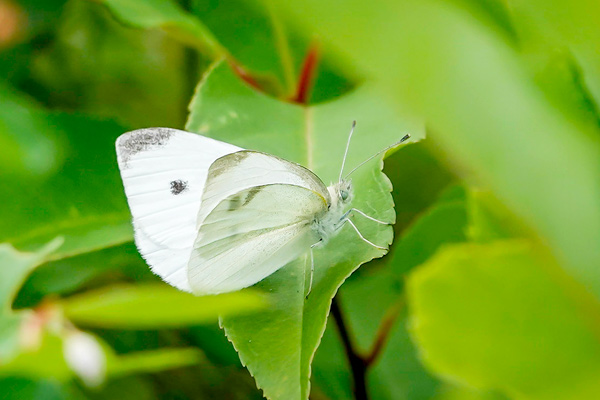
Small white butterfly (Pieris rapae L.)
It damages head and cauliflower, kohlrabi, turnip, small radish and other cruciferous crops. It develops two to three generations per year. The butterflies fly at the end of April – beginning of May. Young caterpillars feed on the leaves without affecting the upper epidermis, then they eat round holes and later they eat the entire leaf except for the thick veins. The damaged tissues rot and smell unpleasant.
Bath white butterfly (Pieris daplidicae L.)
It damages cruciferous crops. It develops two to three generations. It overwinters as a pupa. The butterflies fly in April–May. The forewings of the adult insect are white, mottled with black spots and stripes. The caterpillars feed by gnawing the leaves, buds and pods in seed-production fields.
Fam. Gelechiidae
Tomato leaf miner (Tuta absoluta Meyrick)
An invasive species which over the last 10 years has created serious problems in tomato cultivation. The caterpillar damages tomato, potato, pepper and other species in the fam. Solanacea, including weeds such as black nightshade and jimsonweed. The tomato leaf miner does not attack cucumber, zucchini, parsley, dill, lettuce, carrot and others, and these can be used in crop rotations. Depending on the temperature, the development of one generation of T. absoluta lasts from 29 to 38 days, which allows the pest to multiply very rapidly. It develops 10–12 generations per year. It overwinters as an egg, pupa or adult in plant residues, in the soil or in other shelters. The caterpillar of T. absoluta mines the leaves and stems and bores into the fruit, causing significant losses in tomato yield in greenhouses and in the open field. Under heavy infestation, the leaves dry up and die completely, while stem mining causes deformation of the plant. Damage to the fruits provides opportunities for the development of diseases that cause their rotting.
Potato tuber moth (Phthorimaea operculella Zell.)
A dangerous pest that attacks the leaves, stems and tubers of plants. Besides potato, it also causes damage to tomato, eggplant and some weed species. On potato tubers it bores galleries under the epidermis. The skin above the damage dries and sinks. The caterpillars also bore zigzag-shaped tunnels of various depths in the tubers, filled with excrement. In our country the potato tuber moth develops four generations. It overwinters in the field and in potato stores as a fully grown caterpillar and as a pupa. In spring, the butterflies emerge in April. They lay their eggs on the underside of the leaves and on the tubers.
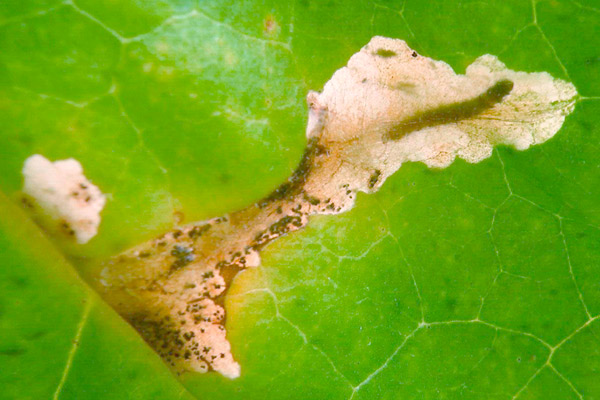
Damage caused by the caterpillars of potato tuber moth (Phthorimaea operculella Zell.)
The caterpillars bore near the central vein and mine the leaves. Severely infested leaves wilt and dry. The caterpillars leave such damaged leaves and enter the stem, boring tunnels directed downwards.
Fam. Plutellidae
Diamondback moth (Plutella maculipennis Curt.)
A widely distributed pest in the country. It damages head and cauliflower, kohlrabi, turnip, small radish and other cruciferous crops. It develops four to six generations per year. The butterflies of the first generation fly towards the end of April – beginning of May. The butterfly has grey-brown forewings. With wings spread it reaches 14–17 mm, and when the wings are folded three rhombuses are formed. Under our conditions the second generation is the most harmful. The caterpillars cause damage already at the seedling stage. They bore under the epidermis and mine the leaves. On cabbage seedlings they eat the vegetative point. Fully grown caterpillars damage the outer and inner leaves of the head, and subsequently the heads remain small and misshapen.
Fam. Acrolepiidae
Leek moth (Acrolepia assectella Zell.)
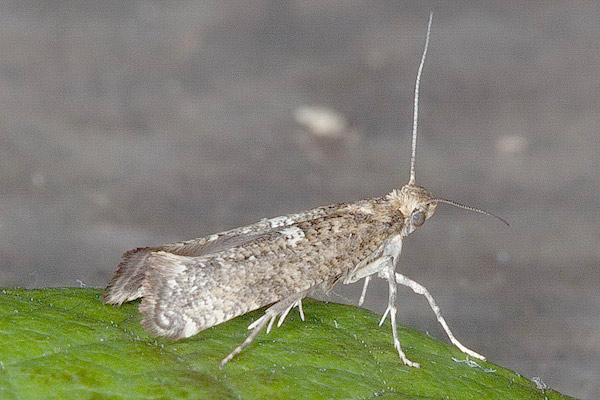
Leek moth (Acrolepia assectella Zell.)
It is found throughout the country. It attacks onion, leek and garlic. It develops two generations per year and overwinters as a butterfly, less frequently as a pupa, in plant residues, under sheds and in other sheltered places. The caterpillars make holes in the leaves or in the flower stalks, enter them and feed on the parenchymatous tissue, which they eat in the form of longitudinal, irregularly shaped strips without affecting the upper epidermis. On garlic and leek leaves they make longitudinal galleries under the epidermis. The damaged leaves turn white and dry.
Fam. Crambidae
Meadow moth (Loxostege sticticalis L.)
It damages pepper, watermelon, melon, carrot, cabbage and others. It rarely feeds on potato and tomato. The meadow moth has three generations per year. It overwinters as a fully grown caterpillar in an elongated silken cocoon in the soil. The caterpillars live openly on the plants. Young caterpillars initially web the leaves with fine silken threads and skeletonise them, and after the second instar they eat them completely, leaving only the coarse veins. Severely damaged plants die. After destroying the leaves of the plants in a given area, in search of food the caterpillars move en masse to neighbouring uninfested fields and can cover considerable distances.
Greenhouse (rusty) moth (Udea ferrugalis Hb.)
It is found in many greenhouses in our country. It damages pepper and cucumber, and under field conditions it attacks cabbage, lettuce, celery, parsley, spearmint, sorrel and others. It develops continuously in greenhouses, having six and partly a seventh generation per year; in the field there are four generations. After hatching, the caterpillars gnaw the lower epidermis and eat partially or entirely the parenchyma without affecting the upper epidermis. Caterpillars of the subsequent instars can destroy the entire leaf blade, leaving only the midrib and petioles. They also damage the fruits of pepper and cucumber. They feed on the pericarp and the seeds.
Fam. Papilionidae
Swallowtails (Papilio machaon L. and Papilio podalirius L.).
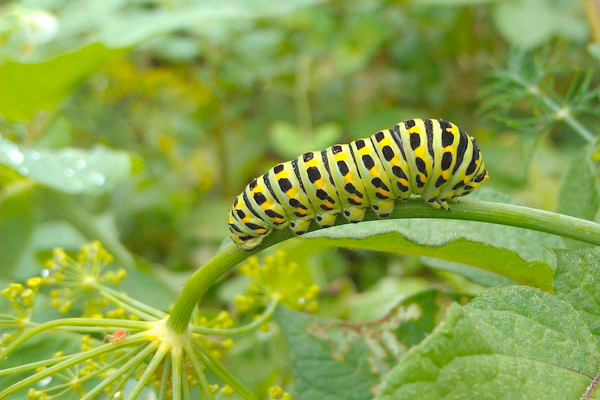
Swallowtail caterpillar
The caterpillars of the well-known beautiful butterflies, commonly known as swallowtails, are the damaging stage. They can often be seen on various umbelliferous plants (parsley, lovage, carrot and others). The caterpillars feed on the leaves and often completely destroy the leaf mass. They are usually found as single specimens, and only rarely do they occur in high numbers. They develop two generations per year. They overwinter as pupae. The first generation of butterflies appears in April and May, the second generation flies in July–August.
In order to limit the infestation by caterpillars of pests from the order Lepidoptera, monitoring is necessary. Food baits, light traps, pheromone traps and others can be used. Timely detection is a prerequisite for effective control.
References
- Atanasov N., M. Vitanov, E. Loginova, E. Ilieva, 2005. Integrated protection of greenhouse crops from diseases and pests. Sofia, Videnov & Son and PantaNeo Publishing House, 159.
- Baharieva D., B. Velev, S. Stefanov, E. Loginova, 1992. Diseases, weeds and pests of vegetable crops. Zemizdat-Sofia, 338.
- Bogacevska N., Y. Stancheva, Hr. Boteva, St. Masheva, E. Loginova, V. Harizanova, H. Samaliev, D. Hristova, D. Karadjova, V. Nikolova, V. Alexandrov, T. Toshkova, D. Grozdanova, 2008. Guide for integrated pest management in vegetable crops. NSRZ. Ministry of Agriculture and Forests. Sofia, 238.
- Tuleshkov Kr., 1958. Butterflies in Bulgaria. State Publishing House Science and Art-Sofia, 339.