

![MultipartFile resource [file_data]](/assets/img/articles/заглавна-овощни-повреда.jpg)
Abstract
Over the last decade, there has been a persistent trend towards an increase in average annual temperatures on a global scale. This has a significant impact on agricultural production, including on the physiology of cultivated plants, agronomic practices, and yield stability. Elevated temperatures substantially affect the dynamics of development, distribution, and biology of a number of economically important diseases and pests, creating new challenges for plant protection and the sustainable management of agro-ecosystems.
Numerous studies confirm that high temperatures simultaneously affect pathogens, pests, and plant resistance, leading to a shift in traditional developmental cycles, increased infection pressure, and adaptation of pathogenic microorganisms. High-temperature stress has a broad spectrum of effects on plants in terms of their physiology and biochemistry. Most often, physiological injuries in cultivated plants as a result of high temperatures are expressed in scorching of leaves and stems, premature leaf fall, suppressed growth of young shoots, and deformation or abortion of fruits. These changes lead to a substantial reduction in photosynthetic activity, disruption of water balance and, ultimately, to reduced yields and deterioration of product quality. In some species, accelerated tissue senescence, impaired pollination, as well as increased sensitivity to pathogens and abiotic stress factors are also observed.
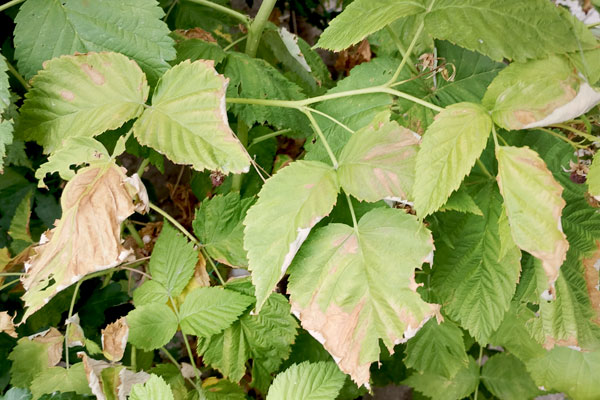
Damage to raspberry caused by high temperatures
Under the influence of temperature stress, fruit crops undergo significant biochemical changes that affect both primary metabolism and the synthesis of protective compounds. Among the most common reactions is the increased accumulation of reactive oxygen species, which induce oxidative stress in the cells (Mittler, 2002). This activates enzymatic antioxidant systems aimed at detoxification and stabilization of membrane integrity (Hasanuzzaman et al., 2013). In addition, an increased synthesis of osmoprotective substances such as proline, sugars, and glycerol is observed, which support water retention and protect proteins from denaturation (Wahid et al., 2007). Temperature stress also inhibits the activity of key enzymes associated with photosynthesis, disrupts the metabolism of macronutrients (such as Ca²⁺, Mg²⁺, K⁺), and reduces chlorophyll synthesis, leading to photodegradation (Camejo et al., 2005).
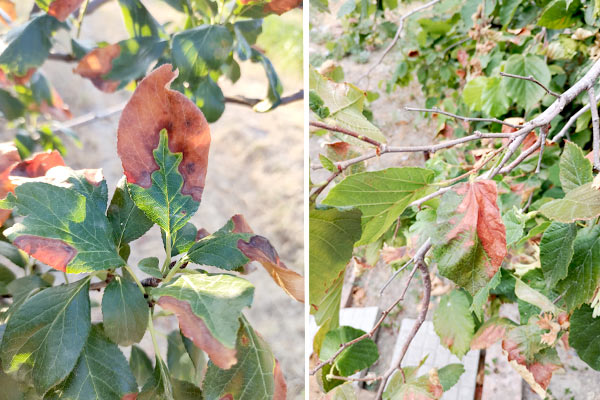
Damage to plum and hazelnut caused by high temperatures
Under prolonged stress, an accumulation of phenolic compounds, flavonoids, and phytoalexins is recorded, which have a protective function, including antimicrobial activity, but often at the expense of growth and fruiting (Krasensky & Jonak, 2012). The intensity of the biochemical response is species- and cultivar-specific and depends on the age of the plant and previous growing conditions.
In cereal crops, it has been established that high temperatures lead to a reduction in the activity of the enzyme nitrate reductase, which regulates nitrogen metabolism. This strongly affects both the composition and the weight of the grains (Paulsen, 1994).
In addition to plants, high temperatures also affect the development of diseases and pests.
Temperature is one of the main factors that strongly influence the distribution and development of insects (Stange and Ayres, 2010). Insects are poikilothermic organisms, i.e. they do not have their own constant body temperature. They assume the temperature of the environment and are dependent on it. All metabolic processes occur within certain temperature limits. With increasing temperatures, most insect species begin to consume larger amounts of food, their development accelerates, and they become more active, which in turn affects their life cycle, population size, and geographical distribution (Porter et al., 1991). Some species fail to adapt to higher temperatures, which leads to slower development and a reduction in their populations. On the other hand, there are many insect species for which higher temperatures contribute to faster reproduction, an increase in the number of generations, and higher population density (Bale et al., 2002; Skendžić et al., 2021). For example, at higher temperature and higher air humidity, populations of the tobacco whitefly (Bemisia tabaci) increase significantly (Pathania et al., 2020). In vegetable crops, Reddy (2013) observed accelerated development in populations of the cabbage root fly (Delia brassicae W.), the onion fly (Delia antiqua M.), the Colorado potato beetle (Leptinotarsa decemlineata S.) and the European corn borer (Ostrinia nubilalis H.).
In fruit species, an increase in the number of generations is observed in the codling moth (Cydia pomonella L.) and the European red mite (Panonychus ulmi Koch) (Porter et al., 1991). The most favourable temperatures for insect development are in the range between 10° and 30°C. For the individual developmental stages there are different optimum temperatures at which physiological processes proceed most intensively. At these optimum temperatures, insects live the longest and exhibit maximum fecundity. For each species there is a so-called lower and upper temperature threshold for development, that is, the lowest and highest temperature below and above which insect development slows down or stops. When temperatures rise above the upper developmental threshold or above 40°C, a lethal effect is observed in many insects. At such high temperatures, enzymes and blood cells in the insect body are destroyed, which leads to their death. For example, larvae of the codling moth (Cydia pomonella L.) die at a temperature of 48°C (Tang et al., 2000). Eggs of the gypsy moth (Lymantria dispar L.) do not hatch at temperatures above 55°C (Hosking, 2001).
Temperature has a substantial effect on the development, virulence, and epidemiology of diseases in cultivated plants. For bacterial diseases, the most favourable conditions for infection and spread are a combination of high air humidity and temperatures in the range from 20 to 30 °C (Pokhrel, 2021). Temperatures outside the optimal range – both above and below – can significantly slow down or completely prevent disease development by suppressing the reproduction and motility of pathogens (Cohen & Leach, 2020). Fungal pathogens also show temperature dependence. In grapevine, powdery mildew (Erysiphe necator) develops most intensively at temperatures between 21 °C and 30 °C, while temperatures above 34 °C cause conidial death (Delp, 1954).
Rising temperatures play a key role in regulating the processes of sporulation and infection development of fungal pathogens in fruit crops. Studies show that in phytopathogens of the genus Monilinia, responsible for brown rot on fruits, the optimum temperature for conidial sporulation and infection is between 20–25 °C. Temperatures below 10 °C or above 25 °C suppress normal spore formation and slow down colonization by the fungal pathogen (Xu et al., 2001). A study conducted with the phytopathogen Monilinia fructicola indicates that with an increase in temperature up to about 25 °C, the time required for release and germination of ascospores is shortened, whereas at temperatures exceeding 30 °C, sporulation is limited.
Studies show that the bacterial pathogens Xanthomonas arboricola pv. pruni and Pseudomonas syringae (causal agents of bacterial canker in stone fruit crops) develop optimally at temperatures of 25–30 °C combined with high humidity and can infect plants in the range from 15 to 35 °C (Rojas et al., 2017; Peetz et al., 2009; West et al., 2024). Forecasting models show that the maximum in vitro growth rate of the bacteria reaches its highest value around 30 °C, while at ≥35 °C it decreases significantly (Rojas et al., 2017).
With the increase in average annual temperature, it becomes necessary to change certain agricultural practices. To reduce damage and losses caused by pests, earlier and more frequent application of insecticides is required.
Many breeding programmes are focused on the development of varieties that are resistant or tolerant to diseases as well as to climate change. In this way, not only will pesticide use be reduced, but plant resistance to high temperatures and drought will also be increased.
Changes in climatic conditions lead to earlier onset of vegetation phases, more frequent and prolonged heat waves, as well as droughts, which directly affect the physiological status of trees, phytopathogenic pressure, and pest behaviour. In this context, it is necessary to reconsider agronomic and plant protection practices. Earlier emergence of pests requires dynamic planning of plant protection with an emphasis on monitoring, optimization of treatments, and the inclusion of resilient technologies. To reduce damage from diseases and pests, breeding programmes aimed at developing cultivars and rootstocks with resistance to key pathogens and adaptability are becoming increasingly important. For sustainable production, the application of agronomic techniques such as mulching and the use of cover crops, which reduce evaporation and maintain soil moisture, is recommended.
The use of organic mulch, such as straw or wood chips around the base of trees, preserves soil moisture and reduces evaporation during the hottest periods. Mulch helps to suppress weed growth, thereby providing trees with more resources to cope with heat.
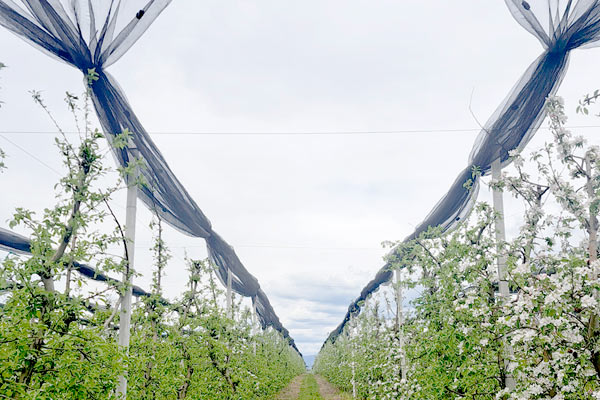
Shade nets
Shading is one of the most effective methods for protecting fruit crops from extremely high temperatures. Shade nets reduce solar radiation by 30% to 50% and can lower temperatures by about 5°C. Regular and proper pruning reduces heat stress by allowing more effective penetration and circulation of air.
Irrigation during the hottest parts of the day can lead to evaporation before trees are able to absorb the moisture. Watering early in the morning or late in the evening ensures that water reaches the roots without being lost due to high temperatures.
Integrated systems for drip irrigation and fertigation, as well as biological control of pests, are recommended. In addition, the implementation of early warning systems and disease forecasting models can support timely decision-making. The introduction of new cultivars, combined with adapted agronomic approaches, is key to maintaining productivity, quality, and profitability of agriculture under conditions of climate change.
REFERENCES
- Bale, J. S., Masters, G. J., Hodkinson, I. D., Awmack, C., Bezemer, T. M., Brown, V. K., ... & Whittaker, J. B. (2002). Herbivory in global climate change research: direct effects of rising temperature on insect herbivores. Global change biology, 8(1), 1-16.
- Camejo, D., Rodríguez, P., Morales, M. A., Dell’Amico, J. M., Torrecillas, A., & Alarcón, J. J. (2005). High temperature effects on photosynthetic activity of two tomato cultivars with different heat susceptibility. Journal of Plant Physiology, 162(3), 281–289. https://doi.org/10.1016/j.jplph.2004.07.014
- Cohen, S. P., & Leach, J. E. (2020). High temperature-induced plant disease susceptibility: more than the sum of its parts. Current opinion in plant biology, 56, 235-241.
- Delp, C. J. (1954). Effect of temperature and humidity on the grape powdery mildew fungus.
- Hasanuzzaman, M., Nahar, K., Alam, M. M., Roychowdhury, R., & Fujita, M. (2013). Physiological, biochemical, and molecular mechanisms of heat stress tolerance in plants. International Journal of Molecular Sciences, 14(5), 9643–9684. https://doi.org/10.3390/ijms14059643
- Hosking, G. (2001). Literature Review-Temperature Mortality Thresholds for Insects.
- Krasensky, J., & Jonak, C. (2012). Drought, salt, and temperature stress-induced metabolic rearrangements and regulatory networks. Journal of Experimental Botany, 63(4), 1593–1608. https://doi.org/10.1093/jxb/err460
- Mittler, R. (2002). Oxidative stress, antioxidants and stress tolerance. Trends in Plant Science, 7(9), 405–410. https://doi.org/10.1016/S1360-1385(02)02312
- Pathania, M., Verma, A., Singh, M., Arora, P. K., & Kaur, N. (2020). Influence of abiotic factors on the infestation dynamics of whitefly, Bemisia tabaci (Gennadius 1889) in cotton and its management strategies in North-Western India. International journal of tropical insect science, 40, 969-981.
- Paulsen, G. M. (1994). High temperature responses of crop plants. Physiology and determination of crop yield, 365-389.
- Pokhrel, B. (2021). Effects of environmental factors on crop diseases. Journal of Plant Pathology and Microbiology, 12(5), 553.
- Porter, J. H., Parry, M. L., & Carter, T. R. (1991). The potential effects of climatic change on agricultural insect pests. Agricultural and Forest Meteorology, 57(1-3), 221-240.
- Reddy, P. P. (2013). Impact of climate change on insect pests, pathogens and nematodes. Pest Management in Horticultural Ecosystems, 19(2), 225-233.
- Rojas, E. I., Adaskaveg, J. E., Madden, L. V., & Johnson, G. I. (2017). A model for predicting Xanthomonas arboricola pv. pruni growth as a function of temperature. PLOS ONE, 12(4), e0177583. https://doi.org/10.1371/journal.pone.0177583
- Skendžić, S., Zovko, M., Živković, I. P., Lešić, V., & Lemić, D. (2021). The impact of climate change on agricultural insect pests. Insects, 12(5), 440.
- Stange, E. E., & Ayres, M. P. (2010). Climate change impacts: Insects. Encyclopedia of life sciences, 1.
- Tang, J., Ikediala, J. N., Wang, S., Hansen, J. D., & Cavalieri, R. P. (2000). High-temperature-short-time thermal quarantine methods. Postharvest Biology and Technology, 21(1), 129-145.
- Wahid, A., Gelani, S., Ashraf, M., & Foolad, M. R. (2007). Heat tolerance in plants: An overview. Environmental and Experimental Botany, 61(3), 199–223. https://doi.org/10.1016/j.envexpbot.2007.05.011
- Xu, X. M., Guerin, L., & Robinson, J. D. (2001). Effects of temperature and relative humidity on conidial germination and viability, colonization and sporulation of Monilinia fructigena. Plant Pathology, 50(5), 561-568.