

![MultipartFile resource [file_data]](/assets/img/articles/житна-дървеница-заглавна.jpg)
![MultipartFile resource [file_data]](/assets/img/articles/фигура-3-яйца-паразити.jpg)
Cereal crops are attacked by a large number of pests, which often multiply calamitously and cause serious damage. Some of them cause harm during the autumn-winter period, and others during the spring-summer period, resulting in a reduction in the quantity and a deterioration in the quality of the production.
In our country, numerous pests are encountered in cereal crops, which in certain years multiply en masse and are capable of causing economically significant losses. All this necessitates systematic monitoring for their occurrence, development, and infestation.
According to a number of authors Areshnikov (1982), Alekhin (1996), Radjabi (2000), Dizlek and Özer (2024), the Sunn Pest (Eurygaster integriceps Put.) is the economically most important pest of cereal crops. In our country, it most severely damages wheat, less so barley, oats, and rye, and very rarely corn and watermelon (Grigorov and Gospodinov, 1964; Grigorov 1976; Grinko Vladimirovich, 2007). The Sunn Pest prefers wheat because it finds the most favorable conditions for feeding and for accumulating a sufficient amount of nutrients necessary for overwintering there (Grigorov and Grigorov, 2003).
The Moorish Shieldbug (Eurygaster maura L.) and the Austrian Shieldbug (Eurygaster austriaca L.) are found in mixed populations with the Sunn Pest (Grigorov, 1954).
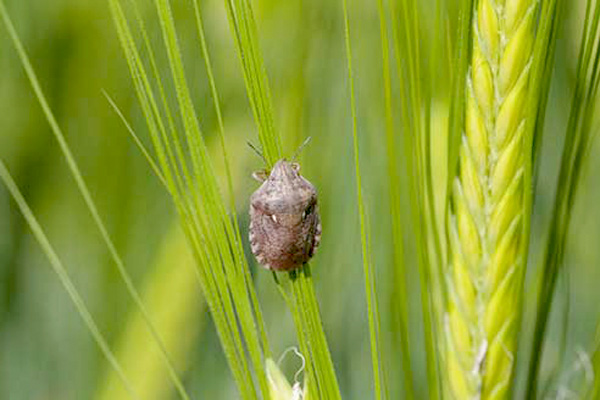
Sunn Pest (Eurygaster integriceps Put.)
The Sunn Pests damage the stems of cereal plants and the grain, resulting in a reduction in its quantity and a deterioration in its quality. Damaged grains contain a smaller amount of gluten, the resulting flour has impaired baking qualities, which is why the bread is dense.
Damaged grain has lower absolute and hectolitre weight, as well as less protein. The greatest damage is caused by larvae of the fourth and fifth instars, as well as adult insects of the new generation. It has been established that at a density of one larva per m2 (respectively one adult of the new generation), the number of grains damaged by them is from 40 to 60% (Lazarov et al., 1969).
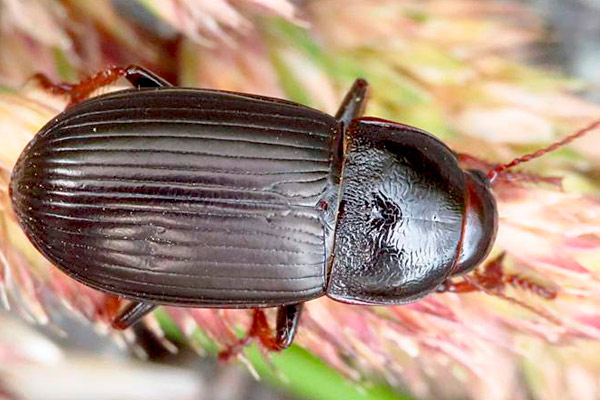
Common Cereal Ground Beetle (Zabrus tenebrioides Goeze) – Adult
Among the cereal ground beetles in our country, there are 6 species, of which the most widespread and of greatest importance is the Common Cereal Ground Beetle (Zabrus tenebrioides Goeze) (Grigorov and Grigorov, 2003). This species is widespread throughout our country. It attacks wheat, barley, rye, less so oats and corn (Grigorov and Grigorov, 2003). The adults gnaw on grains in the ears and cause some grain to drop. However, this damage is not of great economic significance. The larvae make vertical burrows with smooth walls in the soil, up to 40 cm deep, and feed on plant leaves. They usually come to the surface at night, pull in plant material, suck out the juices, and the damaged plants resemble chewed-off stubble. The damage is patchy. During warmer winters, the larvae do not interrupt their feeding and continue their harmful activity (Grigorov and Grigorov, 2003).
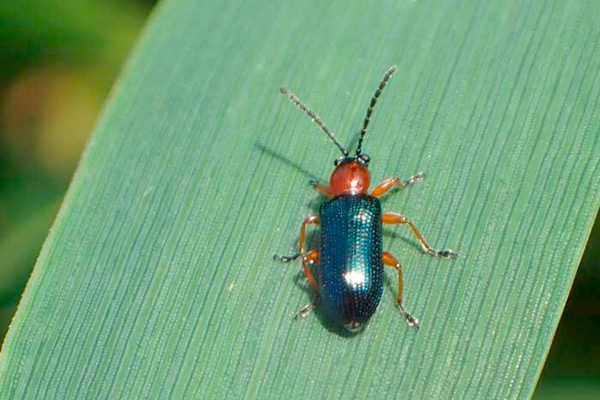
Cereal Leaf Beetle (Oulema melanopa L.) – Adult
The Cereal Leaf Beetle (Oulema melanopa L.) is one of the pests that reduces wheat yields. According to Pavlov and Trenchev, (1981), the main damage is caused by larvae of the III and IV instars, and losses can reach up to 80%. The beetles feed by gnawing narrow and long strips parallel to the midrib of the leaves. Under severe damage, the leaves dry out. Infestation is usually concentrated in separate foci, most often on the periphery and less frequently in the interior of cereal crops. The hatching of the larvae coincides with the heading and flowering of cereals. They gnaw strips on the leaves, similar to the adults, but leave the lower epidermis untouched. The leaves turn white, subsequently dry out and crack. Under heavy infestation, the crop from a distance resembles prematurely ripened grain.
On cereal crops, 39 species from 19 genera of the superfamily Scarabaeoidea are harmful. The most numerous are the species of the genus Anisoplia. They damage sown seeds, roots, underground stems, leaves, floral parts, and grains. Many species are harmful in the larval stage and are soil pests (Grigorov and Grigorov, 2003).
Aphids are one of the main pests of cereal crops. The species most commonly encountered and causing damage are: Sitobion avenae Fabr., Schizaphis graminum Rond., Rhopalosiphum maidis Fitch, Sipha maydis Pass., Diuraphis noxia K., Rhopalosiphum padi L., and Anoecia corni Fab (Grigorov, 1980). The microclimate in the area, the cultivar, and the sowing density influence the development and multiplication of aphids.
Cereal crops are damaged by 43 species of cereal flies (Grigorov and Grigorov, 2003). The damage is caused by the larvae, which attack leaves, stems, ears, floral parts, and grains. The population density of the flies depends on climatic conditions, sowing dates, sowing rate, cultivar characteristics, soil type, proximity to uncultivated areas with wild cereals, destruction of volunteer plants, etc. Cereal flies are among the pests that mainly cause damage in autumn. The most common among them are the Hessian fly (Mayetiola destructor Say.), the Gout fly (Chlorops pumilionis Bjerk.), and the Frit fly (Oscinella frit L.).
Another pest of cereal crops is the Wheat Thrips (Haplothrips tritici Kurd.). The thrips concentrate on plants that have not yet headed and feed by sucking sap from the upper part of the ears, which turns white, and in these places the spikelets do not form grain. The damage is similar to that caused by the Sunn Pest—partial white ear—but on a much smaller scale. Usually, only the uppermost parts of the ear are affected, and rarely more than half. The larvae suck sap from the grain, most often clustering in the crease. The feeding site on the grain turns white and becomes rough, and the crease widens, deepens, and turns yellowish-brown.
The Wheat Stem Sawfly (Cephus pygmaeus L.) is also found on cereal crops. It damages wheat, rye, barley, and oats. In our country, its main host plant is soft winter wheat and partly winter rye and barley. The damage is caused by the larva, which moves from top to bottom within the pith, filling it with light-colored excrement and frass. Until wax maturity sets in, the larvae gnaw through all internodes. Damaged plants are difficult to detect. Usually, they remain weaker, with underdeveloped ears, and in earlier attacked plants, the ears turn prematurely white (Grigorov and Grigorov, 2003).
During the period 2023-2024, observations were conducted in cereal crops in the region of Stara Zagora. A total of 250 decares of wheat, cultivar 'Enola', were surveyed.
Standard entomological methods were used to record the population density of the pests.
The meteorological characteristics for the period 2023-2024 allow us to trace the occurrence and development dynamics of the main pests in the Stara Zagora region, according to the phenological stages of the crop, which include - emergence, third leaf, tillering, stem elongation, heading, flowering, milk development, wax development, and full maturity. Given the optimal sowing date for the region of October 1-20 and the presence of moisture, emergence begins in mid-October. The tillering phase occurs already in autumn and concludes in mid-March. The period of active vegetation usually begins in early April, heading starts in early May. Wax development begins in early second ten-day period of June. Often, temperatures in the region are higher, and combined with soil and atmospheric droughts, they adversely affect grain ripening and filling.
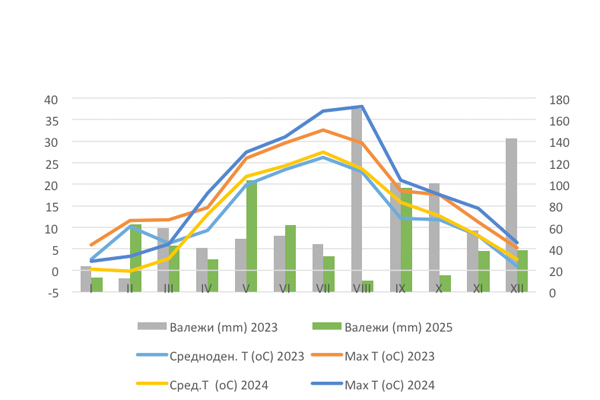
Figure 1. Meteorological characteristics for the Stara Zagora region during 2023-2024.
The studies conducted in the period 2023–2024 in the region of Stara Zagora show that the pest density in the wheat agrocenosis is determined by the phytosanitary status of the crops, the impact of environmental factors, and the effectiveness of the applied control methods.
Analysis of the species composition of the Sunn Pests revealed that representatives of the genus Eurygaster dominate, constituting 95% of the recorded Sunn Pests, while those of the genus Aelia have a significantly lower presence—only 5% (Figure 2).
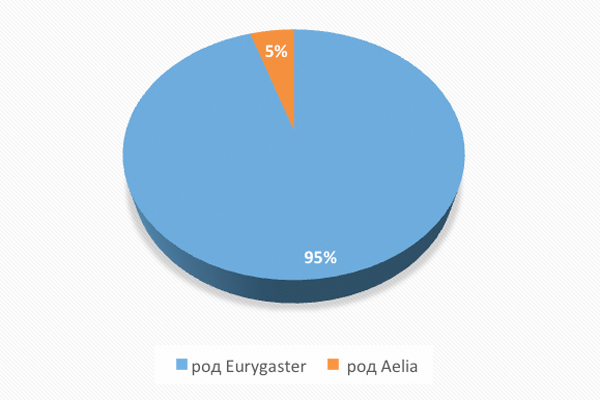
Figure 2. Percentage ratio of Sunn Pests recorded in wheat crops during 2023-2024.
The spring migration of the Sunn Pest in 2023 began at the end of April (April 25), while in 2024 it was earlier, at the beginning of April (April 9). We attribute this to the higher average daily temperatures in 2024, which for the period reached 13°C (Figure 1, Table 1).
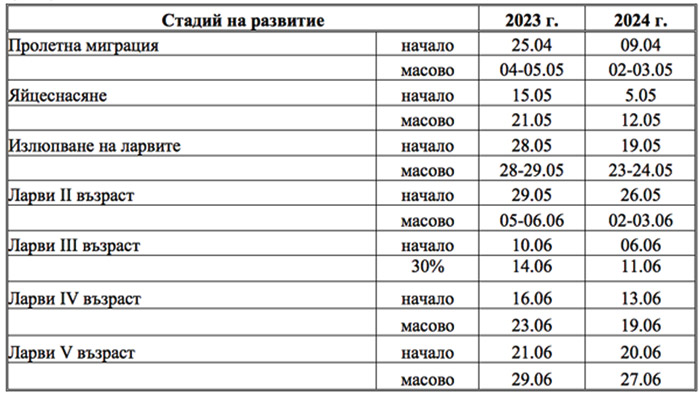
Table 1. Development of the Sunn Pest in wheat crops during 2023 and 2024.
Mass migration is also directly dependent on temperature conditions. In both years, it occurred during the first ten-day period of May. Oviposition in 2023 began in mid-May (May 15), due to lower average daily temperatures, which reached 19.8°C. In 2024, oviposition was at the beginning of May, as a result of higher temperatures reaching 21.8°C. The onset of larval hatching in 2023 was recorded on May 28; for 2024, respectively on May 19, 9 days earlier due to higher temperatures. Larvae of the third instar appeared in the first ten-day period of June (end of milk development and beginning of wax development), fourth instar in the second ten-day period of June, and fifth instar at the end of June. Adults of the new generation were observed in early July. Mass summer migration in both years was recorded in mid-July.
Concurrently with the observations of the Sunn Pest, the role of egg parasitoids from the genus Telenomus and the genus Trissolcus was recorded. In 2023, 90% of the Sunn Pest eggs were found to be parasitized, and in 2024, respectively 95% (Figure 3).

Figure 3. Parasitized eggs of the Sunn Pest (%)
In recent years, the Common Cereal Ground Beetle (Zabrus tenebrioides Goeze) has been one of the main pests of cereal crops, especially in the absence of crop rotation—a condition that favors its development.
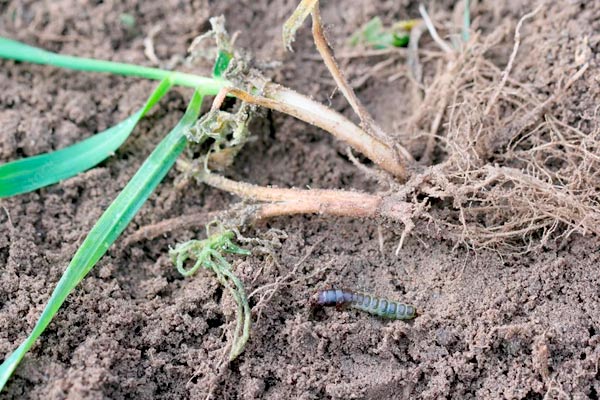
Damage caused by the larva of the Common Cereal Ground Beetle (Zabrus tenebrioides Goeze)
Its development has two key moments—the appearance of adults in volunteer crops and the onset of harmful activity by the larvae. From the data in Table 3, it is evident that in 2024, the appearance of adults in crops and the onset of harmful activity by the larvae was 2-3 days earlier. We explain this by higher average daily temperatures, reaching 12.8°C.

Table 3. Development of the Common Cereal Ground Beetle during 2023 -2024.
The harmful activity of the Common Cereal Ground Beetle (larvae) in the crops begins in the second half of October (October 19-22), 6-7 days after establishment in volunteer crops. The population density of the Cereal Ground Beetle was low for the entire region both in 2023 and 2024, ranging from 0.5-1 larva/m2, which is due to seed treatment, improved cultivation agrotechniques, proper crop rotation, etc. (Table 3).
The Cereal Leaf Beetle (Oulema melanopus L.) damages oats, barley, and wheat most severely. Favorable conditions for the development of this species are high temperatures, dry and warm weather in April and May.
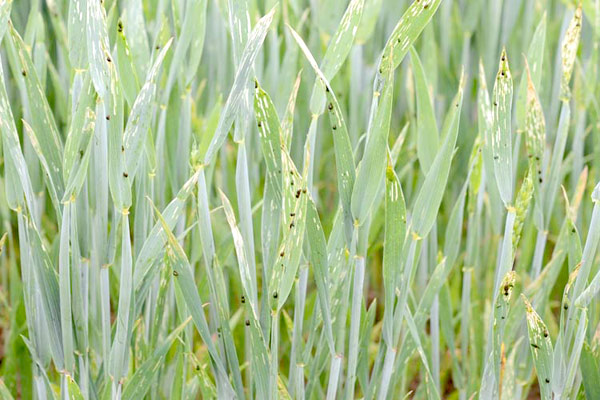
Damage caused by the larva of the Cereal Leaf Beetle (Oulema melanopus L.)
The migration of the Cereal Leaf Beetle into crops in spring is directly related to temperature and usually begins at the end of March, beginning of April. The first adults of the Cereal Leaf Beetle were recorded in May, with the species appearing 12 days earlier in 2024 compared to 2023; we attribute this to the higher average daily temperatures for the period, reaching 21.8°C. Mass appearance of the pest in cereal crops in 2023 was in the first ten-day period of April, and in 2024 in the second ten-day period of the month. The beginning of oviposition was established in mid-April. In 2023, the first laid eggs were recorded on April 19, and in 2024 on April 10, i.e., 9 days earlier. We again attribute this to the warmer weather.
Mass hatching of larvae in both years occurred in the second ten-day period of May (May 13-16). During this period, the average daily temperatures ranged between 19.8-21.8 °C. Adults of the new generation were recorded in the second ten-day period of June (June 11-16) (Table 4).
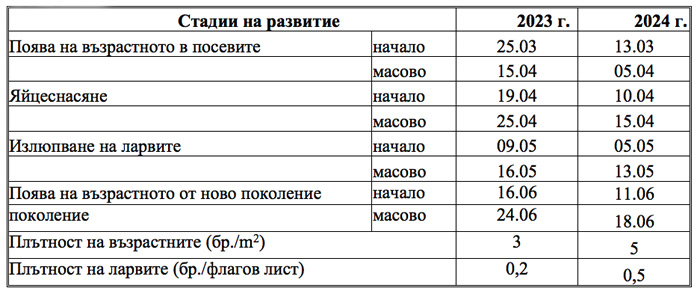
Table 4. Occurrence and development of the Cereal Leaf Beetle in wheat crops during 2023-2024.
The phenological development of the pest begins at different times in different years depending on temperature. Overall, the occurrence and development of the Cereal Leaf Beetle in 2023 was later compared to 2024. We attribute all of this to the warmer weather during the period.
In recent years, the Cereal Leaf Beetle in the region has been found at low density: 3 individuals/m2 in 2023, and respectively 5 individuals/m2 in 2024, but it remains a constant object for monitoring. Larval density was low, ranging from 0.2-0.5 larvae/flag leaf in both years.
Observations were also made for cereal flies in the crops. During the surveys in 2023, an average density of 1 individual/m2 was established. In 2024, the population density of flies was recorded at 2 individuals/m2. Chemical control against them was not carried out due to their low density.
Conclusions
As a result of the conducted research, the following conclusions can be drawn:
- In wheat crops for the Stara Zagora region, those of economic importance are: the Sunn Pests of the genus Eurygaster, the Common Cereal Ground Beetle, and the Cereal Leaf Beetle.
- The egg parasitoids from the genus Telenomus and the genus Trissolcus, which achieved parasitism of 90% of the Sunn Pest eggs, are significant for maintaining the low pest density in the surveyed crops.
- The population density of the Cereal Ground Beetle during the survey period was also low, ranging from 0.5-1 larva/m2, which is due to good cultivation agrotechniques and properly maintained crop rotation.
- In recent years, the Cereal Leaf Beetle in the region has been found rarely; larval density in wheat crops was low at 0.2-0.5 individuals per flag leaf in both years, and adults at 3-5 individuals/m2.
References
- Alekhin V.T., 1996. Methodology for forecasting wheat grain damage and quality reduction caused by the Sunn Pest. 15. [In Russian]
- Areshnikov, B.A. 1982. The Sunn Pest and control measures / B.A. Areshnikov S.P. Starostin. Moscow: Kolos, 287. [In Russian]
- Grigorov S., 1954. A new pest of cereal plants in our country – the Sunn Pest. Plant Protection Bulletin, year 2, book 3. [In Bulgarian]
- Grigorov St., 1976. Entomology. State Publishing House for Agricultural Literature, Sofia. [In Bulgarian]
- Grigorov, S. 1980. Aphids and their control. State Publishing House Zemizdat. Sofia, 285. [In Bulgarian]
- Grigorov S., G. Gospodinov, 1964. The Sunn Pest, Journal of Plant Protection, No.10. [In Bulgarian]
- Grigorov S., P. Grigorov, 2003. Pests of Cereal Crops in Bulgaria and their Control. Plovdiv. [In Bulgarian]
- Grinko A.Vladimirovich, 2007. Harmfulness of Sunn Pest larvae, Scientific Journal, No.34 (10). [In Russian]
- Lazarov V., Grigorov St., Kontev Hr., Gospodinov G., 1969. The Sunn Pests in Bulgaria and their Control. [In Bulgarian]
- Pavlov A., G. Trenchev, 1981. New insecticides for controlling Cereal Leaf Beetle larvae. Journal "Plant Sciences", book 3. [In Bulgarian]
- Radjabi G., 2000. Ecology of Cereals’ Sunn-Pests in Iran. Tehran, Iran, Ministry of Jihad and Agriculture, Agricultural Research, Education and Organization Publication.
- Dizlek, H., M. Özer, 2024. A study to clarify whether sunn pest (Eurygaster integriceps) increases amylase activity in wheat, Heliyon, Volume 10, Issue 10, e30870.