

![MultipartFile resource [file_data]](/assets/img/articles/заглавна-лозе-русе.jpg)
Abstract
The contemporary challenges concerning the production of organic products, food quality and safety, are the new guidelines that must be decisive for achieving competitiveness in the European and world markets.
In order to improve the available varietal base, in recent years, significant emphasis has been placed on creating resistant grapevine varieties or those with increased resistance to diseases of specific economic importance for Bulgaria, having their place in the system of disease control methods.
A contribution to this are also the breeding forms and varieties created through inbreeding (self-pollination) and hybridization at ARRI "Obraztsov Chiflik", Rousse.
Newly bred varieties are less sensitive or have increased resistance to biotic and abiotic environmental factors.
A rich genetic fund of inbred lines has been created in the Institute's collection – an invaluable asset for Bulgarian breeding. Such is the segregating population of self-pollinated plants from the Storgoziya variety, which allows for the identification of loci associated with resistance to various fungal diseases and economically important agronomic characteristics.
The result of the breeding program aimed at creating disease-resistant grapevine varieties are two wine varieties, which were recognized in 2019 by IASSAS.
A characterization has been made of two disease-resistant wine grapevine varieties bred at ARRI "Obraztsov Chiflik" - Rousse: Kristalen, created through hybridization of the varieties Pamid Rouse1 and Kailashki Misket in 1996, and Misket Viking, originating from the hybridization of varieties Naslada and Chardonnay in 1996.
A major problem for viticulture at the beginning of the 21st century is its ecological transformation, i.e., growing vines without the use of pesticides or with their use only as a last resort, and transforming it into a source for the production of ecologically pure grapes and wine. The contemporary challenges concerning the production of organic products, food quality and safety, are the new guidelines that must be decisive for achieving competitiveness in the European and world markets [2]. The creation of disease-resistant varieties is one way to solve this problem. Research in this area has been conducted on a wide scale since the 1960s [1; 3]. As a result of these studies, wine and dessert grape varieties with practical disease resistance have been bred and introduced into production.
A wide range of grape varieties is cultivated in Bulgaria, as the natural conditions in the country are extremely diverse and at the same time suitable for the development of this economic sector. When planting a new vineyard, it is extremely important that the selected varieties correspond to the climatic and soil conditions of the area and the intended use of the grapes [5].
The contemporary challenges concerning the production of organic products, food quality and safety, are the new guidelines that must be decisive for achieving competitiveness in the European and world markets.
With the aim of improving the available varietal base, in recent years, significant emphasis has been placed on creating resistant grapevine varieties or those with increased resistance to diseases of specific economic importance for Bulgaria, having their place in the system of disease control methods [4].
Newly bred varieties are less sensitive or have increased resistance to biotic and abiotic environmental factors.
The purpose of the new varieties is to satisfy the needs of the domestic market and be suitable for export. They must have an excellent appearance of the bunch and berry, and high transportability, which would also ensure their high competitiveness in the foreign market. Furthermore, their high plasticity to environmental conditions would provide an opportunity to export grapevine planting material to other countries.
A contribution to this are also the varieties created through the methods of hybridization and inbreeding (self-pollination) at ARRI "Obraztsov Chiflik", Rousse :
- Inbreeding has been used in the past exclusively for genetic analysis of individual grapevine varieties and forms. As a method for creating new grapevine varieties, it has not been scientifically or methodologically developed, nor systematically applied. The main reason for underestimating and ignoring inbreeding in the breeding of this crop is the sharp decrease in plant vitality and the intensification of degenerative processes in the inbred progeny.
In recent decades, certain quantitative and qualitative thresholds have arisen in grapevine breeding, which are extremely difficult to overcome, especially in the creation of large-fruited, seedless, and cold- and disease-resistant varieties.
Recently, interest in inbreeding, both abroad and in Bulgaria, has been increasing.
Inbreeding research in Bulgaria is conducted on several grapevine varieties – Bolgar, Alphonse Lavallée, hybrid 3/32, Palieri, etc. These studies prove that our previous perceptions of this method, applied to grapevines only for genetic analysis, are quite outdated. Self-pollination allows for obtaining economically valuable recessive and transgressive forms with high qualities. It has also been established that self-pollination of some dessert varieties can produce seedlings of the second and third inbred generation with normal development and fruiting, which is of great importance for the needs of heterosis breeding. Because grapevine varieties are propagated vegetatively, ensuring genetic stability of transgressive forms is not a problem.
The implementation of inbreeding as a breeding method for grapevines was introduced at ARRI "Obraztsov Chiflik". The method, developed by Prof. Dr. Ivan Todorov, does not exclude or neglect the use of hybridization. However, it proves to be more rational for the genetic improvement of grapevines when it comes to important economic traits controlled by polymeric and recessive genes. Therefore, it can be applied as a highly effective recombinator of genetic material accumulated in the rich global gene pool of high-quality and highly heterozygous hybrid varieties.
A rich genetic fund of inbred lines has been created in the Institute's collection – an invaluable asset for Bulgarian breeding. Such is the segregating population of self-pollinated plants from the Storgoziya variety, which allows for the identification of loci associated with resistance to various fungal diseases and economically important agronomic characteristics [6,7,8,9,10,11,12,13].
For the breeding efforts of ARRI "Obraztsov Chiflik" to be competitive, a priority in the program is the breeding of wine varieties, analogues of the most widely distributed wine varieties - Cabernet Sauvignon and Pinot Chardonnay, resistant to cold and cryptogamic diseases.
- Intraspecific and interspecific hybridization between varieties and hybrids, using new and diverse genetic plasma, bearing high economic qualities and resistance – for the creation of dessert and wine varieties, followed by selection.
The result of the breeding process using this method are two wine grapevine varieties, resistant to cryptogamic diseases and low temperatures, originating from interspecific hybridization – Misket Viking and Kristalen.
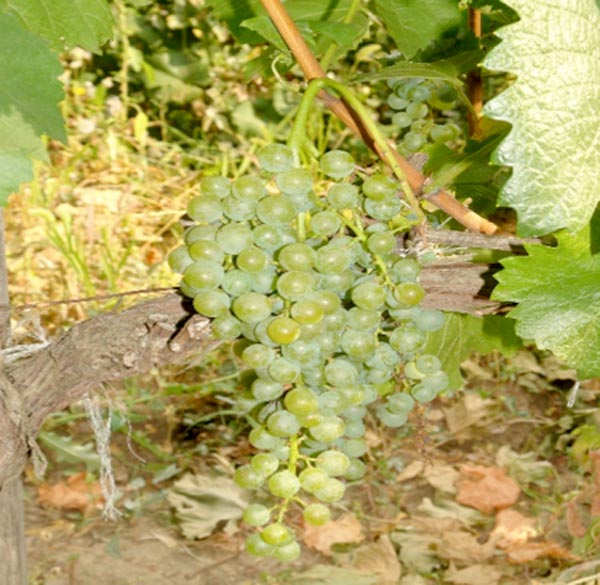
Misket Viking variety has increased winter hardiness and is moderately resistant to cryptogamic diseases within the limits of the European-Asian vine Vitis vinifera L. It requires limited treatment against downy and powdery mildew, only in the presence of very high humidity (soil and air) under natural infection conditions [Figure 1].
In case of severe damage from extreme cold below minus 18-20oC, it shows good regenerative capacity. Misket Viking is suitable for cultivation with all types of training systems in regions of the country with favorable conditions for the development and fruiting of early- and mid-ripening white wine grape varieties.
Misket Viking is a typical wine variety.
The average weight of the grape bunch is around 120 g, and that of the berry – 1.92 g. The consistency of the berry is fleshy and juicy, and the taste – harmonious with a muscat aroma. The seeds are fully developed. The air-dry weight of 100 seeds is 3.41 g.
In technological ripeness, the grapes contain 22.55 % sugars and 9.01 g/l titratable acids. The grapes do not shatter and possess very good transportability. The resistance of the berry to pressure is 650 g, and to detachment from the pedicel – 237.5 g.
Misket Viking surpasses Misket Otonel in terms of quality and fertility.
Misket Viking grapes are suitable for the production of high-quality white wines. After microvinification at the Institute of Viticulture and Enology – Pleven, the grapes showed very good qualities. The conclusion from the analysis of the grape must is that the grapes are healthy, with good appearance, preserved from diseases and pests, and with high sugar content - 224 g/dm3.
Characteristic of the hybrid is the good ratio of glucose to fructose with a predominance of fructose, which indicates good grape ripeness. The titratable acidity is well preserved for a white wine. Malic acid predominates, which imparts a slightly green acidity. Upon analyzing the wine, it was found to be clear with a yellowish-green color, distinct fruity aroma, pleasant freshness, full-bodied, with good harmony between alcohol, sugars, and titratable acids.
The alcohol content is high and imparts a slight pungency to the taste, which is explained by the higher sugar content in the grapes.
During two tastings of wines from microvinification of grapes of this variety at Vinprom Rousse, scores of 7.5 were given compared to Chardonnay wine (with a score of 6.0). In addition to wines, Misket Viking grapes are also suitable for the production of high-alcohol beverages.
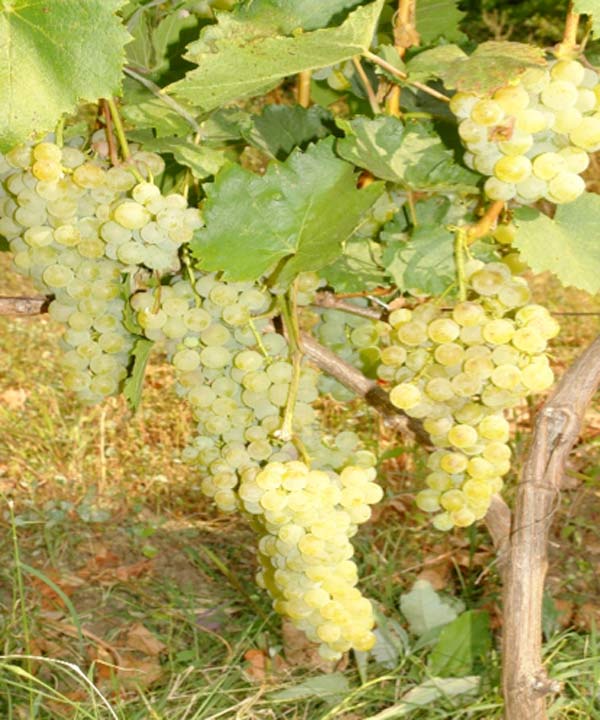
Kristalen variety has increased winter hardiness and is resistant to cryptogamic diseases within the limits of the European-Asian vine Vitis vinifera L. It requires limited treatment against downy and powdery mildew, only in the presence of very high humidity (soil and air) under natural infection conditions [Figure 2].
In case of severe damage from extreme cold below minus 18-20oC, it shows good regenerative capacity. Kristalen variety is suitable for cultivation with all types of training systems in regions of the country with favorable conditions for the development and fruiting of early- and mid-ripening white wine grape varieties.
Kristalen is a typical wine variety.
The average weight of the grape bunch is around 196.5 g, and that of the berry – 2.73 g. The consistency of the berry is fleshy and juicy, and the taste – harmonious with a muscat aroma. The seeds are fully developed. The air-dry weight of 100 seeds is 2.99 g.
In technological ripeness, the grapes contain 19.26 % sugars and 7.42 g/l titratable acids. The grapes do not shatter and possess very good transportability. The resistance of the berry to pressure is 595 g, and to detachment from the pedicel – 194.5 g.
Kristalen variety surpasses Misket Otonel in terms of quality and fertility.
Kristalen grapes are suitable for the production of high-quality white wines. After microvinification at the Institute of Viticulture and Enology – Pleven, the grapes showed very good qualities. The conclusion from the analysis of the grape must is that the grapes are healthy, with good appearance, preserved from diseases and pests, and with a sugar content of - 180g/dm3.
Characteristic of the hybrid is the good ratio of glucose to fructose with a predominance of fructose, which indicates good grape ripeness. The titratable acidity is well preserved for a white wine. Malic acid predominates, which imparts a slightly green acidity. Upon analyzing the wine, it was found to be clear with a yellowish-green color, distinct fruity aroma, pleasant freshness, full-bodied, with good harmony between alcohol, sugars, and titratable acids.
During two tastings of wines from microvinification of grapes of this variety at Vinprom Rousse, scores of 7.0 were given compared to Chardonnay wine (with a score of 6.0). In addition to wines, Kristalen grapes are also suitable for the production of high-alcohol beverages.
Conclusions
By developing the breeding process at a modern scientific and methodical level and utilizing diverse genetic plasma, new grapevine varieties can be created that meet the requirements for ecological viticulture, surpassing Bulgarian and international standards in terms of economic qualities. This ensures the main element of the technology for ecological viticulture and winemaking – the variety.
Newly bred domestic and foreign grapevine varieties and forms with enriched heredity and a high degree of heterozygosity for the most important economic traits should be used as source material for breeding.
As a result of intensive breeding activity at ARRI "Obraztsov Chiflik", Rousse, a number of grapevine varieties adapted to the continental climate conditions in Bulgaria have been created, and the outcome of the breeding program aimed at creating disease-resistant grapevine varieties are two disease-resistant wine varieties - Kristalen, created through hybridization of the varieties Pamid Rouse1 and Kailashki Misket in 1996, and Misket Viking, originating from the hybridization of the varieties Naslada and Chardonnay in 1996.
REFERENCES
- Valchev, V., Y. Ivanov, G. Petkov. 1984. New grapevine variety Naslada. Horticultural and Viticultural Science, No. 3, 75-79.
- Dimitrova, V., D. Vachevska, V. Dimitrov, V. Peikov. 2007. Viticulture and winemaking in Bulgaria – state and prospects for development in the European Union. Scientific conference with international participation, IVE-Pleven, 29-30.08., 7-16
- Ivanov, Y., V. Valchev. 1971. Cold resistance and downy mildew resistance of interspecific grapevine hybrids. Genetics and Breeding, 3, 139-146
- Kostadinova M., Ts. Lyubenova, N. Genov. 2007. Reaction to diseases and pests of dessert grapevine varieties grown in Bulgaria. /review/. Viticulture and Enology, no. 6, 21-30.
- Todorov I. 1998. Problems of vine-growing in Bulgaria on the eve of 21st century. "Viticulture and Enology", 4, 35-36
- Batovska D., Todorova I., Parushev S., Bankova V., Dyakova G., Nedelcheva D., Popov S. 2007. Preliminary study on the relationships between Plasmopara viticola resistance in grapes and some phenolic and surface components of the berries. Dokladi na Bulgarskata academia na naukite, ISSN 1310-1331, vol. 60, N 3, 257-262.
- Batovska D.I, I.T. Todorova, D.V. Nedelcheva, S.P. Parushev, A.I. Atanasov, T.D. Hvarleva, G.J. Dyakova, V.S. Bankova, S.S. Popov. 2008. Preliminary study on biomarkers for the fungal resistance in Vitis vinifera leaves. Journal of Plant Physiology, Vol. 165, Issue 8, 791-795.
- Batovska D.I, I.T. Todorova, V.S. Bankova, S.P. Parushev, A.I. Atanasov, T.D. Hvarleva, G.J. Dyakova, S.S. Popov. 2008. Seasonal variations in the chemical composition of vine-grape leaf surface. Natural Product Research, Vol. 22, № 14, 1237-1242.
- Roychev, V., Ivanov, M., Nakov, Z., Simeonov, I., Ivanov, A., Dyakova, G., Yaneva, V., Yanev, M., 2023. Ampelographic characteristics of grapevine varieties with increased resistance to fungal diseases and low winter temperatures.
- Hvarleva Tzv., A. Bakalova , K. Russanov, G. Djakova, I. Ilieva, A. Atanassov, I. Atanassov. 2009. Toward marker assisted selection for fungal disease resistance in grapevine. Biotechnol. & Biotechnol. Eq. 23, 4, 1431-1435.
- Hvarleva Tzv., Kr. Russanov, A. Bakalova, M. Zhiponova, G. Djakova, A. Atanassov, I. Atanassov. 2009. Microsatellite linkage map based on F2 population from Bulgarian grapevine cultivar Storgozia. Biotechnoly&Biotechnological Equipment (B&BQ), 23, 1, 1126-1130.
- Todorova I.T., Batovska D.I., Parushev S.P., Djakova G.J., Popov S.S. 2010. Surface metabolic composition of berries collected from 13 Bulgarian grapevine plants. Natural Product Research, vol. 24, Issue 10, 935-941
- Batovska D., I. Todorova, G. Djakova, I. Ivanova, S. Popov. 2010. GC-MS analysis of the leaf surface components of four Bulgarian grapevines grown under different conditions, Natural Product Research, vol. 24, Issue 11